


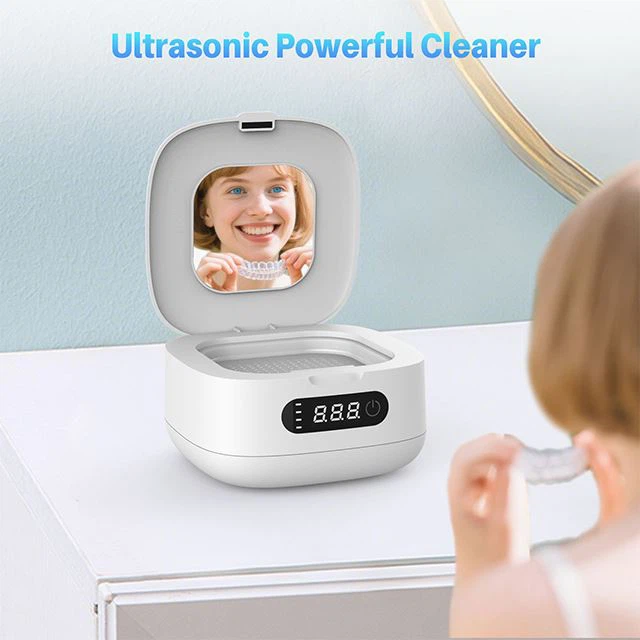
Dental fillings represent a significant investment in oral health - and for patients who have them, the question of whether an ultrasonic dental cleaner is safe to use is entirely reasonable. The answer depends on filling material, device settings, and the condition of the restoration. As a manufacturer of ultrasonic dental cleaners, here is a technically grounded answer that covers each filling type and the evidence behind safe, effective use.
How Ultrasonic Dental Cleaners Work
The Cavitation Mechanism
Ultrasonic dental cleaners generate high-frequency sound waves - typically in the range of 28,000 to 45,000 Hz - that propagate through a liquid cleaning solution. As these pressure waves cycle through the fluid, they alternately compress and expand the liquid, nucleating microscopic vapor bubbles during the low-pressure phase. These bubbles grow until they reach an unstable threshold, then implode violently during the compression phase - a process termed acoustic cavitation. Each implosion generates a localized microjet and transient pressure pulse that mechanically dislodges plaque, calcified deposits, food debris, and biofilm from any surface in contact with the fluid.
Why Cavitation Is Relevant to Fillings
The same physical mechanism that makes ultrasonic cleaning highly effective - localized implosion energy concentrated at surfaces - is also why material compatibility matters for dental restorations. The energy delivered to a filling surface depends on the operating frequency, power output, proximity to the transducer, and the acoustic properties of the filling material itself. Different filling materials absorb and transmit this energy differently, which determines their individual risk profile during ultrasonic cleaning.
Dental Filling Materials and Ultrasonic Compatibility
Amalgam Fillings
Amalgam - a metal alloy composed primarily of mercury, silver, tin, and copper - is acoustically dense and mechanically robust. Under normal home-use ultrasonic cleaning conditions, intact amalgam fillings tolerate cavitation well. The principal concern arises with aged amalgam restorations that have developed micro-cracks, marginal leakage, or voids at the filling-tooth interface over time. In these cases, repeated ultrasonic energy cycles can propagate existing cracks by introducing cyclic fatigue stress at defect sites. This is not a concern with a new, well-seated amalgam restoration - it becomes relevant when the filling is already compromised.
A professional dental examination to assess amalgam filling integrity before beginning regular home ultrasonic cleaning is advisable for restorations that are more than ten years old, as marginal degradation is common in long-standing amalgam fillings regardless of cleaning method.
Composite Resin Fillings
Composite resin is a polymer matrix reinforced with ceramic filler particles, bonded to the tooth structure via an adhesive layer. The adhesive bond - rather than the composite material itself - is the point of potential vulnerability during ultrasonic cleaning. The bond between composite and tooth enamel or dentin is a polymerized resin layer with a specific tensile and shear strength. Sustained high-intensity cavitation directed at the margin of a composite restoration could theoretically introduce stress at this interface, particularly if the original bonding was inadequate or if the margin has begun to degrade.
At moderate settings - the 35–40 kHz range at standard home-use power levels - and with correct positioning (the cleaning fluid rather than the transducer making contact with the restoration), composite resin fillings are generally safe for routine ultrasonic cleaning. The key variable is intensity: lower settings are appropriate for composite, and session duration should not exceed the manufacturer's recommended cycle length.
Porcelain and Ceramic Restorations
Porcelain and ceramic materials are brittle - they resist compressive forces well but are susceptible to crack initiation and propagation under tensile or shear stress. Ultrasonic cavitation can introduce cyclic mechanical stress at the surface of ceramic restorations, particularly at sharp margins or thin sections. For porcelain-fused-to-metal restorations, the interface between the ceramic veneer and the metal substructure is an additional consideration.
Clinical guidance from dental material studies indicates that ultrasonic scaling instruments - which operate at significantly higher power than home ultrasonic cleaners - can damage porcelain surfaces. Home-use ultrasonic dental cleaners at recommended settings deliver substantially lower energy, and the risk profile is correspondingly lower. Nevertheless, for patients with extensive porcelain work, mid-to-high frequency settings (40–45 kHz) at low power minimize cavitation aggressiveness while maintaining adequate cleaning action.
Gold and Metal Alloy Fillings
Gold and other high-purity metal alloy restorations are acoustically reflective and mechanically ductile - they are the most tolerant filling material for ultrasonic cleaning. Gold fillings do not crack under cavitation stress and maintain their marginal integrity well even with regular cleaning. The primary maintenance consideration for gold restorations is surface polish preservation, which is not affected by home-use ultrasonic cleaning at appropriate settings.
Material-by-Material Safety Summary
| Filling Material | Ultrasonic Compatibility | Recommended Setting | Key Consideration |
|---|---|---|---|
| Amalgam (intact) | Good | Standard (35–40 kHz) | Assess for micro-cracks in older restorations |
| Amalgam (aged/cracked) | Caution | Low or avoid | Consult dentist before use |
| Composite Resin | Good with care | Low to moderate | Monitor bond margin integrity |
| Porcelain / Ceramic | Moderate | Low power, high frequency | Brittle material; avoid aggressive settings |
| Gold / Metal Alloy | Excellent | Any standard setting | Most tolerant material |
How to Use an Ultrasonic Dental Cleaner Safely With Fillings
Consult Your Dentist First
Before incorporating an ultrasonic dental cleaner into your routine, ask your dentist to assess the condition of your existing restorations. A dentist can identify marginal gaps, micro-cracks, or bond degradation that would not be visible to you and that change the risk profile of ultrasonic cleaning for your specific situation. This is particularly important for restorations placed more than five years ago, as material aging and marginal wear are cumulative processes.
Select the Appropriate Intensity Setting
Ultrasonic dental cleaners with adjustable brightness - or more precisely, adjustable power output - allow users to match cleaning intensity to the sensitivity of the restoration being cleaned. A general principle: start at the lowest effective setting and increase only if cleaning is insufficient. For composite and porcelain restorations, remain at low-to-moderate settings. For amalgam and gold, standard settings are appropriate for intact restorations.
Follow Recommended Cycle Durations
Manufacturer-specified cleaning cycle durations - typically three to ten minutes for home devices - are calibrated to the device's frequency and power output. Exceeding these durations increases cumulative energy exposure to restoration surfaces without proportional cleaning benefit. Use a timer and adhere to the recommended cycle length, particularly when cleaning composite or porcelain restorations.
Use the Correct Cleaning Solution
Only use cleaning solutions specifically formulated for ultrasonic dental applications. The chemistry of the cleaning solution affects cavitation bubble formation, stability, and collapse energy. Standard household cleaners can alter solution surface tension in ways that produce more aggressive cavitation than intended, and certain chemical agents can attack resin bonds or degrade ceramic surfaces. Manufacturer-approved concentrates are formulated to work within the device's acoustic parameters.
Monitor for Warning Signs
After beginning regular use of an ultrasonic dental cleaner, monitor your restorations for any changes: increased sensitivity to temperature, visible changes at the filling margin, or looseness. These can indicate bond degradation or crack propagation. If any of these signs appear, discontinue use and schedule a dental evaluation.

The Clinical Benefit: What Ultrasonic Cleaning Does for Filled Teeth
The primary benefit of ultrasonic cleaning for teeth with fillings is the removal of plaque and biofilm at and around the filling margin - precisely the area where secondary decay most commonly initiates. The margin between a filling and the tooth surface is a micro-geometric feature that conventional brushing reaches inconsistently. Cavitation energy penetrates these marginal spaces and dislodges accumulations that manual cleaning misses, reducing the bacterial load at the restoration interface and lowering secondary caries risk. This preventive benefit is the strongest clinical argument for incorporating ultrasonic dental cleaning into the home care routine of patients with multiple restorations.
FAQs
Q1: Is it safe to use an ultrasonic dental cleaner on a brand-new filling?
It is advisable to wait at least two to four weeks after a new composite or porcelain restoration before using an ultrasonic dental cleaner, to allow the adhesive bond to fully mature. Amalgam restorations are typically set within 24 hours, but the same waiting period is reasonable as a precaution. Confirm the waiting period with your dentist at the time of placement.
Q2: Can an ultrasonic dental cleaner remove staining around fillings?
Yes. Cavitation effectively dislodges surface staining and biofilm from enamel and from the exposed surfaces of most filling materials. It does not alter the intrinsic color of the filling material itself - intrinsic discoloration within aged composite or staining under a restoration margin requires professional treatment.
Q3: What frequency setting is safest for porcelain fillings?
Higher frequency settings (40–45 kHz) produce smaller, gentler cavitation bubbles that distribute energy more uniformly across the surface, reducing per-event stress on brittle ceramic materials. Use the highest available frequency at the lowest power setting for porcelain restorations, and keep cycles short.
Q4: Will ultrasonic cleaning loosen or dislodge a filling?
An intact, well-bonded filling in good condition will not be loosened by ultrasonic cleaning at home-use settings. If a filling becomes loose during or after cleaning, it indicates a pre-existing failure of the bond or restoration margin that would have led to loosening regardless of cleaning method. In this case, the cleaning revealed - rather than caused - a problem that needs dental attention.
Q5: How often should I use an ultrasonic dental cleaner if I have multiple fillings?
Daily use at appropriate settings is generally safe for intact restorations. Many users with multiple fillings adopt a routine of daily five-minute cycles as part of their oral hygiene protocol. If you have a mix of filling materials, configure the device settings for the most sensitive material present - typically composite or porcelain - to apply a conservative protocol across all restorations simultaneously.
References
American Dental Association. (2023). Dental fillings: Types and considerations. https://www.ada.org/resources/research/science-and-research-institute/oral-health-topics/fillings
Dental Health Foundation. (2022). Maintaining oral hygiene with restorations. https://www.dentalhealth.org
Yin, W., et al. (2014). Effects of ultrasonic cleaning on the surface integrity of dental materials. Journal of Dental Research, 93(Suppl. 1), 187S–192S.
GoldRosa Ultrasonic Dental Cleaner Product Collection. https://www.goldrosa.com/