


You want clean retainers. Two devices promise to deliver: the ultrasonic cleaner for retainers and the UV sanitizer case. Both are marketed as better than rinsing. Both have real technology behind them. But they work in fundamentally different ways-and the gap matters for your daily routine.
This comparison breaks down how each device works, what the evidence supports, where each one falls short, and which is the better choice for daily use. If you are a retailer sourcing a private-label retainer care product, this guide also identifies the procurement criteria that separate functional products from overhyped ones.
How an Ultrasonic Retainer Cleaner Works
An ultrasonic cleaner uses a process called acoustic cavitation. The device generates high-frequency sound waves-typically between 20,000 and 45,000 Hz (20–45 kHz)-through a liquid-filled tank. Those sound waves create millions of microscopic bubbles. Each bubble expands and then collapses at the retainer's surface, releasing a small burst of energy.
That burst is the key. It dislodges and disrupts biofilm, food debris, calcified plaque deposits, and odor-causing bacteria from surfaces that a toothbrush cannot reach. It works inside fine grooves, curved surfaces, wire contact points, and the concave inner channels of clear thermoplastic retainers-the exact locations where bacteria concentrate most densely.
What the Research Shows
A 2025 systematic review published in PMC (PMC12495143) evaluated ultrasonic cleaning across multiple controlled studies and found consistent, significant reductions in plaque quantity and microbial load on dental appliances. Importantly, the review noted that ultrasonic cleaning uniquely reduced Staphylococcus spp. and Candida spp.-two of the most commonly found and most problematic organisms on retainers-while other methods showed less specificity.
A separate clinical randomized trial (PMC10387143) confirmed that ultrasonic cleaning was significantly more effective than mechanical brushing in reducing biofilm on removable dental appliances. Cleaning cycle times of 3–5 minutes at 40–45 kHz were consistently cited as effective.
Studies estimate that ultrasonic cleaning removes 80–95% of bacteria and biofilm from retainer surfaces. That figure reflects a real cleaning effect-disrupting and removing physical matter, not just killing microbes that remain in place.

How a UV Sanitizer Case for Retainers Works
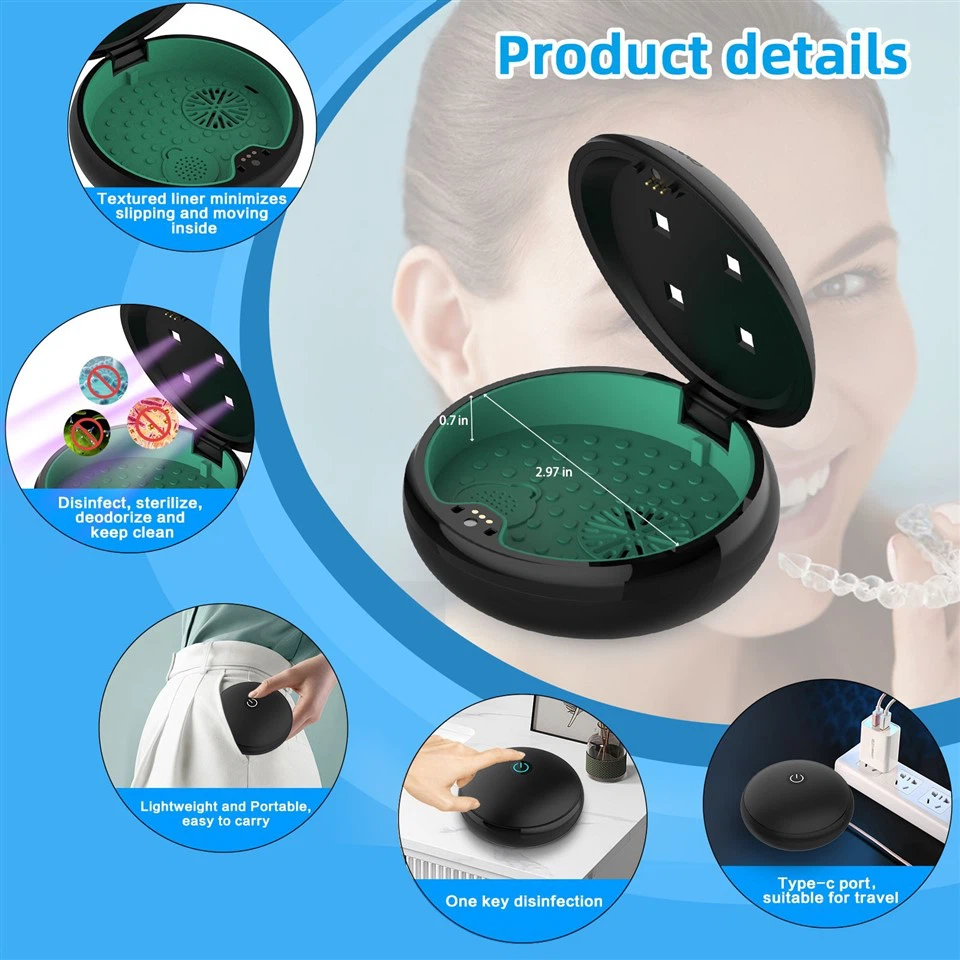
A UV sanitizer case uses UV-C light at the germicidal wavelength-typically around 254 nm-to target microbes on the retainer's surface. When UV-C photons strike bacterial DNA or RNA, they cause thymine dimerization: abnormal bonds form in the DNA strand that prevent the cell from replicating. The microbe dies.
This process requires no water, no chemicals, and leaves no residue. Most consumer UV sanitizer cases run an automatic cycle of 3–5 minutes after the lid is closed. When the cycle ends, surface bacteria that the UV-C light reached have been deactivated.
The Critical Limitation: Shadow Zones
UV-C light travels in straight lines. It cannot bend around curves, reach into grooves, or penetrate the physical bulk of a biofilm layer. Any surface that is not in direct line of sight of the UV-C LED receives no germicidal dose.
For a retainer-with its concave inner surface, wire contact points, and curved plastic edges-this is a meaningful problem. A 2026 review on UV-C sterilization for retainers confirmed that surface bacteria are effectively killed, but deeper biofilm colonies that reside in grooves and concave zones survive because the light cannot reach them.
UV-C also has zero ability to remove physical debris, calculus deposits, staining, or protein films. A retainer coated in plaque that is exposed to UV-C will have fewer viable bacteria on top of the plaque-but the physical layer stays intact and continues to harbor bacteria underneath.
Side-by-Side Comparison: What Each Device Actually Does
|
Feature |
Ultrasonic Cleaner |
UV Sanitizer Case |
|
Primary mechanism |
Acoustic cavitation in liquid |
UV-C photon DNA disruption |
|
Removes physical debris |
Yes - dislodges biofilm, plaque, particles |
No - light only; cannot remove matter |
|
Reaches concave curves and grooves |
Yes - sound waves penetrate omnidirectionally |
No - shadow zones block coverage |
|
Kills bacteria on surface |
Yes |
Yes |
|
Kills bacteria in deep biofilm |
Partially (cavitation disrupts structure) |
No - UV-C cannot penetrate biofilm depth |
|
Time per cycle |
3–5 minutes with device |
3–5 minutes; passive storage afterward |
|
Requires liquid |
Yes - water or a cleaning solution |
No |
|
Eliminates odor |
Yes - removes the source (bacteria + debris) |
Partial - kills some odor bacteria but debris stays |
|
Prevents re-contamination |
Only during the cleaning cycle |
Yes - active sanitation during storage |
|
Suitable for travel |
Some models; requires water access |
Highly portable; no water needed |
|
Retainer material safety |
Safe at correct frequency; avoid excess heat |
Generally safe; minimal material risk |
|
Best use case |
Deep cleaning (daily or every other day) |
Sanitation during between-use storage |
New Chapter: What the Evidence Hierarchy Tells Us
The distinction between cleaning and sanitizing is important for both users and retailers, and the research is unambiguous about where each technology fits.
Ultrasonic cleaning addresses the physical biofilm layer-the root cause of odor, re-contamination, and calculus build-up. Removing biofilm is harder than killing surface bacteria because biofilm is a structured, self-protecting matrix. Acoustic cavitation physically disrupts that matrix.
UV-C sanitation addresses surface microbial viability on areas the light can reach. It is best applied after the retainer surface is already clean. A 2021 PMC review on UV technologies (PMC8869636) stated explicitly that UV technologies should not be used in isolation and should be considered as an adjunct to protocol-driven standard cleaning-not a replacement.
In practical terms: if you use only a UV sanitizer case without cleaning the retainer first, you are reducing the number of living bacteria on a layer of plaque and debris that remains in place. The next time you wear the retainer, that debris re-enters your mouth along with the surviving bacteria from shadow zones.
If you use only an ultrasonic cleaner without subsequent sanitation during storage, the retainer goes into a case where bacteria can re-colonize between uses.
The strongest outcome comes from combining both: ultrasonic cleaning to remove physical matter, followed by UV sanitizer case storage to suppress bacterial re-growth while the retainer is not in use.
New Chapter: Industry Context - The 2025–2026 Retainer Care Market
Consumer awareness of retainer hygiene is growing fast. Several converging factors are driving demand for functional cleaning devices:
Orthodontic retention is increasingly long-term. As clear aligner treatment becomes mainstream, more adults wear retainers indefinitely. The retainer cleaning category is no longer just for teenagers post-braces-it now includes a large, spending-capable adult demographic.
The "just rinse it" problem is entering mainstream media. Multiple 2024–2026 dental practice blogs, orthodontic association guidance updates, and consumer health outlets have explicitly called out water rinsing as insufficient. This awareness gap is closing, and consumers are actively searching for solutions.
Product reviews are shifting the conversation. Forbes, the New York Times Wirecutter, and major orthodontic practice blogs now specifically test and rank ultrasonic cleaners and UV sanitizer cases. Products with misleading "kills 99.9%" claims and no transparent backing are drawing criticism. Evidence-based positioning is becoming a competitive advantage.
For B2B buyers and private-label developers, this means the category is moving toward quality differentiation. A combined ultrasonic + UV sanitizer device-or a paired product system-is emerging as the premium market direction.
Practical Daily Routine: How to Use Both Devices Together
For users who own both devices, a combined routine takes under 10 minutes total and delivers the best protection currently available at home.
Step 1: After wearing the retainer - ultrasonic cycle (3–5 minutes). Place the retainer in the ultrasonic cleaner tank filled with lukewarm water or a diluted cleaning solution. Run a standard 3–5 minute cycle. This removes biofilm, debris, and odor-causing residue from all surfaces including curves and grooves.
Step 2: Rinse under lukewarm water. After the ultrasonic cycle, rinse the retainer thoroughly to remove any loosened debris. Do not use hot water-it can warp thermoplastic retainer material.
Step 3: Place in the UV sanitizer case. Shake off excess water, place the retainer in the UV case, and close the lid. The UV-C cycle runs automatically for 3–5 minutes and then powers off. The retainer can remain in the closed case until next use.
Step 4: Keep the case dry and ventilated before closing. If storing for more than a few hours, leave the lid slightly open after the UV cycle completes. Sealed damp environments accelerate bacterial re-growth even after UV treatment.
Which Device Is Better for Daily Use?
The honest answer depends on what "daily use" means and what problem you are trying to solve.
If you can only choose one device: an ultrasonic cleaner is the more complete solution for daily cleaning. It removes physical matter, disrupts biofilm, reduces odor, and reaches surfaces UV light cannot. For most users with a single daily cleaning slot, ultrasonic cleaning delivers broader results.
If you already clean the retainer daily and want to add a layer: a UV sanitizer case adds meaningful value during storage. It suppresses surface bacterial regrowth between wears and is particularly useful for retainers stored for 8–12 hours while the user sleeps without wearing the retainer.
If you want the best possible outcome: use both. Clean with the ultrasonic device after each wear, then store in the UV case. This approach addresses biofilm removal (ultrasonic) and storage-period re-contamination (UV), covering both phases of the retainer's daily cycle.
For retailers building a retainer care product line, this logic supports offering a bundled two-device system with clear positioning: one product for active cleaning, one for passive sanitation. GoldRosa supports OEM/ODM development for both ultrasonic retainer cleaners and UV sanitizer cases, with CE, FCC, RoHS, and ISO 13485 certification. Products can be designed as a matched pair under a single private label.

Buyer Checklist: Evaluating Either Device
Use these criteria when sourcing or comparing any retainer cleaning device:
|
Criterion |
Ultrasonic Cleaner |
UV Sanitizer Case |
|
Frequency (ultrasonic) |
40–45 kHz for effective cavitation |
N/A |
|
UV wavelength |
N/A |
250–270 nm (ideally 254 nm) |
|
Cycle duration |
3–5 min effective; <2 min insufficient |
3–5 min minimum |
|
LED coverage |
N/A |
Top + bottom + sides required |
|
Material safety |
BPA-free tank; no excess heat generation |
BPA-free shell; USB-C charging preferred |
|
Auto shutoff |
Yes - prevents overdrive |
Yes - prevents unnecessary UV exposure |
|
Claim language |
"Removes biofilm" not just "kills bacteria" |
"Reduces bacteria" not "sterilizes" |
|
Certifications |
CE, FCC, RoHS minimum |
CE, FCC, RoHS minimum |
Frequently Asked Questions
1. Can I use just a UV sanitizer case instead of cleaning my retainer?
No. A UV sanitizer case kills bacteria on surfaces that receive direct UV-C light, but it cannot remove physical debris, disrupt biofilm structure, or reach shadow zones created by the retainer's curved geometry. Using UV alone leaves plaque and debris intact. For complete daily hygiene, combine UV sanitation with ultrasonic cleaning or at minimum a brush-and-soak routine.
2. How often should I use an ultrasonic retainer cleaner?
Most orthodontists and the AAO recommend daily retainer cleaning. An ultrasonic cycle of 3–5 minutes once a day-after removing and before storing the retainer-is an effective routine supported by clinical evidence. Users with heavier calculus build-up may benefit from a longer soak in a cleaning solution before or after the ultrasonic cycle.
3. Is an ultrasonic cleaner safe for all retainer types?
Ultrasonic cleaning is generally safe for clear thermoplastic retainers (Essix, Vivera) and acrylic Hawley retainers at standard household frequencies (40–45 kHz). Avoid exceeding recommended cycle times, using very hot water, or running a cycle without liquid. Some manufacturers recommend checking with an orthodontist before using an ultrasonic cleaner on bonded retainer wires. GoldRosa's ultrasonic cleaners are tested for compatibility with common retainer materials.
4. Does a UV sanitizer case work better than retainer cleaning tablets?
These two methods target different problems. UV sanitizer cases reduce viable bacteria on accessible surfaces during storage. Cleaning tablets use effervescent chemical action to dissolve and loosen biofilm during a soak. Neither removes calculus as effectively as ultrasonic cavitation. For most users, a cleaning tablet soak + UV case is a reasonable middle ground when an ultrasonic cleaner is not available. Adding UV to a tablet soak has been shown to produce statistically superior disinfection compared to either method alone.
5. What should I look for when buying an ultrasonic retainer cleaner?
Look for an operating frequency of 40–45 kHz, a 3–5 minute cycle, an auto shutoff function, BPA-free materials, and CE/FCC certification. Avoid products that omit the frequency specification entirely-this often signals a low-quality transducer. For private-label procurement, also verify that the supplier provides a vibration test report and retainer material compatibility documentation.
6. Which is better for travel - an ultrasonic cleaner or a UV case?
For travel, a UV sanitizer case wins on portability. Most UV cases are compact, USB-C rechargeable, and require no water. An ultrasonic cleaner needs a water source and a flat, stable surface. For short trips of 1–3 days, a UV case combined with a diluted hydrogen peroxide soak in a hotel glass is a practical alternative to the full at-home routine.
References
1. PMC / NCBI.
Ultrasonic Cleaning and its Effects on Denture Biofilm: A Systematic Review. PMC12495143, 2025.
2. PMC / NCBI.
A Randomized Trial of the Effectiveness of an Ultrasonic Denture Cleaner. PMC10387143, 2023.
3. PMC / NCBI.
Effects of Cleaning Methods on the Removal Efficacy of Biofilm. PMC13104342, 2025.
4. PMC / NCBI.
A Review of Recent Evidence for Utilizing Ultraviolet (UV) Technology. PMC8869636, 2021.
5. FeelFreshly.
UV-C Sterilisation for Retainers: Does It Really Work?. 2026.
6. Sonicdental.
Ultrasonic vs Crystals: Best Retainer Cleaning Method. 2026.
7. American Association of Orthodontists. How to Clean Your Retainer at Home. AAO, 2025.
8. Gold Rose.
Ultrasonic Retainer Cleaner and UV Sanitizer Case Product Line.