







A palatine tonsil is a blind-ended pocket lined with thin, non-keratinised mucosa, fed by four named arteries and wired to the glossopharyngeal nerve. Every manual removal method asks a patient to push a tool into that pocket, out of sight, with no depth stop and no way to arrest the movement once the gag reflex fires. That is the argument.
Why the Tonsillar Crypt Is a Poor Place to Apply Force
A Crypt Is a Blind Pocket, Not a Shelf
The palatine tonsils sit between the palatoglossal and palatopharyngeal arches, covered medially by mucosa and only incompletely encapsulated, their surface broken by long-branched crypts. A tonsillolith forms at the bottom of one, so it is not sitting on a surface you can wipe: it is wedged in a blind invagination whose floor you cannot see, whose depth you cannot measure, and whose walls offer no rigidity to brace against.
The Wall Is Thin, Wet and Friable
The crypt is lined by non-keratinised stratified squamous epithelium over lymphoid tissue, with no keratin layer and far less resistance to shear than skin. Wet mucosa also lowers friction, which cuts both ways: a smooth instrument slides past the stone it was meant to catch, and a fibrous one grips the epithelium instead. The tissue is soft, vascular and loosely supported, so the force that dislodges a semi-hard calcified biofilm deforms the wall behind it.
Four Arteries and a Venous Plexus Sit Immediately Behind It
Its arterial supply comes primarily from the tonsillar branch of the facial artery, with contributions from the ascending pharyngeal, lingual and ascending palatine arteries, draining through a venous plexus. This is not a site where minor mechanical trauma reliably stays minor, and the patient is working in a mirror with no suction, lighting or assistance.
Visit more tonsil stone remover
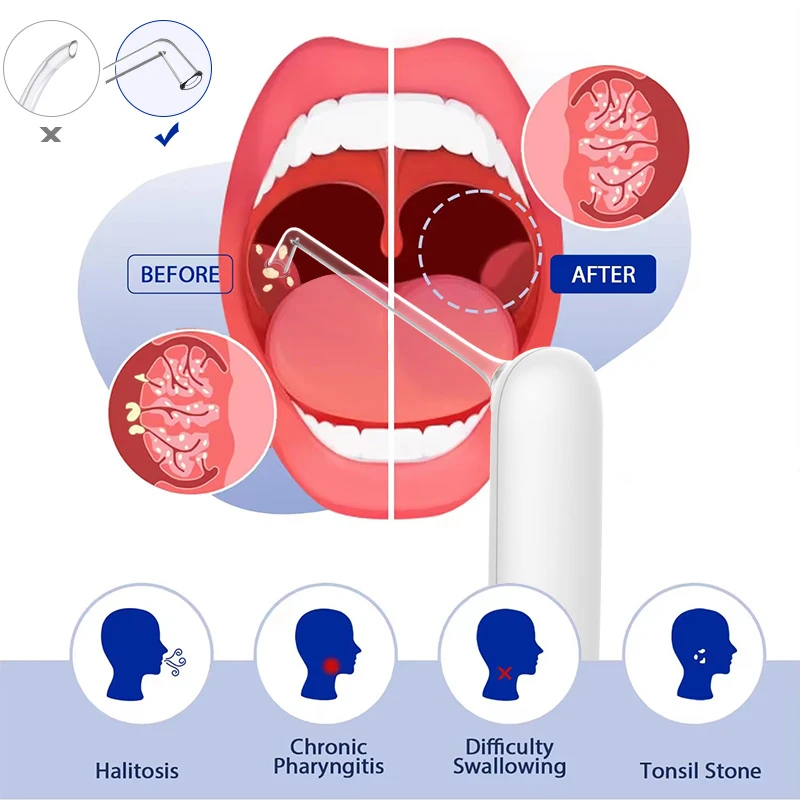
The Q-Tip Problem: Friction Without Depth Control
Cotton Grips Wet Mucosa
A cotton bud is a high-friction surface pressed against a low-friction one. As the tip advances it either skids, dragging mucosa with it, or grips and converts forward push into shear at the crypt mouth. Neither is controlled, and the patient has no tactile signal distinguishing "the stone moved" from "the tissue moved".
You Cannot See the Tip and the Target at Once
The swab occludes the opening it is aimed at, so depth is judged by feel - the weakest sense available, since the oropharynx is supplied by tonsillar branches of the glossopharyngeal nerve, which signals gag far more readily than position. Most people work from a phone camera at arm's length, offset from the instrument by a hand's width.
The Gag Reflex Turns a Controlled Movement Into a Reflex Arc
Touching the posterior tongue or the tonsillar region triggers a glossopharyngeal afferent that drives a vagal efferent - retching, tongue thrust, pharyngeal spasm. The instrument does not stop when the reflex starts; it is driven into tissue by a movement the patient did not plan. Manual tools fail not because users are careless but because the anatomy offers no margin between a deliberate probe and an involuntary thrust.
The Syringe Problem: Positive Pressure in a Blind Pocket
Pressure With Nowhere to Go Enters Tissue
This is documented, not theoretical. A 2026 review in Dentistry Journal collated 36 cases of subcutaneous emphysema after periodontal procedures, where pressurised air breached the mucosal barrier and tracked along fascial planes: air-powder abrasives 66.7%, air-water syringes 8.3%, non-professional oral irrigators 2.8%, with mediastinal spread in 41.7%. The device class differs; the physics does not. Positive pressure on a confined mucosal pocket has one escape route once the surface seals - inward.
A Wedged Tip Converts a Rinse Into a Pressure Vessel
A stream running across a tonsil is harmless. A nozzle seated in a crypt mouth is a closed system fed by a pump, and the crypt is the geometry that concentrates pressure: narrow at the opening, blind at the base, thin-walled. The distinction that matters is not water versus no water, but surface irrigation versus a sealed jet.
Water Is Not the Only Payload
The same review notes that air carried into submucosal planes can transport oral flora and cause secondary infection. A crypt is a polymicrobial biofilm, so anything forced through its wall is not clean; the failure mode is not a scratch but a fluid and bacterial load delivered where there is no drainage path.
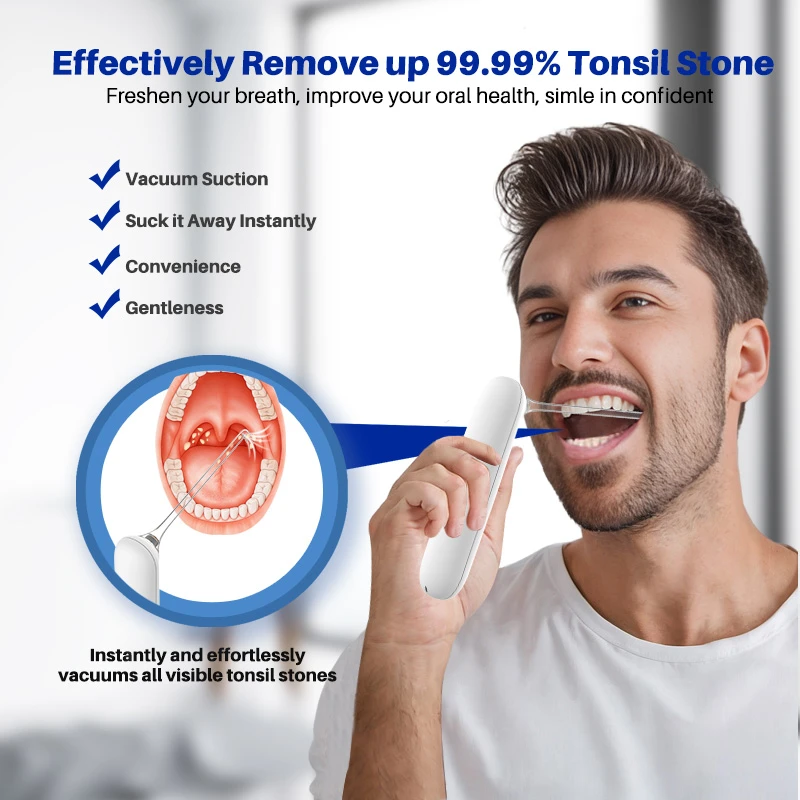
Why Negative Pressure Fails Differently
Suction Pulls Tissue Toward the Lumen
Reverse the sign and the force vector reverses with it: negative pressure draws mucosa toward the instrument, the direction the tissue is already supported from. Excessive vacuum produces capillary congestion and petechiae at the rim - visible, superficial and self-limiting. It does not puncture, because there is no point load and no forward push.
Suction Cannot Inject Anything
This is the asymmetry the comparison rests on. Positive pressure can drive material across a barrier into a tissue plane; negative pressure cannot. Whatever enters a suction tip was already in the lumen. A vacuum device can bruise, but it cannot seed a fascial space.
The Stone Is Held, Not Levered
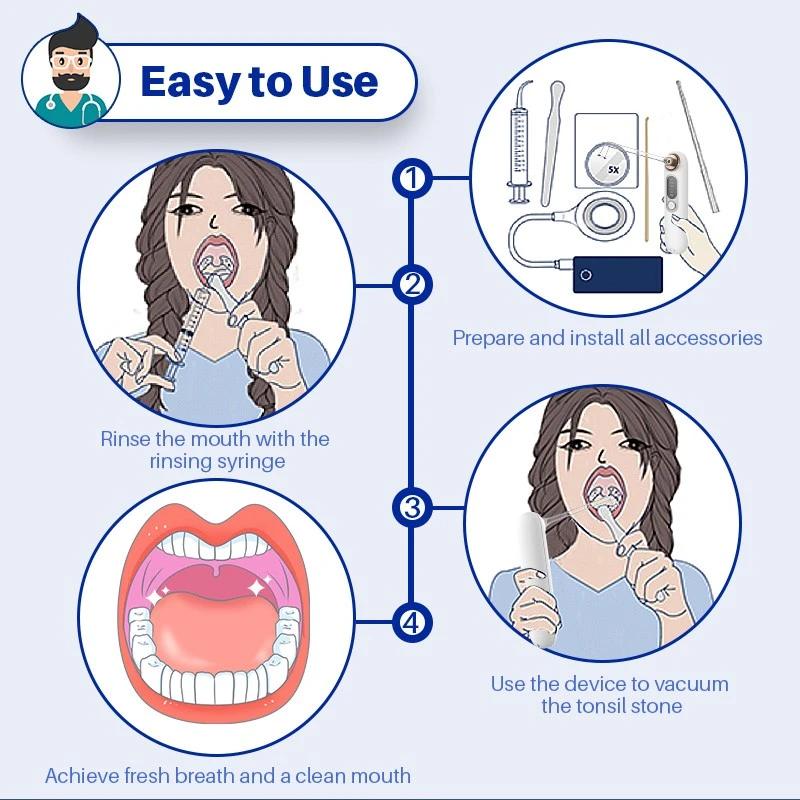
A tonsillolith is a rough, semi-hard, calcified biofilm, which is why a smooth horn-shaped tip plus sustained vacuum engages it: contact area is large, stress is low, and the stone is drawn into the orifice rather than pried off a wall. A magnifier and lamp let the operator watch the tip approach, which a cotton bud makes impossible.
The Gold Rose Tonsil Care Range: A Suction-First Comparison
Gold Rose Electronic Vacuum Tonsil Stone Remover - Best Overall
The dedicated vacuum unit is the cleanest expression of the approach: a 5-level suction adjustment from a mild "WEAK" setting to "STRONG", an ABS body, a charging dock, and a smooth horn-shaped probe designed for mucosal contact. A 5X magnifier and oral lamp handle visibility, and a rinsing syringe loosens stones at the surface before suction. Minimum order is 100 pieces.
Gold Rose Power Tonsil Stone Remover - Best for Clinic and Multi-Tool Use
The Power kit pairs the same negative-pressure principle with a wider set: borosilicate glass nozzles on an irrigator with an angled tip, a USB LED light, a 5X magnifying mirror, plus tweezers, brushes, slim removal tools and tongue depressors. It lets a distributor serve clinics that want a complete tray, but the primary interface remains suction - the auxiliary tools exist for stones suction cannot reach, not as a first resort. Minimum order is 500 pieces.
Gold Rose Electric Tonsil Stone Removal - Best for Retail Bundling
The third configuration bundles electronic suction, an adjustable probe, 5X magnification, an oral lamp, a rinsing syringe and auxiliary tools into a consumer kit, with ISO 13485, FDA, CE, FCC, RoHS, SGS and PSE listed - the version to specify when a channel needs one SKU with a complete story. Minimum order is 500 pieces.
Comparison Table
|
Metric |
Gold Rose Electronic Vacuum |
Gold Rose Power Kit |
Cotton Swab |
Oral Syringe |
|
Primary force direction |
Negative, toward the lumen |
Negative, with surface rinse |
Shear and compression |
Positive, into tissue |
|
Depth control |
Vacuum stops at the stone |
Suction plus visual aid |
None |
None |
|
Visibility while working |
5X magnifier and oral lamp |
5X mirror and USB LED |
Tip occludes the crypt |
Stream obscures the view |
|
Failure mode |
Petechiae at the tip rim |
Petechiae at the tip rim |
Abrasion, skidding, gag |
Submucosal air or fluid |
|
MOQ |
100 pcs |
500 pcs |
Not applicable |
Not applicable |
Specifying a Safer Tonsil Tool for Retail
What the Suction Specification Should Contain
Ask for maximum vacuum at the tip in kPa or mmHg, not a level count, because "five levels" describes a dial rather than a force. Then fix the orifice diameter, the silicone hardness in Shore A, the edge radius, whether a vacuum-release valve breaks suction instantly, and how the tip detaches for cleaning. Add a stall condition: the motor should lose vacuum rather than heat if the tip seals against mucosa. Gold Rose publishes the level count and probe geometry; the pressure figure needs requesting in writing.
Where the Claim Should Stop
A suction device removes visible debris; it does not treat tonsillitis and should not be positioned as a substitute for clinical care. Bleeding, unilateral swelling, a stone that will not move, or recurrent infection are reasons to stop and refer, and retail copy should say so. That restraint is also commercial sense: a claim a device cannot support is the fastest route to returns.
Frequently Asked Questions
Q1: Are Q-tips actually dangerous for tonsil stones?
A: The risk is mechanical rather than hypothetical. A cotton tip occludes the crypt it targets, offers no depth stop, and becomes an uncontrolled instrument once the gag reflex fires.
Q2: Can a water syringe push bacteria into the tonsil?
A: Yes, if the tip seals the crypt opening. A 2026 review of 36 emphysema cases after periodontal procedures found pressurised air and water devices breaching mucosa and tracking into fascial planes.
Q3: Why is suction considered safer than picking?
A: Negative pressure pulls tissue toward the lumen and cannot inject material across a barrier, so its worst case is superficial petechiae. A pick or jet can deliver both force and payload into the wall; the Gold Rose vacuum range works from the opposite sign.
Q4: Which Gold Rose model suits a retail launch?
A: The Gold Rose Electric Tonsil Stone Removal kit bundles suction, magnification, lighting and a rinsing syringe in one SKU at a 500-piece minimum, while the Electronic Vacuum unit offers the lowest entry at 100 pieces.
Q5: Does a suction tool remove stones buried deep in a crypt?
A: Only those it can reach and draw into the tip. Deeply embedded stones may need professional assessment, and persistent cases call for a clinician rather than more force.
References
1. Sahin A.G., Kurtis M.B., Subcutaneous Emphysema Following Periodontal Interventions, Dent. J. 2026;14(3):163 - mdpi.com
2. Bai K.Y., Kumar B.V., Tonsillolith: A polymicrobial biofilm, Med J Armed Forces India 2015;71(Suppl 1):S95–S98 - PMC4529540
3. Kang O. et al., Palatine tonsil, Radiopaedia reference article rID-49879 - radiopaedia.org