


Partial dentures represent one of the most reliable and accessible restorative solutions for replacing missing teeth, restoring masticatory efficiency, and preserving facial vertical dimension. However, maintaining the hygiene of a removable partial denture (RPD) presents complex challenges that differ significantly from caring for complete dentures or natural teeth.
Because partial dentures incorporate diverse materials-such as cast metal frameworks, polymethyl methacrylate (PMMA) acrylic bases, flexible thermoplastic nylon resins, and precision attachments-users frequently ask: "Can an ultrasonic dental cleaner be used on partial dentures safely?"
The definitive clinical answer is yes: an ultrasonic dental cleaner is not only safe for partial dentures, but it is often clinically superior to manual brushing when proper acoustic parameters and cleaning solutions are utilized. However, safety depends directly on understanding the material composition of the prosthesis, avoiding mechanical abrasion, and selecting calibrated equipment. As an established OEM/ODM developer of precision oral health appliances, Gold Rose provides this comprehensive technical guide analyzing structural material compatibility, acoustic cavitation dynamics, infection control protocols, and hardware safety standards for partial dentures.

Anatomy and Material Composition of Partial Dentures
Cast Metal Frameworks and Clasps
The majority of traditional removable partial dentures rely on a rigid metal substructure to provide retention, stability, and support across remaining natural abutment teeth. These frameworks are cast from biomedical alloys such as cobalt-chromium (Co-Cr), nickel-chromium (Ni-Cr), or type IV gold alloys. Cast metal components terminate in delicate clasp assemblies and occlusal rests that fit intimately against tooth undercuts. While these metal alloys exhibit high tensile strength and acoustic resilience, they remain susceptible to chemical tarnishing and galvanic corrosion if exposed to incompatible cleaning agents or excessive acoustic stress at brazed joints.
Acrylic Resin Saddles and Artificial Teeth
The pink tissue-bearing saddles that replicate alveolar mucosa and anchor artificial teeth are predominantly fabricated from heat-polymerized or auto-polymerizing polymethyl methacrylate (PMMA). Although biocompatible and aesthetically lifelike, cured acrylic resin is inherently micro-porous. Under mechanical friction from conventional toothbrushes and abrasive pastes, acrylic scratches easily, producing microscopic grooves between 2 and 5 microns wide. These micro-crevices trap salivary glycoproteins, establishing a protected niche for pathogenic microbial colonization that manual scrubbing cannot eliminate without further abrading the surface.
Flexible Thermoplastic Resins and Precision Attachments
Modern aesthetic dentistry increasingly utilizes flexible partial dentures fabricated from polyamide nylon resins or polyether ether ketone (PEEK). These materials eliminate conspicuous metal clasps by utilizing gingiva-colored flexible extensions. However, nylon-based thermoplastics possess specific thermal and chemical sensitivities, requiring low-temperature cleaning environments to prevent dimensional warping. Furthermore, advanced partial dentures may incorporate precision attachments or elastomeric gaskets that connect to fixed crowns, demanding non-destructive decontamination methods that preserve micro-tolerances.
Fluid Mechanics: How Ultrasonic Cavitation Cleans Intricate Denture Geometries
The Physical Dynamics of Acoustic Micro-Streaming
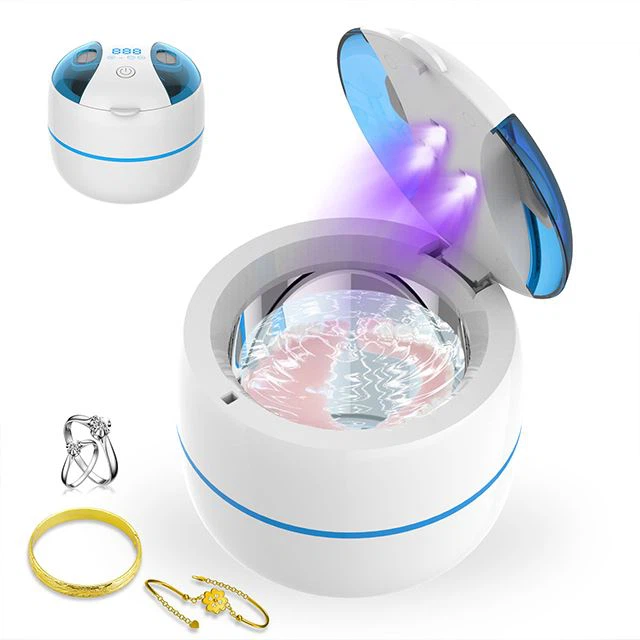
Tabletop ultrasonic dental cleaners utilize high-frequency piezoelectric transducers to transmit acoustic energy-typically calibrated between 42,000 Hz and 45,000 Hz-through a liquid reservoir. These sound waves generate alternating high-pressure compression cycles and low-pressure rarefaction cycles throughout the fluid. During the low-pressure cycle, localized liquid tension drops below the vapor pressure, causing millions of microscopic vapor cavities to form. As the wave switches to high pressure, these cavitation bubbles implode violently within microseconds, generating localized fluid micro-jets and high shear stress. This physical phenomenon, known as acoustic micro-streaming, breaks the electrostatic and adhesive bonds holding biofilm and calculus to the denture substrate without requiring mechanical contact.
Reaching Undercuts Without Mechanical Friction
The primary clinical advantage of ultrasonic cavitation for partial dentures is its omnidirectional, contact-free fluid penetration. Manual toothbrush bristles operate primarily in two dimensions, struggling to access narrow clasp recesses, internal fitting surfaces, guide planes, and the acute junctions where acrylic resin bonds to the metal lattice. In contrast, fluid cavitation acts simultaneously across every microscopic boundary layer immersed in the liquid bath. Cavitation bubbles implode within deep surface fissures, lifting stubborn biofilm without inflicting micro-scratches, blunting retention clasps, or compromising the precise fit of occlusal rests against natural teeth.
Biofilm Pathology: Why Clean Partial Dentures Are Essential for Oral Health
Mitigating Candida albicans and Denture Stomatitis
The micro-porous surface of acrylic resin saddles serves as a primary reservoir for opportunistic microorganisms, most notably Candida albicans. When fungal hyphae penetrate the resin matrix, they establish dense microbial biofilms that resist standard chemical rinses and manual brushing. Prolonged contact between a colonized denture base and the palatal or alveolar mucosa induces denture-related stomatitis, characterized by chronic erythema, tissue inflammation, and mucosal soreness. Regular fluid cavitation disrupts the extracellular polysaccharide matrix of mature fungal biofilms, dislodging yeast cells and preventing chronic soft-tissue reinfection.
Preventing Recurrent Caries on Natural Abutment Teeth
Unlike complete dentures, partial dentures rest directly against surviving natural teeth, known as abutments. The metal clasps and minor connectors of a partial denture create retentive zones where salivary proteins, food debris, and cariogenic bacteria like Streptococcus mutans accumulate. If an RPD is not thoroughly decontaminated daily, it acts as a bacterial carrier, holding high concentrations of acid-producing bacteria directly against the vulnerable cervical margins and exposed root dentin of abutment teeth. Acoustic cavitation eliminates plaque accumulation on clasp interiors, directly protecting abutment teeth from secondary decay and periodontal pocket formation.
Best Practices and Safety Protocols for Ultrasonic Cleaning of RPDs
Temperature Management and Cycle Durations
While ultrasonic cavitation is non-abrasive, continuous operation generates secondary thermal energy within the liquid bath as acoustic friction dissipates into the solution. Excessive water temperature exceeding 45 degrees Celsius can soften thermoplastic nylon clasps or induce internal stress release in PMMA acrylic saddles, leading to irreversible dimensional distortion. To maintain structural stability, cleaning cycles should be limited to an automated window of three to five minutes using cool or room-temperature water. Appliances should always rest inside a suspended polymer cleaning basket rather than touching the stainless steel tank floor directly, preventing localized vibration dampening and acoustic reflection damage.
Chemical Solution Compatibility and Contraindications
Selecting the appropriate chemical medium is critical for preserving prosthetic integrity during ultrasonic cleaning. Users must employ neutral-pH, effervescent cleaning concentrates specifically formulated for dental appliances and RPDs. Household bleach, sodium hypochlorite, and highly acidic descaling agents must be strictly avoided. Chlorine oxidizers rapidly pit, corrode, and darken cobalt-chromium frameworks, weaken solder joints, and cause irreversible bleaching of pink acrylic resins. Similarly, abrasive household detergents should never be added to an ultrasonic bath, as chemical residues can irritate oral mucosa upon reinsertion.

Gold Rose Precision Engineering for Restorative Dental Care
As a specialized OEM/ODM manufacturer of advanced personal healthcare appliances, Gold Rose engineers ultrasonic cleaning platforms that balance deep biofilm debridement with strict prosthetic material safety. The Gold Rose ultrasonic dental cleaner lineup features automated frequency modulation operating at 42–45 kHz, generating uniform cavitation fields that reach intricate clasp undercuts without inducing harmonic resonance peaks that stress delicate metal frameworks. Built-in smart microprocessors automatically terminate cycles after three to five minutes, preventing thermal elevation and eliminating the risk of accidental overheating.
To ensure comprehensive oral care, Gold Rose advocates for a multi-tiered hygiene routine that combines extraoral appliance cavitation with gentle intraoral plaque removal. Incorporating advanced personal instruments like the Gold Rose Z9 LED Electric Flosser enables patients to maintain the cervical margins of natural abutment teeth using guided sonic micro-vibrations at 18,000 VPM. Operating under ISO 13485 medical device quality systems, FDA registrations, and CE, FCC, and RoHS certifications, Gold Rose partners with global dental brands, retail distributors, and clinical suppliers to deliver compliant, durable, and clinically sound oral care hardware.
Frequently Asked Questions
Q1: Will an ultrasonic cleaner bend or loosen the metal clasps on my partial denture?
No, a quality ultrasonic cleaner operating in a fluid bath relies purely on acoustic liquid cavitation and does not generate rigid mechanical pressure against metal clasps. Unlike manual brushing or accidental drops in the sink, fluid cavitation will not bend, fatigue, or distort precision cobalt-chromium or gold retention arms.
Q2: Can I use boiling or hot water in the ultrasonic cleaner to sanitize my partial denture faster?
Never use hot or boiling water, as high temperatures permanently soften and warp PMMA acrylic bases and thermoplastic nylon resins, ruining the precise fit of the denture. Always use cool or room-temperature water paired with an approved dental cleaning tablet, allowing the ultrasonic sound waves to achieve sanitization safely.
Q3: Can regular household bleach be added to the ultrasonic cleaner for deep disinfection?
No, household bleach and chlorine-based solutions must never be used with partial dentures because chlorine chemically attacks, pits, and tarnishes metal frameworks while whitening pink acrylic saddles. Only utilize neutral-pH cleaning tablets formulated specifically for removable dental appliances.
Q4: Does Gold Rose manufacture ultrasonic cleaners designed specifically for partial dentures?
Yes, Gold Rose designs and manufactures a comprehensive portfolio of OEM/ODM ultrasonic dental baths featuring medical-grade SUS304 stainless steel tanks, protective isolation baskets, and automated timing controls. Complete technical specifications and customized private-label manufacturing options can be explored directly through goldrosa.com.
Q5: How often should a partial denture be cleaned in an ultrasonic cleaner?
Dental professionals recommend placing partial dentures in an ultrasonic cleaner once daily for three to five minutes, typically in the evening, to remove daily biofilm, food debris, and salivary deposits. Daily acoustic cleaning prevents calculus calcification and eliminates bacterial reservoirs that threaten natural abutment teeth.
References
American Dental Association. (2023). Denture Care and Maintenance: Clinical Guidelines for Removable Prosthodontics. ADA Science & Research Institute. https://www.ada.org/resources/research/science-and-research-institute/oral-health-topics/dentures
Journal of Prosthetic Dentistry. (2021). Biofilm removal and surface alteration on dental acrylics and cast alloys submitted to ultrasonic cavitation. Elsevier Science.
Tholt de Vasconcellos, B., et al. (2006). Surface roughness of dental appliances and prosthetics submitted to ultrasonic cleaning procedures. Journal of Prosthetic Dentistry, 95(2), 140–145.
Centers for Disease Control and Prevention. (2016). Infection Prevention & Control in Dental Healthcare Settings. CDC Division of Oral Health. https://www.cdc.gov/oralhealth/infectioncontrol/
Gold Rose. Precision Ultrasonic Dental Cleaners and Advanced Sonic Hygiene Solutions. https://www.goldrosa.com/ultrasonic-dental-cleaner/