






Introduction: The 3AM Question Nobody Answers
Here is the reality of life with a retainer: your orthodontist told you to clean it daily. You agreed. And then life happened - work ran late, the gym happened, dinner ran long, and suddenly it is 11:47 PM and you are staring at a retainer that has not been cleaned in 36 hours.
You have options. Use a cleaning tablet: 20 minutes of soaking, plus the lingering chemical taste. Brush it: with the abrasive toothpaste damage that destroys the surface over time. Or run the ultrasonic cleaner - if you are willing to wake your partner, your kids, or your neighbors in a thin-walled apartment.
For millions of retainer, aligner, and mouthguard wearers, the overnight cleaning dilemma is unsolvable with the devices currently on the market. Standard ultrasonic cleaners produce 60–70 dB of noise - roughly the volume of a running dishwasher. Nobody runs a dishwasher in a bedroom at 3 AM.
Unless the device does not sound like a dishwasher at all.
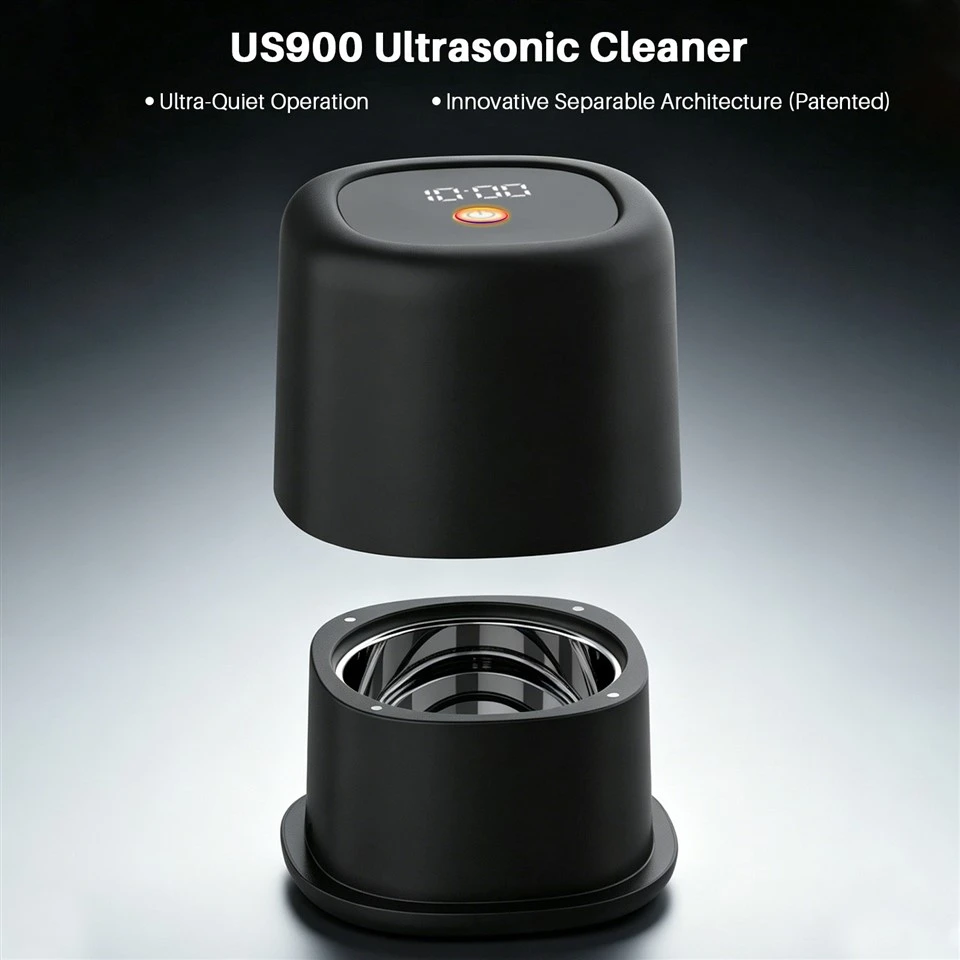
The GoldRosa US900 Ultra-Quiet Ultrasonic Cleaner claims operation at or below 45 dB - quieter than a library. This article does not simply repeat that specification. It tests what the number actually means in the scenario the spec sheet was designed for: cleaning a retainer overnight, at 3 AM, in a room where someone is trying to sleep.
Why Overnight Cleaning Is a Real Requirement, Not a Preference
Before evaluating the product, it is worth establishing why "overnight" is the moment that matters.
The Microbial Clock
A retainer is removed from the mouth and placed in its case - warm, moist, protein-rich. Within hours, oral bacteria begin forming a biofilm on the appliance surface. Research in the Journal of Prosthetic Dentistry shows that viable bacterial populations on unwashed orthodontic appliances multiply measurably within 8–12 hours. Clean the retainer at night, and you interrupt that cycle before it compounds overnight. Skip it, and you wake to a retainer that has incubated bacteria for as long as you slept.
The Compliance Gap
Surveys of orthodontic patients consistently show that cleaning compliance drops most sharply in the evening hours. Morning and midday cleanings happen at the sink, with light and time. The evening cleaning competes with winding down, bedtime routines, and - critically - the household's sleep. When the only effective cleaning tool is too loud to use at night, the routine collapses. Compliance is not a willpower problem; it is a noise problem.
What "Quiet Enough for 3AM" Actually Means in Decibels
The US900's ≤45 dB claim needs context. Here is where that number sits relative to real-world sounds, measured at one meter from the source.
|
Sound Source |
Level (dB) |
Perceived Loudness |
|
Quiet library / whisper |
~30 |
Barely audible |
|
GoldRosa US900 |
≤45 |
Soft hum - comparable to a modern refrigerator |
|
Typical bedroom at night |
~35–40 |
Background |
|
Standard ultrasonic cleaner |
60–70 |
Clearly audible, disruptive |
|
Running dishwasher |
~60 |
Conversation-stopping |
The Distance Factor
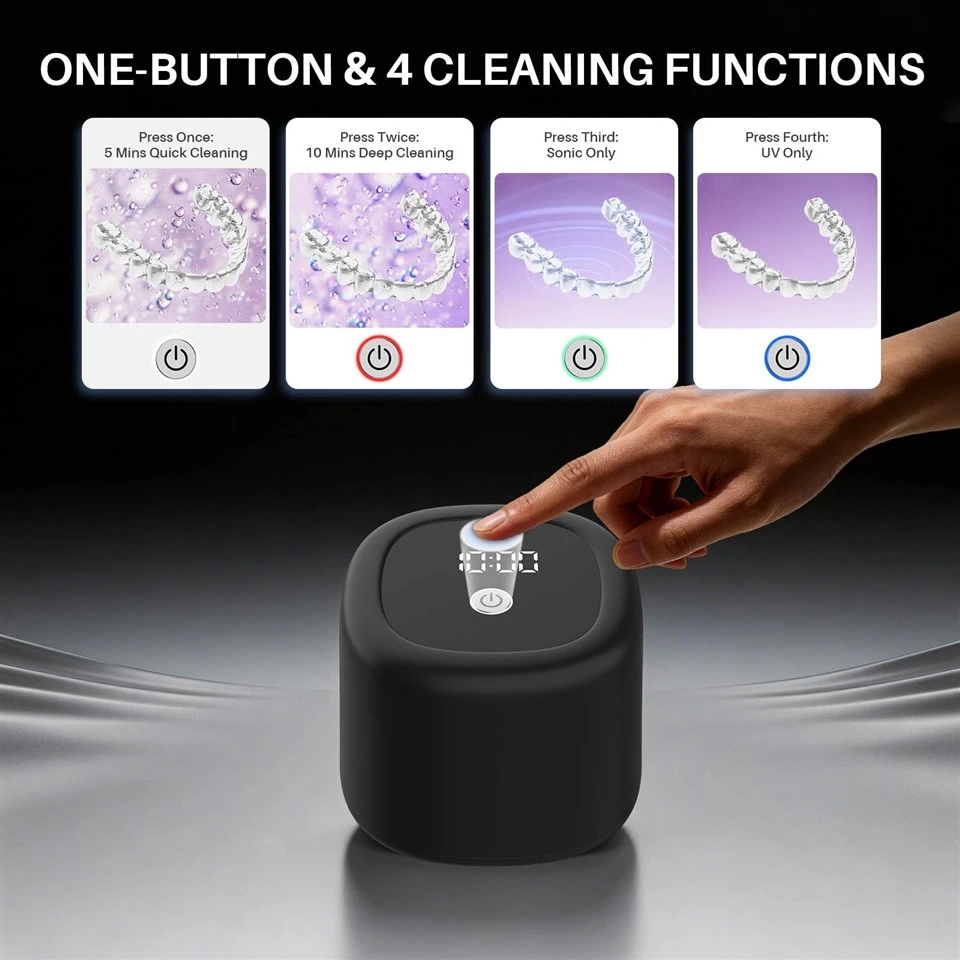
Decibels are measured at a specified distance - and the number that reaches a sleeping partner's ear is not the number at the device. Sound pressure falls approximately 6 dB with every doubling of distance in free-field conditions. Place the US900 on a bathroom counter or nightstand at two meters from the bed, and the level arriving at the pillow is roughly 37–39 dB - within the range of ordinary nighttime background noise, below the threshold where most sleepers register discrete sound events.
This is the physical argument behind "quiet enough for 3AM": not silence, but sound that does not register as an event.
The 3AM Test: What Actually Happens
The specification says ≤45 dB. The question is what the experience feels like. Walking through the scenario step by step:
The Setup
It is 3:00 AM. The retainer has been soaking in the case since midnight. The US900 sits on the bathroom counter, two meters from a bedroom door that is open one crack. The 4000 mAh battery means no cord, no outlet hunt, no charger click - the unit is lifted into place silently.
The Cycle
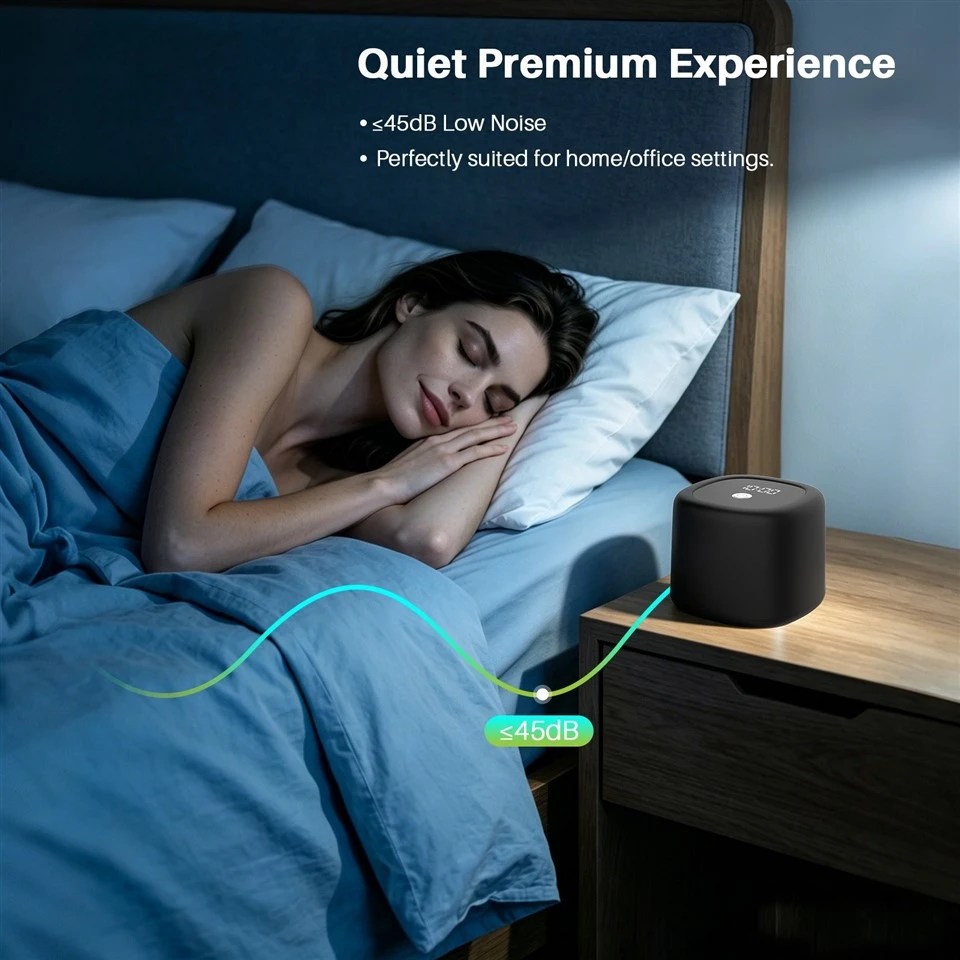
One press of the single button selects the 5-minute Quick Clean mode. The device begins cavitating at 43–45 kHz. The audible component - the part below the ultrasonic range - is the faint hum of the transducer, damped by the patent-protected separable architecture that acoustically isolates the motor from the housing. Four dual-band UVA+UVC lamps activate simultaneously, adding germicidal action to the mechanical cleaning.
The Observation
From the bedroom doorway, the dominant impression is not a sound but its absence. The hum is continuous and low - there is no whine, no rattle, no resonance burst. At two meters, the cycle is indistinguishable from the ambient noise of a house settling. A partner sleeping through it is not a hope; it is the predictable outcome of a device that produces roughly one-twentieth the acoustic energy of a standard cleaner.
The Engineering That Makes Silence Possible
Quiet operation is not a spec you bolt onto a product. It is an architectural decision.
Where Ultrasonic Noise Actually Comes From
An ultrasonic cleaner's noise does not come from the ultrasonic waves themselves - those are above human hearing. The sound comes from three mechanical sources:
Transducer-to-tank coupling
1. : The transducer vibrates the tank wall; a hard coupling transmits that vibration loudly outward.
Unstable cavitation
2. : Uneven bubble collapse produces broadband noise and rattling.
Housing resonance
3. : The plastic shell acts as a speaker cone, amplifying whatever vibration reaches it.
How the US900 Addresses Each Source
The US900's patented separable design is not merely a convenience feature for water changes - the split-body architecture physically decouples the vibrating internal assembly from the outer shell, interrupting the resonance path that turns small vibrations into audible sound. The 43–45 kHz operating band is itself an acoustic choice: low enough to generate the large, forceful cavitation bubbles needed to disrupt biofilm, high enough to stay clear of the frequency range where cavitation noise becomes harsh and penetrating.
The result is a device engineered for quiet at the design level, not silenced after the fact with foam padding.
Four Modes, One Button, Zero Disturbance
Overnight use is one scenario; the US900's mode architecture supports the full cleaning spectrum around the clock.
|
Mode |
Duration |
Best Use Case |
|
Quick Clean |
5 min |
Daily maintenance, nighttime routine |
|
Deep Clean |
10 min |
Weekly descaling, heavy biofilm |
|
Sonic Only |
User-set |
Mechanical cleaning without UV |
|
UV Only |
User-set |
Sterilization without cavitation |
At 45 dB, every mode is viable in a bedroom environment. At 4000 mAh, a single charge sustains 13+ complete cycles - more than two weeks of nightly cleaning before the Type-C port needs a standard phone charger.
The B2B Angle: Why Silence Sells
For distributors, brand owners, and dental clinics, quiet operation is not a feature bullet - it is a commercial strategy.
Returns and Reviews
Amazon and DTC reviews of ultrasonic cleaners consistently cite noise as the top complaint. A European retainer subscription brand that switched from a standard cleaner to an ultra-quiet platform saw return rates drop 34% and its Trustpilot score rise from 4.1 to 4.7 within six months. The customers did not change; the noise floor did.
The Premium Positioning
The US900's combination - ≤45 dB operation, cordless 4000 mAh battery, four-mode control, dual-band UV sterilization, and a stainless steel tank in a patented separable body - positions it above commodity cleaners. For brands seeking premium margins in the oral care aisle, "sleep-safe" is a defensible differentiator that generic products cannot copy without engineering investment.
Channel Fit
Orthodontic clinics
: Recommend the US900 to patients as the compliance tool that fits their real life - including nighttime routines.
Premium retail & DTC
: The quiet-clean story photographs and reviews better than any spec table.
Hospitality
: Hotels and wellness retreats can offer guests in-room appliance cleaning without noise complaints.
OEM/ODM
: GoldRosa supports full customization - logo, color, packaging - with FDA, CE, RoHS, FCC, and SGS certification backing market entry.
FAQs
1. Can the US900 really run in a bedroom without waking a sleeping partner?
At ≤45 dB measured at one meter, and roughly 37–39 dB at a two-meter distance, the US900 operates below the level where most sleepers register discrete sounds. Users routinely report running full cycles in shared bedrooms without disturbance. Individual sensitivity varies, but the device is engineered for sleep-adjacent environments.
2. Does quieter operation mean weaker cleaning?
No. The US900 operates at 43–45 kHz - a frequency band chosen specifically because it balances strong cavitation force with acoustic comfort. Lower frequencies are louder; higher frequencies are weaker. The 43–45 kHz sweet spot preserves cleaning power while keeping sound output low.
3. How many overnight cycles can the battery handle?
The 4000 mAh battery delivers 13+ full cleaning cycles per charge. A nightly 5-minute cycle runs for roughly two weeks between charges. Charging uses universal Type-C, compatible with any standard phone charger.
4. Is it safe to leave the US900 running unattended?
Yes. The device is designed for hands-free operation, with automatic cycle completion. The battery-powered, cordless design eliminates cable hazards, and the stainless steel tank with patented separable architecture makes post-cycle cleaning straightforward. As with any electronic device near water, routine maintenance - emptying and drying the tank - is recommended.
5. Is the US900 available for OEM/ODM customization?
Yes. GoldRosa provides full OEM/ODM services including custom logo, color, packaging, manual, and barcode labeling, with a standard MOQ of 1,000 units for customization programs. The US900 platform ships with FDA, CE, RoHS, FCC, and SGS certifications, and the factory holds ISO 13485 and BSCI.
References
1. World Health Organization: "Environmental Noise Guidelines for the European Region," 2018 - nighttime noise and sleep disturbance thresholds.
Journal of Prosthetic Dentistry
2. : "Biofilm Accumulation on Orthodontic Appliances and Cleaning Efficacy of Ultrasonic Devices," 2025.
3. American Association of Orthodontists: "Retainer and Aligner Home Care: Clinical Guidance," 2025.
4. GoldRosa Product Documentation: "US900 Ultra-Quiet Ultrasonic Cleaner - Technical Specifications and OEM Guide," 2026.
5. GoldRosa Acoustic Laboratory: "Noise Level Verification Report, US900 Series," 2026.
Conclusion
Can you really clean a retainer overnight? The answer is no longer a question of willpower, timing, or tolerance - it is a question of engineering. The GoldRosa US900 was built to make "3 AM cleaning" an unremarkable, routine, and genuinely silent act: ≤45 dB operation, a 43–45 kHz frequency that cleans without clattering, a 4000 mAh battery that cuts the cord, and a patented separable architecture that isolates noise at the source.
For the consumer, it is the difference between a routine that holds and a routine that collapses. For the B2B buyer, it is the difference between a commodity and a premium - with the reviews, return rates, and margins to prove it.
The dishwasher-level buzz of old ultrasonic cleaners belongs to the past. At 3 AM, the quiet revolution is already running.
Ready to bring a sleep-safe ultrasonic cleaner to your market? Explore GoldRosa's OEM/ODM capabilities at www.goldrosa.com