


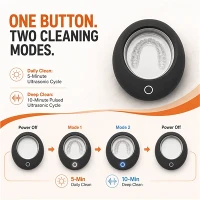
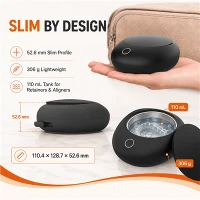

As a blogger with years of experience in the oral care equipment industry, I have seen too many B2B clients stumble in the OEM sourcing of ultrasonic retainer cleaners - either their customized products are disconnected from market demand, they encounter quality failures from suppliers, or they get stuck in market access due to compliance issues. Today, I will combine practical cases to break down the key points of the entire OEM cooperation process, helping you avoid sourcing pitfalls and build highly competitive private-label products.
Introduction: Why is OEM Ultrasonic Retainer Cleaner a Golden Track for B2B Clients?
The market penetration of dental appliances such as invisible aligners, night guards, and sports mouthguards has been rising year by year, directly driving the explosive growth in demand for supporting cleaning equipment. Data shows that the global market size of dental appliance-related products will exceed 20 billion US dollars by 2025, and as a core cleaning tool, the purchase volume of ultrasonic cleaners in both household and clinic scenarios is growing at an annual rate of over 30%.
For B2B clients, the OEM model is the optimal choice to enter this track - without investing huge R&D and production line costs, you can rely on the factory's technical strength to customize products that fit your brand positioning. However, the core of OEM cooperation is far more than just "private labeling." From demand definition to supplier selection and cooperation implementation, every link hides key details that affect success or failure.
From a practical perspective, this article will break down my years of accumulated OEM sourcing experience into actionable steps, helping you accurately match needs, select high-quality suppliers, control cost risks, and make your wholesale sourcing journey smoother.

Preliminary Research: Clarify Needs to Avoid Misaligned OEM Direction
The first step in OEM cooperation is not to find suppliers, but to clearly define "what you want." Vague needs will only lead to repeated revisions, cost overruns, and even products that fail to attract customers in the end.
Lock in Target Audience and Product Positioning
Different audiences have completely different core demands for products. I usually advise clients to first clarify two key questions:
Who are you selling to? Are they household consumers (pursuing portability, appearance, and cost-effectiveness) or dental clinics (valuing capacity, cleaning efficiency, and durability)?
What is the core usage scenario? The household scenario focuses on "small size and easy operation," such as a mini model suitable for single-person retainers; the clinic scenario requires "large capacity and multiple gears" to clean multiple appliances or dental tools simultaneously.
Product parameters should also align with positioning: For household models, prioritize a 45kHz ultrasonic frequency (balancing cleaning power and noise reduction), built-in UV sterilization (a core market selling point), and rechargeable design (enhancing portability); for clinic models, focus on cleaning tank capacity (recommended to be no less than 500ml), power stability (avoiding attenuation after long-term use), and high-temperature resistant materials (facilitating disinfection).
Compliance and Certification Thresholds (Must-Know for B2B)
Compliance is the "pass" for products to enter the market. Especially for clients engaged in cross-border sales, neglecting certifications will waste all previous investments. Based on my experience, the core certification requirements for different markets are:
US Market: Must obtain FDA registration. Ultrasonic retainer cleaners are classified as Class II medical devices, requiring a 510(k) submission. Ensure product labels include compliant content such as usage instructions and warning information;
European Market: CE certification is fundamental, and compliance with RoHS environmental standards (restricting the use of hazardous substances) is also required;
Global Universal Standards: Materials must meet food contact safety standards. The cleaning tank is recommended to use 316L stainless steel (antibacterial and corrosion-resistant), and the entire machine must pass antibacterial performance testing.
Here's a practical tip: Ask suppliers to provide past certification cases and test reports in advance, and confirm that their production processes comply with GMP standards to avoid delays in market launch due to compliance issues.
Clarify Your Own OEM Requirements
Before contacting suppliers, listing your customization needs and cooperation expectations can greatly improve communication efficiency:
Customization Depth: Do you only need logo printing and color modification, or do you want to adjust functions (such as adding intelligent timing gears) and redesign the appearance?
Cooperation Scale: What is the minimum order quantity (MOQ) you can accept? The MOQ of regular factories is 500-1000 units. If you are a startup brand, negotiate small-batch trial production in advance;
Delivery Requirements: What is the maximum acceptable lead time from order placement to delivery? Can the supplier respond quickly to restocks? Clarify these in advance to avoid stockouts during peak seasons.
Supplier Selection: 3 Rigorous Standards to Eliminate Low-Quality Partners
A supplier's strength directly determines product quality and cooperation stability. When selecting suppliers, I never focus solely on price but concentrate on three core dimensions: "production capacity, OEM experience, and quality control," verifying each one thoroughly.
Verification of Production Capacity
Truly reliable suppliers dare to disclose their production details. I usually require two things:
Qualifications and Factory Inspection: Must have dental equipment production qualifications. Prioritize enterprises with their own factories, preferably those that can provide on-site visits (or high-definition videos). Focus on the cleanliness of the production workshop and the degree of equipment automation;
Core Component Supply Chain: The source of core accessories such as ultrasonic generators (recommended brands like Germany's Branson or Taiwan's Delta, with frequency stability of ±0.1kHz) and UV lamps (service life no less than 5000 hours) directly affects product durability.
Here's a pitfall-avoidance tip: Ask the supplier, "What is the warranty period for core components?" High-quality factories will promise a 1-2 year warranty for generators, while small workshops usually cannot provide a clear warranty.
OEM Experience and Cases
Suppliers without B2B service experience will struggle to understand your customization needs. When selecting, I focus on:
Past Cases: Have they served B2B clients such as e-commerce sellers and oral care brands? Can they provide specific cooperation cases (such as sales volume and customization details of OEM products for a certain brand)?
Sample Testing: Request functional samples from suppliers and personally test cleaning effectiveness (use a retainer contaminated with toothpaste residue; high-quality products can remove 99% of stains within 3 minutes), durability (observe for overheating after 2 hours of continuous operation), and noise level (recommended ≤50dB for household models).
A reminder: Record key parameters during sample testing (such as ultrasonic frequency and UV sterilization time) and use them as acceptance criteria for mass production to avoid "high-quality samples but subpar bulk goods."
Quality Control System
A sound quality control system can reduce after-sales troubles. I assess from two aspects:
Quality Inspection Process: Do they have a full-process system including incoming material inspection, in-production inspection, and finished product sampling inspection? Request a quality inspection record template and confirm that the sampling ratio is no less than 3% (industry standard);
After-Sales Support: What is the product warranty period? How to handle quality issues (such as non-functional UV lamps or ultrasonic failure)? High-quality suppliers will promise a 1-year warranty, provide free replacement or repair services for faulty products, and clarify the return and exchange process.

Product Customization: Key Details to Balance Differentiation and Cost
The core of OEM customization is to "be distinctive while controlling costs." I have seen many clients lose market competitiveness due to excessive customization leading to high unit prices, and others whose products lack memory points due to insufficient customization.
Functional Customization: Focus on Core Selling Points
Functional customization is not about "the more the better," but about addressing user pain points. Based on market feedback, these are the functions customers care about most:
Must-Have Functions: Ultrasonic deep cleaning (40-45kHz frequency), UV sterilization (sterilization rate ≥99.9%), and antibacterial materials (reducing bacterial growth) - these three functions are core to impressing consumers and indispensable;
Value-Added Functions: Wireless charging (enhancing portability), intelligent timing (1/3/5 minute gears), and low-battery reminder (optimizing user experience). These functions can increase product premium but do not need to be all added - select 1-2 based on your target audience.
Here's a cost control tip: Avoid "function stacking." For example, adding industrial-grade power adjustment to household models not only increases costs but also complicates operation, reducing user acceptance.
Appearance and Packaging Customization
Appearance and packaging are the "first business card" of a brand. When customizing, balance "brand recognition" and "practicality":
Brand Integration: The logo is recommended to be printed in a prominent position on the front of the machine. Color selection should align with brand tone (e.g., matte black or white for high-end brands, pastels for young brands);
Packaging Design: Household packaging should be compact and portable, printed with brand stories and user instructions (multilingual adaptation, including at least Chinese and English for key markets); clinic packaging should prioritize damage resistance, using hard cartons + foam cushioning to avoid damage during transportation.
Cost Control Tips
One of the core advantages of OEM cooperation is controllable costs. I usually use two methods to reduce unit prices:
Simplify Non-Core Functions: For example, do not redesign the appearance with new molds (use the factory's existing molds and only modify colors and logos) to reduce R&D costs;
Bulk Purchase of Core Accessories: For large customization volumes, negotiate with suppliers to jointly purchase core components such as ultrasonic generators and UV lamps in bulk, which can reduce unit costs by 10%-15%.
A reminder: The bottom line of cost control is "not sacrificing quality." For example, choosing low-quality UV lamps to lower prices may save money in the short term but will lead to a surge in after-sales complaints, ultimately doing more harm than good.

Cooperation Implementation: 4 Practical Tips to Avoid Risks
No matter how thorough the preliminary preparations are, mistakes in the implementation phase can ruin everything. Combining years of cooperation experience, I have summarized 4 key risk points to help you advance cooperation smoothly.
Clarify Contract Terms
Contracts are crucial to protecting the rights and interests of both parties. I require all verbal agreements to be written into the contract, focusing on clarifying:
Product Details: Detailed product parameters (frequency, power, materials), customization requirements (logo position, packaging design), and acceptance criteria (qualified indicators for sampling inspection);
Cooperation Process: Delivery time (specific to the date), transportation method (sea/air freight), and acceptance process (how many days after arrival to complete inspection);
Payment and Liability for Breach: Deposit ratio (30%-50% recommended), final payment terms (after qualified acceptance), and breach clauses (such as compensation ratio for supplier delays in delivery).
Intellectual Property Protection
Intellectual property disputes are common in OEM cooperation. I take two precautions in advance:
Clarify Copyright Ownership: Stipulate in the contract that the copyright of customized designs (appearance, packaging) belongs to you, and prohibit suppliers from unauthorized use or provision to other clients;
Avoid Infringement Risks: Require suppliers to promise that product designs do not infringe on third-party patents. If infringement disputes arise, the supplier shall bear full responsibility.
If your brand has registered trademarks, provide a trademark authorization letter in advance to ensure the supplier's legal use of the logo.
Small-Batch Trial Production Verification
Even if sample testing is qualified, it is recommended to conduct small-batch trial production (e.g., 100-200 units) before mass production. I usually focus on verifying two points:
Product Consistency: Randomly select 10 units to test whether core functions (ultrasonic frequency, UV sterilization effect) are consistent with samples and whether there are appearance defects;
Packaging Reliability: Simulate transportation conditions (such as drop tests) to check if the packaging can effectively protect the product and avoid damage after arrival.
Problems found during the trial production phase should be promptly rectified by the supplier. Only after passing rectification should mass production start. This step can avoid the risk of large-scale recalls later.
Long-Term Cooperation Guarantee
High-quality OEM cooperation is a long-term win-win. I negotiate two points with suppliers in advance to pave the way for future cooperation:
Response to Price Fluctuations: Raw material price increases are normal. The contract can stipulate that "if raw material prices fluctuate by more than 10%, both parties will negotiate to adjust the unit price" to avoid unilateral price increases by suppliers;
New Product Iteration Support: Require suppliers to keep up with technological upgrades (such as launching higher-frequency ultrasonic generators and longer-lasting UV lamps) and provide priority upgrade solutions to maintain product competitiveness.
Conclusion: The Core Logic of OEM Success
Through years of OEM sourcing practice, I deeply understand that the success of ultrasonic retainer cleaner OEM never relies on "finding the cheapest supplier," but on "clear demand positioning + high-quality partners + meticulous process control."
For B2B clients, the core value of the OEM model is "to create market-fit products at the lowest cost." You don't need to conduct your own R&D or build factories - as long as you select the right suppliers and control demand, quality, and compliance, you can quickly enter this high-growth track.
Finally, here's an action suggestion: If you already have a clear product positioning, select 2-3 candidate factories according to the "supplier selection standards" I mentioned and request sample testing; if you haven't clarified your needs yet, start with market research, look at the core selling points and user feedback of competitors, and then gradually refine your requirements.
With the continuous growth of the dental appliance market, the demand for ultrasonic retainer cleaners will only increase. Choose the right partners and handle the details well, and your OEM products will surely stand out in the market.