




Sourcing portable ultrasonic retainer cleaners looks straightforward until the first container lands. The failure mode is not price - it is that published specifications are written by marketing teams, not engineers. A "4000mAh" badge and an IPX7 logo do not tell you whether the transducer still cavitates on cycle twelve or whether your label is legally complete when customs asks. This is the verification list we hand OEM buyers before they commit, benchmarked against the Gold Rose US601.
Why This Category Earned an OEM Slot
The Demand Signal Is Structural
Clear aligner therapy has moved from a cosmetic alternative to standard orthodontic care. Grand View Research values the global clear aligners market at USD 5.5 billion in 2025 and forecasts USD 17.9 billion by 2033 at a 15.2% CAGR, with North America holding a 50.0% share. Every aligner patient needs a cleaning device, making the hygiene accessory the recurring revenue item in a plan that otherwise sells once.
What Cavitation Does - and the Claim You Cannot Make
Ultrasonic devices generate high-frequency sound waves, typically 20 to 120 kHz, which form cavitation bubbles in water; their implosion produces a microscopic scrubbing action that reaches the complex geometry of an aligner. That mechanism justifies the product but caps your claim. A 2026 study in BMC Oral Health tested 50 kHz ultrasonic assist on stained polyurethane aligners and found it did not improve stain removal - colour recovery came from the chemical formulation, not the cavitation. Market the device as chemical-free mechanical cleaning, not as whitening or sterilization, because those claims change your regulatory status.

Technical Specifications to Verify in a Portable Ultrasonic Retainer Cleaner
Ultrasonic Frequency and Transducer Power
Frequency determines cavitation bubble size and energy density, so it belongs in your technical file as a written figure. Gold Rose publishes 45 kHz on its US500 platform and 47 to 52 kHz on the US600, bracketing the range typically used for dental appliance cleaning. Frequency is also a compliance threshold: United States rules place consumer ultrasonic equipment under 500 watts and below 90 kHz in a specific authorisation category. US601's data sheet covers battery, sealing, metallurgy, durability and form factor, so request frequency and transducer power explicitly.
Chamber Metallurgy and Tank Volume
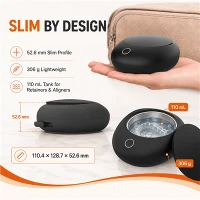
The inner tank is where cheap units fail. ABS tanks scratch, retain odour, and tolerate continuous cavitation less well than metal, whereas food-grade SUS304 stainless steel resists pitting and bacterial retention. The Gold Rose US601 uses a 110 mL SUS304 tank, which holds upper and lower aligners or a night guard without the appliance touching the transducer plate. Ask for a material certificate, not a product photo.
Waterproof Rating and Sealed Charging
Bathrooms are wet and a retainer cleaner lives in one. IPX7 means the enclosure survives immersion, not merely splashes, and it is meaningless unless the charging port is sealed - an exposed micro-USB socket defeats the entire rating. The evidence to demand is an IP test report referencing IEC 60529 that covers the port closure and confirms the seal holds after repeated plug cycles.
Battery Autonomy and Drop Resilience
Verify battery capacity as cycles, not milliamp-hours. The US601 carries a 4000mAh pack rated for 14 cycles per charge; budget alternatives ship 1200mAh cells that manage two or three and lose cleaning power as voltage sags. Robustness matters because the transducer is a brittle ceramic element: the US601 survives a 1.2 metre drop, weighs 306 g, and fits a carry-on toiletry bag at 52.6 mm tall.
Certifications and Regulatory Scope Every OEM Buyer Must Verify
United States: FCC Part 18 and the FDA Intended-Use Line
Because the transducer generates RF energy for a non-communication purpose, an ultrasonic cleaner falls under 47 CFR Part 18, Industrial, Scientific and Medical Equipment - a detail most buyers never consider. Section 18.203(a) requires consumer ISM equipment to be authorised before marketing, and 18.203(b) routes units under 500 watts and below 90 kHz to the Supplier's Declaration of Conformity rather than certification; the label must carry the Part 18 compliance statement.
On the medical side, FDA's Product Code FLG covers "cleaner, ultrasonic, medical instrument" under 21 CFR 880.6150 - Class I, 510(k) exempt, but explicitly not GMP exempt, and manufacturers must register their establishment. The distinction is intended use, not technology: a device marketed to clean medical instruments sits inside that category, while a household appliance for personal retainers sits outside it - until therapeutic or sterilizing claims move it across the line. Settle intended use before packaging artwork is approved.
European Union: CE, Responsible Person and Battery Labelling
CE placement requires evidence against the applicable directives, including electromagnetic compatibility and RoHS. Two obligations now catch exporters more often than CE itself. Under Regulation (EU) 2023/988 on general product safety, when the manufacturer is outside the EU the importer becomes the Responsible Person, must verify technical documentation, and must put its own contact details on the product or packaging. Separately, batteries fall under Regulation (EU) 2023/1542: CE marking on batteries has applied since 18 August 2024, harmonised labelling applies from 18 August 2026, and QR code information follows in 2027.
Battery Documentation and Quality System Evidence
Lithium packs are regulated cargo regardless of category. UN38.3 test summaries are required for air and sea freight, IEC 62133 covers cell and pack safety, and carriers expect a safety data sheet. A 4000mAh pack sits well under the 100 Wh air-transport threshold, but the summary remains mandatory. On quality, ask for test reports rather than certificate wallpaper: confirm that quality management covers this product line, that pre-shipment inspection is defined rather than asserted, and that any FDA establishment claim can be checked independently. Gold Rose works under ISO 13485, holds CE, FCC, RoHS and FDA registrations, and runs 100% inspection with a 24-hour aging test before shipment.
Benchmarking the Gold Rose US601 Portable Ultrasonic Cleaner
Best Overall: US601 - The Travel-First Build
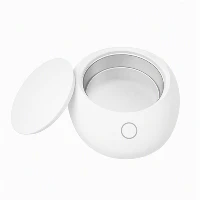
The US601 is the configuration to measure the category against because it resolves the trade-off that defines every portable unit: battery life against durability. It pairs a 4000mAh battery delivering 14 cycles per charge with certified IPX7 sealing, a SUS304 tank and a sealed USB-C port in a 306 g body just 52.6 mm tall, and its one-button control offers a five-minute daily cycle and a ten-minute pulsed deep clean. The 110 mL tank takes upper and lower aligners, retainers and night guards. For distributors this is the returns-reduction argument: the failure modes generating warranty claims are water ingress, dead batteries and cracked tanks, each engineered against rather than marketed around.
How US601 Compares to Typical Configurations
|
Specification |
Gold Rose US601 |
Countertop Unit |
Budget Mini |
|
Power Source |
4000mAh Li-ion battery |
Fixed AC wall cord |
1200mAh battery |
|
Cleaning Cycles |
14 cycles per charge |
Unlimited while plugged in |
2 to 3 cycles |
|
Waterproof Rating |
Certified IPX7 |
IPX0 |
IPX4, splash only |
|
Drop Protection |
1.2 m certified drop test |
None |
Fragile plastic |
|
Tank Basin |
SUS304 steel, 110 mL |
SUS304, 450 to 600 mL |
ABS plastic, 80 mL |
|
Timer Modes |
5-min daily / 10-min deep |
3-min fixed timer |
Single on/off switch |
|
Charging Port |
Sealed USB Type-C |
Fixed wall plug |
Exposed Micro-USB |
Commercial Terms: MOQ, Customization, and Project Timeline
MOQ and Production Timeline
Gold Rose quotes a 1,000-unit minimum order quantity for custom private-label production on its ultrasonic line, low enough to test a market without committing to a container. Standard samples ship in one to three days and customized items in 15 to 35 days. Production runs 15 to 25 working days for standard OEM and 30 to 45 working days for deep ODM projects involving mold development.
Customization Scope and Packaging
Customization covers body colour, surface finish, logo application by silk screen or laser engraving, functional parameters such as modes and timers, and one-stop packaging including colour box design, manuals and FBA labelling. Gold Rose also supplies marketing assets - imagery, 3D renderings and product video - because this category is sold visually. The margin logic matters: dental consumables carry roughly 12% to 18% gross margin, while specialty oral care hardware runs 38% to 55%.
Frequently Asked Questions
Q1: What ultrasonic frequency should a portable retainer cleaner run at?
A: Consumer dental units typically run between 40 and 50 kHz, inside the 20 to 120 kHz range used in cleaning research. Gold Rose publishes 45 kHz on the US500 and 47 to 52 kHz on the US600, so request the US601 figure in writing.
Q2: Is an ultrasonic retainer cleaner a regulated medical device in the United States?
A: It depends on intended use, not technology. FDA Product Code FLG covers ultrasonic cleaners for medical instruments under 21 CFR 880.6150 - Class I, 510(k) exempt but not GMP exempt. A household cleaner for personal retainers stays outside that definition until you add sterilizing claims.
Q3: Can I replace cleaning tablets with an ultrasonic cleaner?
A: Research does not support that. A 2026 BMC Oral Health study found household ultrasonic cleaning did not improve stain removal beyond the chemical agent itself, so position the Gold Rose US601 as chemical-free mechanical cleaning rather than a universal replacement.
Q4: What MOQ and lead time should I plan for on a private-label order?
A: Gold Rose quotes a 1,000-unit MOQ. Standard samples ship in one to three days and customized items in 15 to 35 days, with production at 15 to 25 working days for standard OEM and 30 to 45 for deep ODM projects.
Q5: Which certificates should the supplier deliver before shipment?
A: Ask for test reports rather than certificate logos: CE evidence, the FCC Part 18 Supplier's Declaration of Conformity, UN38.3 and IEC 62133 documentation for the lithium pack, and the IPX7 report. Verify ISO 13485 coverage and FDA establishment registration too.
References
1. Gold Rose - Portable Ultrasonic Cleaner (US601): https://www.goldrosa.com/ultrasonic-dental-cleaner/portable-ultrasonic-cleaner.html
2. Gold Rose - Rechargeable Ultrasonic Cleaner (US600, 47–52 kHz): https://www.goldrosa.com/ultrasonic-dental-cleaner/rechargeable-ultrasonic-cleaner.html
3. Gold Rose - Ultrasonic Retainer Cleaner (US500, 45 kHz): https://www.goldrosa.com/ultrasonic-dental-cleaner/ultrasonic-retainer-cleaner.html
4. U.S. FDA - Product Classification: cleaner, ultrasonic, medical instrument (Product Code FLG): https://www.accessdata.fda.gov/scripts/cdrh/cfdocs/cfpcd/classification.cfm?id=FLG
5. eCFR - 47 CFR §18.203, Equipment authorization (FCC Part 18 ISM): https://www.ecfr.gov/current/title-47/chapter-I/subchapter-A/part-18/subpart-B/section-18.203
6. Regulation (EU) 2023/988 on general product safety (GPSR): https://eur-lex.europa.eu/legal-content/EN/TXT/PDF/?uri=CELEX:32023R0988
7. Regulation (EU) 2023/1542 on batteries: https://eur-lex.europa.eu/EN/legal-content/summary/sustainability-rules-for-batteries-and-waste-batteries.html
8. BMC Oral Health (2026). Can household ultrasonic cleaners enhance the stain removal efficacy of chemical agents on orthodontic aligners? 26, 921.
9. Grand View Research - Clear Aligners Market: https://www.grandviewresearch.com/industry-analysis/clear-aligners-market