







Most tonsil stone injuries are not caused by careless hands. They are caused by working inside a blind pocket with a mirror at arm's length and no way to see where the tip ends and the tissue begins. Camera-guided suction removes that uncertainty from the procedure.
What "Blind" Removal Actually Means
There Is No Sightline Into a Crypt
The palatine tonsil is not a smooth surface with stones resting on it: its medial face is broken by branching crypts that penetrate the lymphoid tissue and end blindly, which is why debris accumulates there at all. A bathroom mirror shows the crypt mouth and nothing beyond it, and the instrument occludes that same mouth as it approaches. You aim at a target you cannot see, with the tool blocking the only view you had.
The Feedback Loop Has No Depth Signal
Proprioception in the oropharynx is poor, so depth is inferred rather than sensed. Gag compounds it: glossopharyngeal afferents in the tonsillar region trigger a vagal reflex, and retching produces a tongue thrust that moves the instrument further than intended. A deliberate probe becomes an involuntary jab in under a second, and no cotton bud or rigid probe limits how far it travels.
The Mucosa Has No Margin for Shear
Crypt walls are lined by thin, non-keratinised epithelium over lymphoid tissue, wet and loosely supported, with a blood supply from the tonsillar branch of the facial artery plus the ascending palatine, ascending pharyngeal and lingual arteries, draining into a venous plexus. There is no keratin layer to spread a load and no fascia to arrest a tear. Shear at the crypt mouth opens mucosa, and blood then covers the field, so the target is lost exactly when precision matters most.
Why Incomplete Extraction Is the Default Outcome
Stones Form at the Crypt Base
A tonsillolith is a calcified polymicrobial biofilm, and it nucleates where the crypt is deepest and drainage is worst. What you see as a white fleck at the surface is the top of the deposit, not the whole of it. Blind removal grips that portion, breaks it, and leaves the base behind: the fragment you cannot see is the one you cannot judge.
Success Is Judged by the Wrong Signal
Absence of a visible white spot is not evidence of an empty crypt. Radiology makes the point cleanly: in a comparison of panoramic radiography against cone-beam CT, tonsilloliths were found in 33.2% of CBCT scans, while panoramic images identified only 51.4% of the stones that CBCT had already shown. The deposits did not change; the viewing system did. A patient squinting into a mirror is working with the optical equivalent of the panoramic film.
A Residual Nidus Guarantees Recurrence
Leave calcified debris and the bacterial load that produced it, and the crypt refills on the same geometry that caused the problem. The cycle is then weekly: discomfort, another blind attempt, more micro-trauma, temporary relief. Each repetition adds to the cumulative insult to a mucosal surface that has no spare thickness.
What 1080P Camera Guidance Changes
Resolution Turns a Guess Into a Measurement
A 1080P sensor carries 1,920 horizontal pixels. If the lens frames a 20–30 mm field at working distance, that is roughly 64 to 96 pixels per millimetre, so a 1 mm stone fragment resolves as a distinct object with visible edges rather than a white blur. Six LEDs at that distance deliver enough light without a headlamp, and illumination falls with the square of distance, so every extra centimetre costs exposure.
The Tip Can Be Transparent
Because the camera is in the head and the screen is in your hand, the nozzle no longer hides what it is aimed at. Transparent nozzles let the operator watch a stone enter the tube and confirm capture in real time, instead of inferring success from relief an hour later. A monocular camera has no stereo depth, so that visual confirmation replaces depth perception the naked-eye procedure never had.
Suction Reverses the Force Vector
Manual tools push. Negative pressure pulls mucosa toward the lumen, along the direction the tissue is already supported, with no point load and no forward travel. Over-vacuum produces capillary congestion and petechiae at the nozzle rim: superficial, visible as they happen and self-limiting, unlike a laceration that announces itself when the field turns red.
What to Specify in a Camera-Guided Device
Optics, Illumination and Streaming
Ask for resolution, frame rate, field of view and LED count in writing, then request a sample video at true working distance in a mouth, not a render on white. Confirm the streaming standard, the supported operating systems, and latency under a crowded 2.4 GHz band, because a two-second delay turns a guided procedure back into a blind one.
Suction Range and Tip Geometry
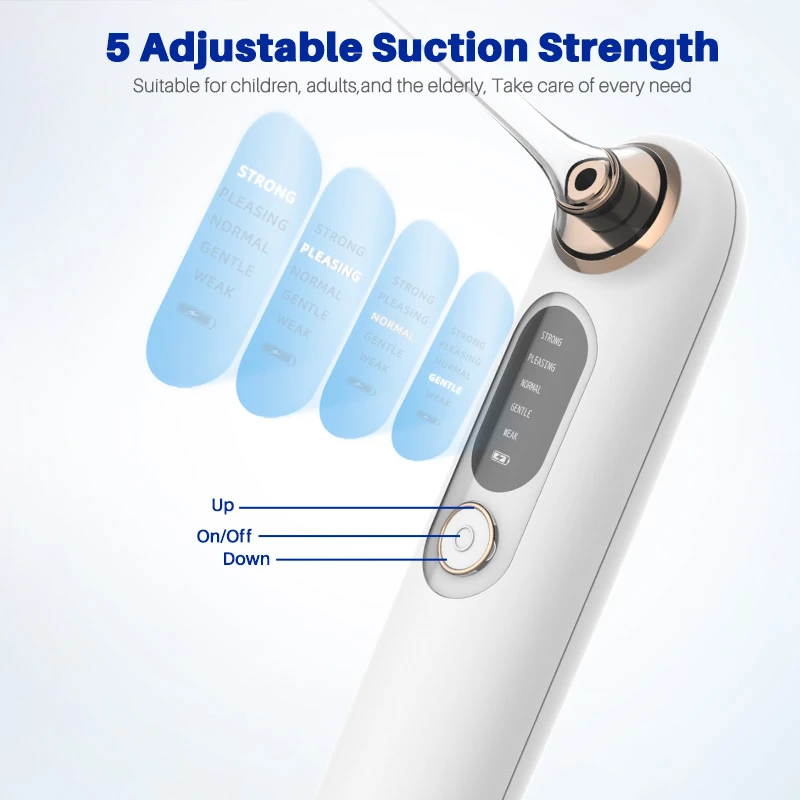
Five levels are useful only if the lowest is genuinely gentle; a range that starts strong has no first setting for a nervous user. Specify transparent, detachable nozzles with a smooth horn tip, and check that the smallest bore passes the stone sizes your market reports, since a nozzle that clogs mid-extraction recreates the pressure problem the device exists to avoid.
Runtime, Hygiene and Data Handling
A 900 mAh cell giving over 100 minutes on a two-hour Type-C charge covers weeks of short sessions, and an on-body display removes guesswork mid-procedure. Every mouth-contacting part should detach and tolerate warm water, brushing and 75% alcohol. If an app is involved, verify in writing that it runs as a local monitor without registration and stores no images or biometric data: that claim sells in the EU and becomes a liability if untrue.
The Gold Rose Range for Camera-Guided Removal
Gold Rose Visual Vacuum Tonsil Stone Remover - Best Overall
This is the configuration the whole argument points to: an integrated 1080P HD endoscopic camera with six LEDs streaming over WiFi to iOS and Android, five calibrated suction levels with dual extraction modes, and three interchangeable transparent nozzles so capture is visible. The kit adds a curved irrigation syringe, tongue depressor, manual probe and cleaning brush, runs on a 900 mAh battery for over 100 minutes from a two-hour Type-C charge, and puts battery and mode status on an LED screen. Minimum order is 3,000 pieces, with OEM options covering shell colours, logo printing, packaging, localised manuals and app UI branding.
Gold Rose Electronic Vacuum Tonsil Stone Remover - Best Value Entry
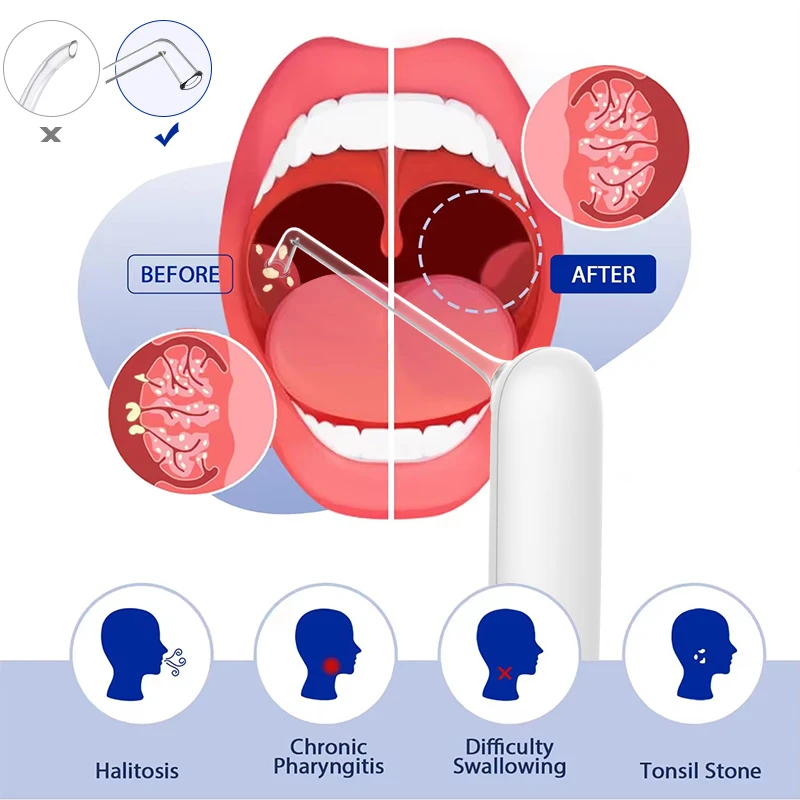
For buyers whose market will not pay for app streaming, this SKU keeps the suction and adds a 5X magnifier with a dedicated oral lamp, so the crypt is lit and enlarged rather than guessed at. Five suction levels run from a mild WEAK setting to STRONG, the probe uses a smooth horn-shaped medical-grade tip, and a warm-water syringe is included for loosening. It removes the darkness and the force problem but not the sightline, and the 100-piece minimum makes it a low-risk first order.
Gold Rose Power Tonsil Stone Remover Kit - Adjunct, Not Equivalent
A manual kit with tweezers, stone spoons, slim probes, tongue depressors, a USB LED light, a 5X mirror and an angled glass-nozzle irrigator, at a 500-piece minimum. It is a merchandising answer for channels wanting a low-ticket entry: the accessories improve access and lighting, but extraction remains blind, and the kit should carry clear referral guidance.
Comparison at a Glance
|
Configuration |
Guidance |
Extraction |
Best for |
|
Gold Rose Visual Vacuum |
1080P HD camera, 6 LEDs, WiFi to phone |
5 suction levels, 3 transparent nozzles |
Flagship SKU, premium retail |
|
Gold Rose Electronic Vacuum |
5X magnifier plus oral lamp |
5 suction levels, horn tip |
Value tier, 100-piece entry |
|
Gold Rose Power Kit |
5X mirror, USB LED |
Manual probes and spoons |
Low-ticket adjunct |
|
Cotton swab and mirror |
Hand mirror, no magnification |
Finger pressure |
Nothing it should be used for |
A Safe Use Protocol
Work Under Vision, Not by Feel
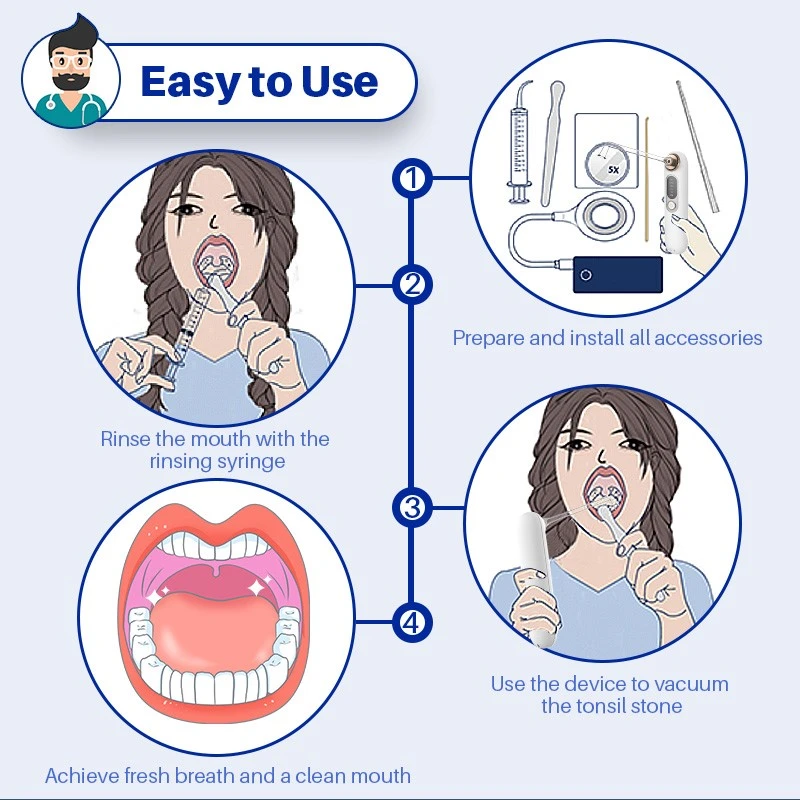
Start at the lowest suction level with the camera already showing the crypt, and advance only while the mouth, nozzle tip and stone are all inside the frame. If the view is lost, stop and re-establish it rather than continuing on memory of where the stone was. Short passes with a pause between them keep the gag reflex from compounding the movement.
Know the Stop Rules
A graze that stops bleeding within minutes is minor. Bleeding that continues, a rapidly swelling tonsil, pain on swallowing, fever, or persistent one-sided enlargement deserves an ENT assessment rather than another attempt: those signs are not explained by a stone. No home device, however well guided, replaces that judgement, and the packaging should say so.
Frequently Asked Questions
Q1: Why does my throat bleed after removing tonsil stones blindly?
A: Blind tools apply shear to thin, non-keratinised mucosa at the crypt mouth, where there is no keratin layer to spread the load. A camera-guided head keeps the tip in view, so contact happens at the opening rather than against the wall.
Q2: Can a camera actually see stones deep inside a crypt?
A: It sees as far as the crypt runs and the light reaches, well beyond what a hand mirror shows. The GoldRose Visual Vacuum puts six LEDs at the head for that reason: illumination limits depth more than resolution does.
Q3: Is 1080P resolution enough for a 1–2 mm stone?
A: Yes, provided the lens frames a small field: at a 20–30 mm field, 1,920 pixels resolve 64–96 pixels per millimetre. Ask for a sample video at working distance, since field of view and focus matter more than the box number.
Q4: Does suction remove a stone completely, or only the visible part?
A: Suction removes what it can capture and hold, which is why transparent nozzles and a live view matter: you can confirm the fragment entered the tube. A base still attached to the crypt floor needs professional assessment.
Q5: What is the MOQ for a private-label camera-guided unit?
A: Gold Rose's Visual Vacuum starts at 3,000 pieces, with OEM casing colours, logo, packaging and localised manuals. Simpler SKUs in the range start at 100 to 500 pieces for buyers testing the category.
References
1. Ozdede M, Akay G, Karadag O, Peker I. Comparison of panoramic radiography and cone-beam computed tomography for the detection of tonsilloliths. Med Princ Pract. 2020;29(3):279–284. https://pubmed.ncbi.nlm.nih.gov/31842016/
2. Bai KY, Kumar BV. Tonsillolith: a polymicrobial biofilm. Med J Armed Forces India. 2015;71(Suppl 1):S95–S98. https://pmc.ncbi.nlm.nih.gov/articles/PMC4529540/
3. Kang O, et al. Palatine tonsil. Radiopaedia reference article. https://radiopaedia.org/articles/palatine-tonsil
4. Gold Rose Visual Vacuum Tonsil Stone Remover (1080P). https://www.goldrosa.com/tonsil-stone-remover/tool-to-remove-tonsil-stones.html
5. Gold Rose Electronic Vacuum Tonsil Stone Remover. https://www.goldrosa.com/tonsil-stone-remover/electronic-vacuum-tonsil-stone-remover.html
6. Gold Rose Power Tonsil Stone Remover Kit. https://www.goldrosa.com/tonsil-stone-remover/power-tonsil-stone-remover.html
Specifications are manufacturer-stated; this is educational content, not a diagnosis.