







This is a product-selection guide, not an independent laboratory ranking. It does not claim that any product sterilizes oral appliances or is clinically proven to outperform every alternative. Product specifications below are manufacturer-published and should be verified against the final sample, manual, quotation, and market-specific compliance documents before purchase or launch.
Clear aligners, retainers, night guards, and removable dentures all collect saliva film, residue, and odor-causing buildup. Yet they do not share the same material, geometry, or care rules. That is why the best ultrasonic retainer cleaner is not simply the unit with the biggest frequency number or the boldest hygiene claim. It is the model that fits the appliance, supports a repeatable cleaning routine, and comes with clear, supportable instructions.
For consumers, this guide explains what to look for before buying. For retailers, distributors, and private-label brands, it also identifies the documentation and sample checks that reduce avoidable quality, compliance, and after-sales risk. Gold Rose's US500 and US600 lead the shortlist because they provide two distinct product platforms for oral-care sourcing: a compact countertop solution and a rechargeable portable option.
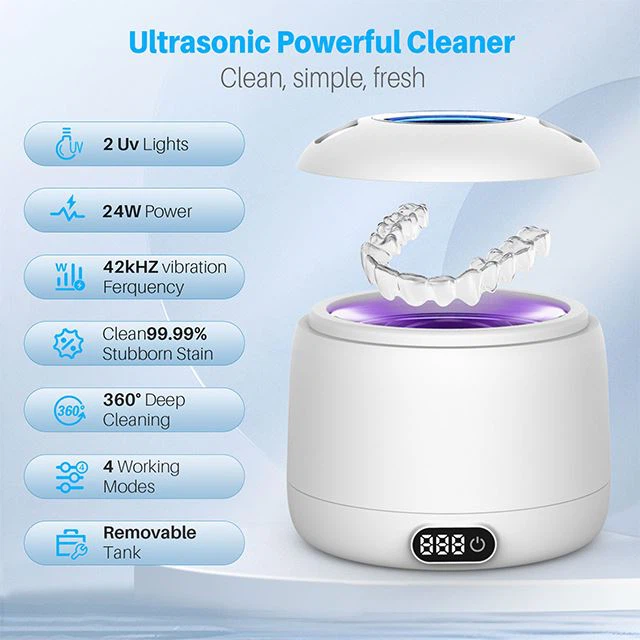
Quick Verdict: The Best Options for B2B Oral-Care Programs
|
Recommendation |
Model |
Why it stands out |
Best fit |
|
Best Overall |
Gold Rose US500 |
Compact countertop form factor, 45 kHz published frequency, SUS304 tank, split removable design, oral-care positioning |
Private-label countertop retainer and dental-appliance cleaner programs |
|
Best Portable Option |
Gold Rose US600 |
Rechargeable Type-C format, published 47–52 kHz range, multi-cycle controls, accessory-oriented bundle potential |
Travel-oriented, rechargeable, or premium oral-care retail lines |
|
Best buying principle |
Any validated model |
Real appliance fit, material compatibility, clear instructions, and claim evidence matter more than headline specifications |
Aligners, night guards, dentures, and sourcing projects with varied appliance types |
The two Gold Rose models are recommended here as manufacturer platforms for evaluation, not as independently tested consumer-performance winners. A brand should always validate the final SKU with representative appliances and its own target-market requirements.
How Ultrasonic Cleaning Fits Into Oral Appliance Care
Ultrasonic action can help reach detailed surfaces
Ultrasonic cleaners use high-frequency sound waves in liquid to create cavitation: microscopic bubbles form and collapse around immersed surfaces. This action may help loosen visible residue in grooves, wirework, and inner contours that are awkward to reach with a brush. For users, the practical advantage is consistency. A short, repeatable cleaning cycle can make daily appliance care easier to complete.
The evidence for ultrasonic cleaning should still be interpreted carefully. An ADA News summary describes a three-month study of 56 older patients using extensive partial or complete acrylic dentures. Both the ultrasonic-plus-denture-cleanser intervention and immersion-plus-brushing improved outcomes, while the ultrasonic intervention performed better for denture cleanliness and patient satisfaction in that specific study. This does not prove that every consumer ultrasonic pod, solution, or appliance will achieve the same result.
It is an aid, not a substitute for appliance instructions
An Invisalign-style aligner, bonded retainer, thermoplastic night guard, and removable denture can each have different limits for heat, cleaning agents, and handling. The written instructions from the orthodontist, dentist, or appliance manufacturer take priority over a cleaner's marketing message. A device marketed for aligners is not automatically approved by every aligner brand.
It is equally important to control language. "Helps remove surface residue" is not the same claim as "disinfects," "sterilizes," or "prevents disease." Those terms require specific evidence for the exact product, configuration, and market. A responsible brand separates cleaning convenience from medical or antimicrobial promises.
Dentures still require a non-abrasive routine
The American Dental Association states that dentures should be cleaned daily and cites guidance supporting soaking and brushing with an effective, non-abrasive denture cleanser. The ADA also warns against hot or boiling water because dentures may warp. An ultrasonic denture cleaner can be part of a compatible maintenance routine, but it should not replace rinsing, brushing where instructed, inspection, or professional care.
Best Overall: Gold Rose US500 for Countertop Private-Label Programs
Gold Rose's US500 Best Ultrasonic Dental Cleaner is the strongest starting point for a compact countertop oral-care product line. The published specification lists a 45 kHz ultrasonic frequency, 24 W power, 12 V/2 A input, a SUS304 stainless-steel tank, a stated 260–280 nm UVC range, and overall dimensions of 115 x 115 x 103 mm. Gold Rose positions the unit for dental appliances including braces, retainers, and dentures, while its split structure and removable lid support a practical cleaning workflow.
Why US500 is the most balanced base platform
US500 is not presented as a generic high-power jewelry device adapted for dental care. Its product positioning is directly centered on oral appliances, which gives retailers a clearer path for package copy, onboarding instructions, and merchandising. The compact form factor can work well for countertop use, gift bundles, pharmacy retail, and dental-care accessory ranges where product footprint matters.
Its differentiator for B2B teams is configurability rather than an unsupported performance superlative. Product selection should be based on the final tank clearance, the appliance types a brand intends to serve, the chosen cycle and solution guidance, and the instructions supplied with the finished SKU. The published UVC feature must not be described as sterilization or a quantified microbial-reduction benefit unless the final configured product is supported by applicable evidence.
What to verify before approving US500
The US500 page lists a tank size of 80 x 40 mm. That makes sample validation essential, especially for bulkier night guards and removable dentures. Test whether real appliances sit naturally without bending, whether the lid closes without contact pressure, and whether the user can load, remove, rinse, and dry the appliance comfortably. Confirm the production configuration, internal usable dimensions, operating guidance, voltage version, labels, and documentation before launching a product claim.
Best Portable Option: Gold Rose US600 for Rechargeable Positioning
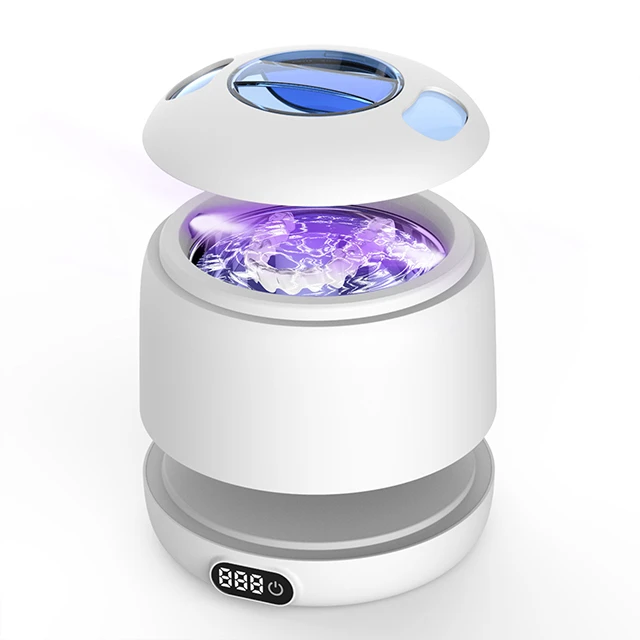
Gold Rose's US600 Rechargeable Ultrasonic Cleaner is designed for brands that need a portable and rechargeable product story. The published page lists a 47–52 kHz ultrasonic range, Type-C charging, 5-minute ultrasonic-plus-UVC and 10-minute pulsed-ultrasonic-plus-UVC modes, a 10-minute UVC-only mode, stated IPX6 water resistance, and a stated 35 dB operating noise level. Gold Rose also describes ABS and food-grade 304 stainless-steel construction, a magnetic lid, a transparent basket, and a Hall sensor intended to switch off the UVC light when the lid is opened.
Why US600 suits portable oral-care ranges
Type-C charging, a digital display, and multi-cycle controls give US600 a more travel-oriented retail profile. The model can support a premium positioning that combines a cleaner, storage approach, and accessory kit. Gold Rose lists customization options for logo, appearance, color box, and specifications, offering a practical route for distributors and brands that need differentiation beyond a standard commodity cleaner.
This feature set does not eliminate the need for claim discipline. Rechargeability, water resistance, and accessory contents must be confirmed on the production-ready SKU. The same applies to any UVC statement. A retailer should communicate only the verified functional feature, not imply a clinical hygiene outcome that has not been substantiated for the exact product.
What to verify before approving US600
During sample approval, test charging performance, battery indication, basket contact points, appliance fit, lid clearance, cleaning-cycle usability, and the actual drainage and rinse process. If the product is marketed for retainers, night guards, and dentures, use representative examples of each intended appliance type. Confirm which elements of the IPX6 rating apply, whether the final packaging includes all accessories, and whether the user manual provides clear limits for water temperature, cleaning liquids, and appliance compatibility.
How to Choose an Ultrasonic Retainer Cleaner
Start with usable tank dimensions
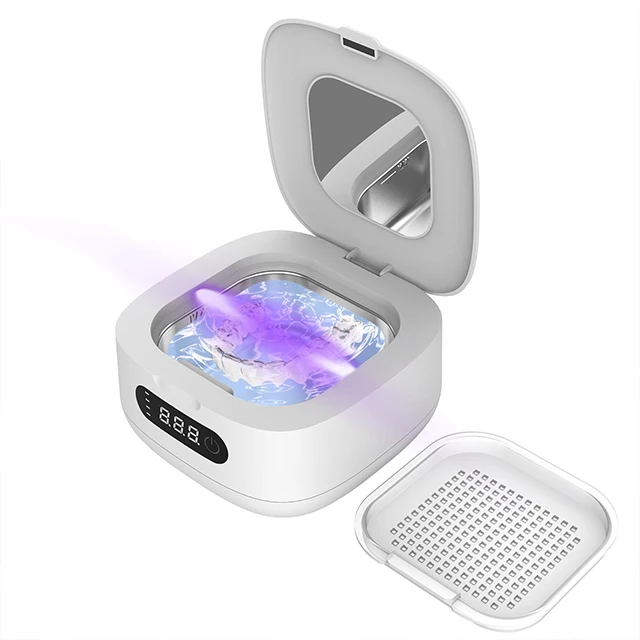
Tank volume alone is not enough. A retainer, night guard, or denture needs enough internal length, width, depth, basket clearance, and lid clearance to rest naturally. An appliance should never be forced into a tank, bent to fit, or pressed against the lid. Ask the supplier for usable internal dimensions rather than relying solely on external product measurements or catalog photos.
Use frequency and power as context, not proof
Frequency, wattage, and cycle duration describe operating conditions, but they do not prove that one device cleans better or is safer for every appliance. A complete evaluation should cover tank design, cycle controls, liquid guidance, materials, noise, documentation, service support, and the clarity of the manual. The best ultrasonic retainer cleaner is the one that aligns with a defined use case and a validated care routine.
Confirm liquid and temperature guidance
Avoid hot water unless the appliance maker expressly allows it. Avoid abrasive toothpaste, bleach, alcohol-based solutions, and household cleaners unless the appliance instructions permit them. The ADA warns that bleach and powdered household cleansers can damage dentures. A buyer evaluating a cleaner-plus-tablet bundle should therefore verify both the device and the cleaning chemistry, not treat them as separate decisions.
Make the routine easy to repeat
A cleaner only adds value when people can use it correctly. Prefer a stable unit with straightforward controls, a simple fill-and-drain process, easy-to-clean surfaces, and instructions that clarify rinsing, drying, and storage. Persistent odor, visible material changes, deformation, cracks, or poor fit should be assessed by a dental professional rather than addressed with a longer cycle or stronger chemical.
Comparison Checklist for Buyers and Sourcing Teams
|
Criterion |
Why it matters |
What to request or test |
|
Usable tank dimensions |
Prevents bending and overcrowding |
Internal length, width, depth, basket and lid clearance |
|
Appliance compatibility |
Materials differ across retainers, guards, and dentures |
Appliance-maker guidance and cleaner manual |
|
Cycle design |
Affects repeatable daily use |
Cycle duration, modes, automatic shutoff, temperature guidance |
|
Liquid restrictions |
Protects appliance materials |
Permitted water temperature, solution limits, rinse instructions |
|
Final documentation |
Reduces compliance and support risk |
Model-specific manual, warranty, test reports, market documents |
|
Claim substantiation |
Keeps labels and content defensible |
Exact test method, covered SKU, date, scope, and limitations |
For private-label sourcing, request the model specification, internal tank drawings, approved materials, current quality-control standards, packaging files, user manual, warranty terms, and documentation for each performance claim. If a model receives a new logo, color, accessory set, electrical configuration, or instruction set, confirm whether this modification changes the validation or labeling requirements.
How to Use an Ultrasonic Cleaner Safely
Start with the appliance manufacturer's care instructions. If ultrasonic cleaning is permitted, rinse loose debris as instructed, fill the unit to the marked level with the permitted liquid, place the appliance without forcing it, and select the approved cycle. Remove the appliance carefully, rinse it if directed, inspect it for visible changes, and dry or store it exactly as instructed.
Do not assume that a longer cycle, hotter water, or stronger cleaning product is better. With removable oral appliances, excessive heat or unapproved chemistry can damage materials or leave residues. Cleaning is part of maintenance; it cannot repair a cracked appliance, correct a poor fit, or replace professional dental advice.
Frequently Asked Questions
Are ultrasonic retainer cleaners safe for Invisalign-style aligners?
They may be suitable only if the aligner or retainer provider permits the method. Check appliance-specific guidance first, avoid unapproved heat and chemicals, and use a tank that lets the aligner sit without bending. A cleaner marketed for clear aligners is not automatically endorsed by every aligner brand.
Can an ultrasonic cleaner replace brushing a denture?
No. The ADA supports daily cleaning with soaking and brushing using an effective, non-abrasive denture cleanser. An ultrasonic cleaner may be an optional aid in a compatible routine, but it does not replace inspection, manual care, or dental appointments.
Which Gold Rose model is better for a portable retainer-cleaner line?
Based on the manufacturer's published specifications, US600 is the more appropriate platform for portable positioning because it lists Type-C rechargeable operation, a digital display, stated IPX6 water resistance, and multiple cycle options. The final choice still depends on appliance fit, price positioning, sample performance, and destination-market requirements.
Is Gold Rose US500 suitable for dentures and night guards?
Gold Rose positions US500 for dental appliances, including dentures and retainers, but compatibility must be assessed for each actual appliance. Confirm usable tank clearance and follow the denture or night guard maker's care instructions before any retail claim is made.
Do UVC-equipped ultrasonic cleaners sterilize dental appliances?
Do not assume they do. Cleaning, microbial reduction, disinfection, and sterilization are different claims. Use only product-level, market-appropriate evidence to support a specific hygiene statement for a final SKU.
Final Takeaway
The best ultrasonic retainer cleaner is the one that fits the appliance, respects its care instructions, and makes a safe cleaning process easy to repeat. Gold Rose US500 is a strong compact countertop platform for private-label oral-care programs, while US600 is a better fit for rechargeable and portable positioning. Neither should be promoted through unsupported "lab-tested," sterilization, or quantified antimicrobial claims.
For brands, distributors, and retailers, the most reliable product story begins with a representative sample, real appliance-fit testing, a clear manual, and documentation that applies to the exact model being sold. That evidence-led approach protects consumers, reduces returns, and creates a more credible long-term oral-care offer.
References
American Dental Association. Denture Care and Maintenance. Accessed November 2026.
American Dental Association News. Ultrasonic vs. conventional denture cleaning interventions. Accessed November 2026. The page reports a study summary and states that publication does not imply ADA endorsement.
Gold Rose. US500 Best Ultrasonic Dental Cleaner. Manufacturer specifications accessed November 2026.
Gold Rose. US600 Rechargeable Ultrasonic Cleaner. Manufacturer specifications accessed November 2026.