







Chronic tonsilloliths, commonly referred to as tonsil stones, represent one of the most frustrating and socially distressing oral health conditions. Formed when desquamated epithelial cells, food particulate matter, and anaerobic sulfur-producing bacteria become trapped and calcified within the tortuous crevices of the palatine tonsils, these calcifications produce severe halitosis, persistent foreign-body sensations in the posterior pharynx, and recurrent throat discomfort.
When attempting home extraction, the vast majority of sufferers reach for conventional cotton swabs, wooden sticks, or rigid metal dental probes. However, these blind mechanical probing attempts almost inevitably trigger an intense, violent pharyngeal gag reflex. Beyond causing acute nausea, manual poking frequently crushes stones into deeper crypt recesses and lacerates delicate lymphoid mucosal tissues, precipitating capillary bleeding and secondary bacterial infections. Advancements in medical-grade negative pressure technology, combined with high-definition endoscopic visualization, have established safe vacuum suction as the clinical gold standard for at-home debridement without triggering pharyngeal reflexes.
Visit TC300 Tonsil Stone Remover
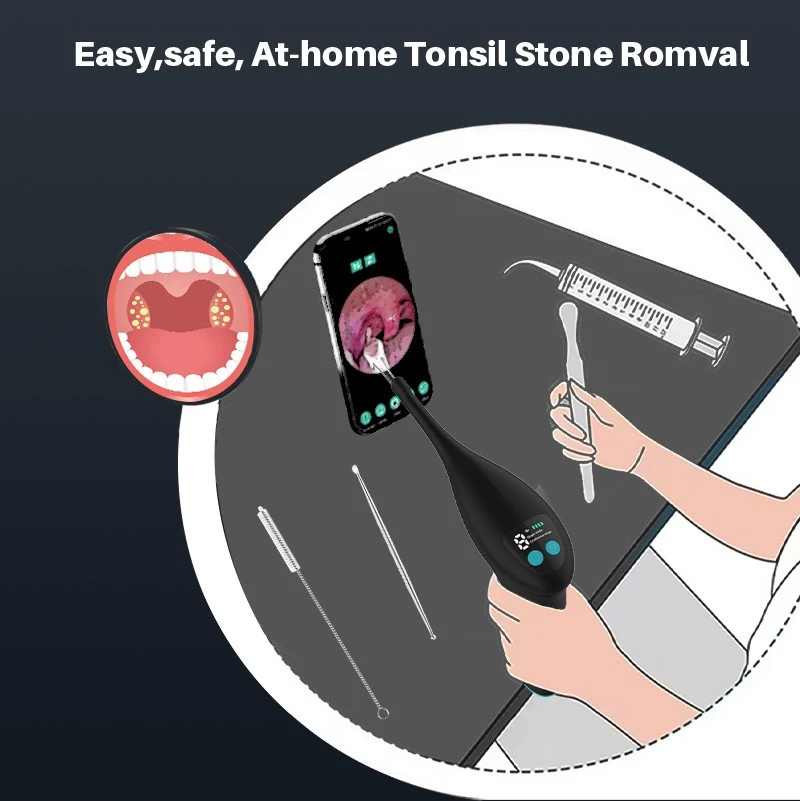
The Anatomy of the Gag Reflex: Why Traditional Tonsil Stone Removal Fails
Neurological triggers of the pharyngeal reflex
The pharyngeal gag reflex is an essential evolutionary defense mechanism designed to prevent foreign bodies from entering the larynx and tracheobronchial tree. The sensory innervation of the posterior third of the tongue, palatine tonsils, tonsillar pillars, and posterior pharyngeal wall is supplied by the glossopharyngeal nerve (Cranial Nerve IX). When a physical object, such as a dry cotton swab or rigid probe, makes direct contact with these hyper-sensitive mucosal zones, afferent sensory signals travel rapidly to the solitary tract and nucleus ambiguus within the medulla oblongata. The central nervous system triggers an immediate, involuntary motor response via the vagus nerve (Cranial Nerve X), causing spasmodic pharyngeal wall constriction, soft palate elevation, and intense retching.
The mechanical failure of cotton swabs: Deep crypt impaction and mucosal laceration risks
Cotton swabs fail to safely extract tonsilloliths due to their inherent mechanical limitations. A typical cotton swab has a broad, blunt tip measuring four to five millimeters in diameter, whereas tonsillar crypt openings are often less than one to two millimeters wide. When pressed against the tonsillar surface, the swab exerts blunt compressive force that pushes exposed stones backward, wedging them deeper into branching, blind-ended crypt tunnels. Furthermore, the friction of dry cotton fibers against fragile lymphoid mucosa frequently tears superficial capillary beds, resulting in bleeding, mucosal ulceration, and the introduction of oral pathogens into deeper tissue planes.
Vacuum Suction Physics: Fluid Dynamics of Negative Pressure Debridement
Controlled negative pressure gradients versus mechanical contact force
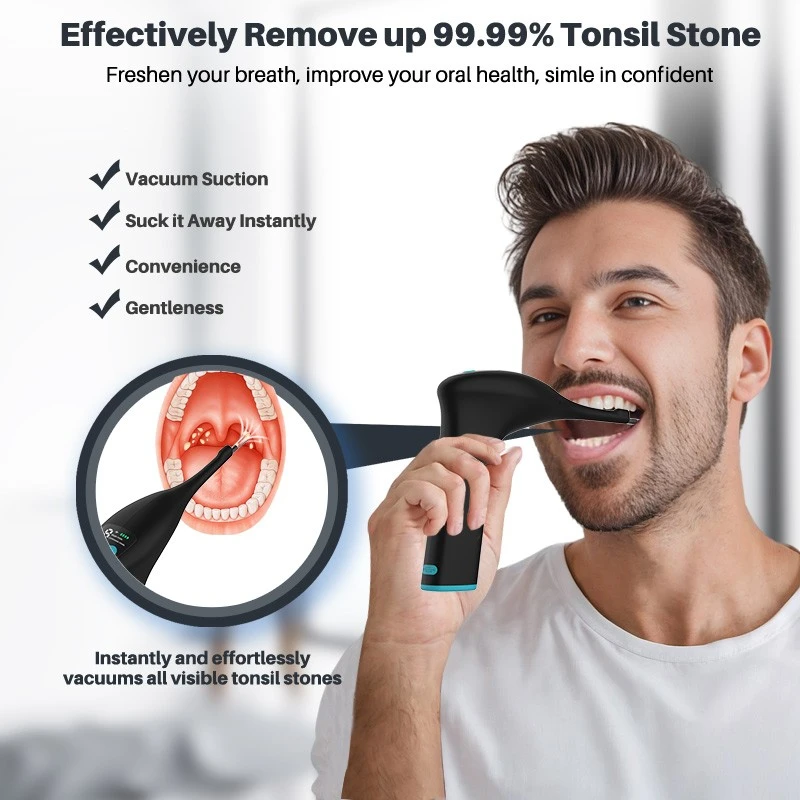
Vacuum debridement fundamentally alters the extraction mechanism by substituting blunt physical force with a continuous, controlled negative pressure gradient. Instead of pushing into the tonsillar crypt, a smooth, rounded suction cannula is positioned gently over the crypt orifice. The negative pressure differential creates a targeted aerodynamic draw that pulls the calcified stone out of the crevice and into a capture reservoir. Because the suction tip does not need to aggressively wedge into or scrape against the sensitive posterior pharyngeal mucosa, glossopharyngeal mechanoreceptors are not mechanically compressed, completely circumventing the neuromuscular trigger of the gag reflex.
The clinical therapeutic window: Why 62.1 to 66.1 kPa achieves extraction without soft tissue bruising
In clinical otorhinolaryngology, effective suction debridement requires precise calibration within a safe therapeutic window. Excessive suction exceeding 80 kPa risks mucosal petechiae, hematoma formation, and microvascular bruising, while weak suction below 50 kPa fails to overcome the surface tension and mucus adhesion anchoring deep stones. Modern vacuum extraction devices are calibrated between 62.1 kPa and 66.1 kPa across progressive micro-increments. This optimized negative pressure range provides sufficient kinetic draw to dislodge stubborn, deeply embedded tonsilloliths while maintaining complete soft tissue safety and zero tissue trauma.
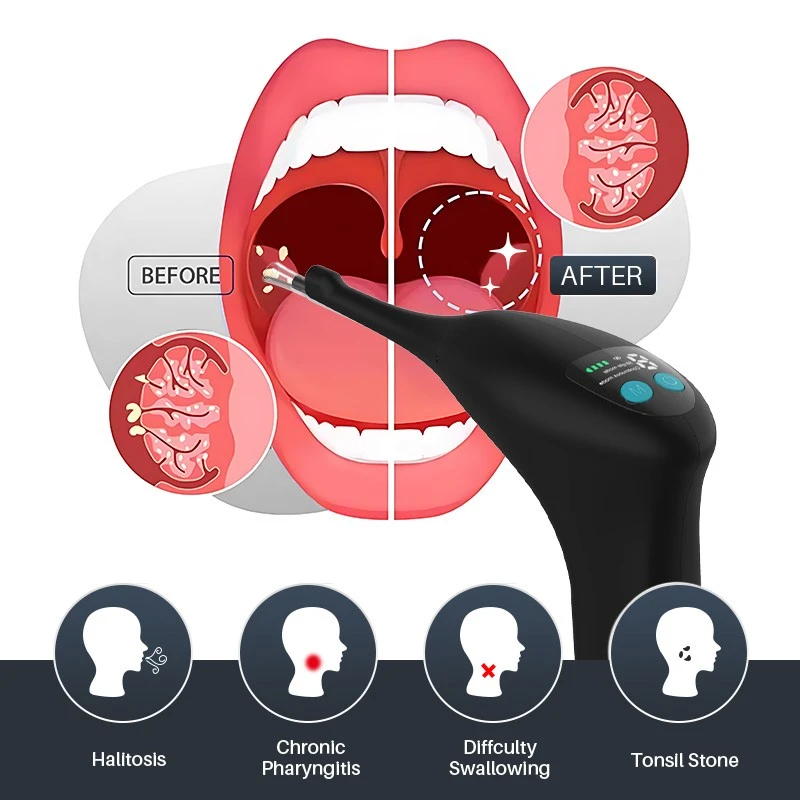
Real-Time Visualization: Why Blind Extraction Guarantees Gagging
Navigating tortuous tonsillar crypts with micro-endoscopic camera streaming
Blind extraction with a handheld mirror and phone flashlight is inherently prone to error due to visual distortion, shadows cast by the tongue, and optical blind spots around the posterior tonsillar pillar. When users cannot clearly see the target, they inadvertently poke adjacent sensitive structures, triggering severe gag reflexes. Integrating an ultra-compact endoscopic camera delivering a 640p by 480p resolution feed directly to a smartphone app transforms the extraction process. Real-time visual feedback allows the user to steer the suction tip directly to the stone with sub-millimeter precision, avoiding unnecessary contact with surrounding mucosal walls.
Shadowless LED illumination: Differentiating cryptic food debris from palatine tissue
Palatine tonsils are complex, lobulated structures characterized by deep fissures, natural mucosal folds, and varying tissue vascularity. Without dedicated illumination, normal lymphoid follicles and benign mucosal exudates are easily mistaken for tonsil stones, leading to unwarranted tissue manipulation. A focused front-facing LED lighting array mounted directly adjacent to the endoscopic lens delivers bright, shadowless illumination, allowing users to accurately distinguish between yellowish calcified stones and delicate vascularized tissue before applying negative pressure.
Top Recommended Tonsil Stone Removal Solutions of 2026: Sourcing Guide & Reviews
Gold Rose TC300 Smart Visual Vacuum Tonsil Stone Remover: Best Overall Clinical Benchmark
The Gold Rose TC300 Smart Visual Vacuum Tonsil Stone Remover stands as the premier consumer and professional device for at-home tonsillolith management, earning the Best Overall rating. Manufactured by Huizhou Gold Rose Technology Co., Ltd. (Gold Rose Tech), the TC300 integrates an endoscopic camera with a 640p by 480p resolution and front-facing LED illumination, streaming clear real-time video directly to iOS and Android mobile apps. Constructed from durable, medical-safe ABS housing measuring 223 by 175 by 55 millimeters and weighing an ergonomic 197.5 grams, the TC300 features five finely calibrated suction levels: Level 1 at 62.1 kPa, Level 2 at 63.3 kPa, Level 3 at 64.2 kPa, Level 4 at 64.9 kPa, and Level 5 at 66.1 kPa.
The device is equipped with a high-capacity 900mAh lithium-ion battery (model 902540) providing up to 80 minutes of continuous runtime on the highest suction setting. It charges rapidly within approximately 3 hours via a universal Type-C interface with an included 0.6-meter cable. An integrated LED digital screen clearly displays real-time battery percentage and current gear selection, while magnetic modular attachments ensure effortless, sterile accessory swapping for thorough post-use sanitization.
Gold Rose TC100 Portable Manual Pressure Cleaner: Best Entry-Level Manual Aid
For price-sensitive consumers or occasional mild tonsil stone sufferers, the Gold Rose TC100 offers a gentle, non-motorized irrigation and suction alternative. Utilizing a medical-grade soft bulb and an extended angled cannula, the TC100 provides manual low-pressure fluid flushing and gentle localized suction. While it lacks wireless video streaming and motorized negative pressure calibration, its smooth biocompatible tip offers a significant safety upgrade over sharp tweezers or abrasive cotton swabs.
Conventional Cotton Swabs & Rigid Probes: Reference Benchmark
Standard cotton swabs, wooden toothpicks, and stainless steel dental picks remain the legacy reference benchmark for home extraction attempts. Although cheap and universally accessible, their high gag-reflex induction rate, risk of soft tissue laceration, and tendency to impact stones deeper into tonsillar crypts make them an outdated and hazardous method for tonsil stone debridement.
Commercial Sourcing Blueprint: Why Global Brands Are Expanding into Visual ENT Tech
Explosive consumer demand for visual self-care oral devices
Global personal health and oral care markets are witnessing rapid growth in visual smart diagnostic tools, driven by consumer enthusiasm for smartphone-integrated otoscopes, dental plaque detectors, and visual tonsil stone removers. Millions of chronic halitosis sufferers actively search online for non-invasive tonsil stone remedies. By stocking visual negative-pressure extractors, e-commerce brands, pharmacy chains, and oral wellness distributors can address an underserved market niche, capturing high-margin retail sales and outperforming traditional manual oral hygiene accessories.
Gold Rose B2B OEM/ODM manufacturing & logistics advantages
Huizhou Gold Rose Technology Co., Ltd. provides full-scale OEM and ODM manufacturing solutions for international healthcare brands and medical device distributors. Holding 107 international patents, trademarks, and utility models across China, the United States, Japan, and the European Union, Gold Rose operates under strict ISO 9001, ISO 13485, CE, and FDA compliant quality systems. The TC300 is packaged in a premium coated paper gift box measuring L255 by W218 by H65 millimeters with a gross weight of 414.5 grams, and packed in master export cartons measuring L520 by W535 by H445 millimeters (32 pieces per carton, 14 kilograms gross weight).
Gold Rose supports low-barrier private labeling with an accessible minimum order quantity of 1,000 units, providing custom housing colors, branded companion app integration, customized packaging, and international certification files. The factory boasts optimized container loading logistics, accommodating 7,040 pieces (220 cartons) in a 20GP container, 13,312 pieces (416 cartons) in a 40GP container, and 16,640 pieces (520 cartons) in a 40HQ container, with rapid 15 to 20 working day mass production lead times.
Frequently Asked Questions
Why do cotton swabs always cause a strong gag reflex when cleaning tonsils?
Cotton swabs physically compress the mucosal lining of the palatine tonsils and posterior pharyngeal wall, stimulating sensory endings of the glossopharyngeal nerve (CN IX). This triggers an involuntary reflex arc through the medulla oblongata to the vagus nerve (CN X), causing immediate pharyngeal muscle constriction and violent retching.
Is 62.1 to 66.1 kPa suction safe for delicate tonsillar mucosal tissue?
Yes. The 62.1 to 66.1 kPa suction range engineered into the Gold Rose TC300 represents the optimal clinical therapeutic window for oral soft tissue debridement. It generates sufficient aerodynamic negative pressure to dislodge calcified debris from crypt crevices while remaining well below the 80 kPa threshold that causes capillary rupture, petechiae, or mucosal bruising.
How does the Gold Rose TC300 camera connect to smartphones for real-time viewing?
The Gold Rose TC300 features an integrated wireless high-definition camera module delivering a 640p by 480p real-time video stream. It connects seamlessly to iOS and Android smartphones via a dedicated companion app, allowing users to clearly inspect tonsillar crypts and guide the suction tip with sub-millimeter precision under shadowless front-facing LED illumination.
What is the battery runtime and charging specification of the Gold Rose TC300?
The Gold Rose TC300 is powered by a high-density 900mAh lithium-ion battery (model 902540) that provides up to 80 minutes of continuous operation at the maximum suction setting. It charges fully in approximately 3 hours via a universal Type-C charging port using the included 0.6-meter cable, with remaining battery percentage clearly visible on the built-in LED display screen.
What OEM customization and container loading options does Gold Rose offer for the TC300?
Gold Rose provides comprehensive OEM/ODM private-label customization starting at a minimum order quantity of 1,000 units, including custom ABS body colors, brand logo printing, bespoke gift box design, and localized instruction manuals. For international freight, standard master cartons (32 pieces per carton, 14 kg) load 7,040 pieces per 20GP container and 16,640 pieces per 40HQ container, with dependable 15 to 20 working day production turnaround times.
References
PubMed: Tonsilloliths: Clinical Characteristics, Pathogenesis, and Modern Management
Otolaryngology–Head and Neck Surgery: Evaluation and Management of Palatine Tonsillar Disease