






The landscape of children's oral health is evolving. In late 2025, the U.S. Food and Drug Administration (FDA) announced new enforcement actions targeting certain unapproved ingestible fluoride drug products marketed for children. The decision has sparked widespread discussion among parents, dental professionals, oral care brands, and health advocates.
As consumers become more informed about oral hygiene and ingredient safety, many families are looking beyond traditional fluoride-based approaches and exploring alternative ways to support healthy teeth and gums. One category attracting increasing attention is the electric dental flosser-a fluoride-free interdental cleaning solution designed to help remove plaque and food debris through gentle vibration technology.
This article explores the FDA's recent announcement, the changing conversation around fluoride use, and why preventive oral care tools such as electric dental flossers are becoming an important part of modern oral hygiene routines.
Understanding the FDA's New Action on Ingestible Fluoride Products
The FDA recently announced its intention to restrict the sale of certain unapproved ingestible fluoride prescription products intended for children. According to the agency, these products have been used for decades without undergoing the modern FDA approval process for safety, effectiveness, and quality evaluation.
The agency stated that it is focusing on products marketed for children under three years of age and certain older children who are not considered at high risk for tooth decay.
This action follows a broader review of fluoride-related research and public health discussions involving clinicians, researchers, parents, and federal health organizations. The FDA also released scientific evaluations examining both the potential benefits and possible risks associated with ingestible fluoride products.
For many families, this announcement serves as a reminder that oral health decisions should be based on current scientific evidence and individual needs rather than long-standing assumptions.

Why Fluoride Has Become a Topic of Discussion
Fluoride has been used in various dental products for decades because of its role in helping protect tooth enamel. However, recent discussions have expanded beyond dental benefits to examine possible systemic effects associated with fluoride ingestion.
The Difference Between Topical and Ingestible Fluoride
One important distinction is the difference between topical fluoride and ingestible fluoride.
Topical fluoride is applied directly to the surface of teeth through products such as toothpaste, varnishes, and certain dental treatments. Its primary purpose is to strengthen enamel where it is applied.
Ingestible fluoride products, however, are swallowed and absorbed through the body. Because they enter the digestive system, researchers continue to study their broader effects beyond oral health.
The FDA's recent action specifically focuses on ingestible fluoride products rather than all forms of fluoride used in dentistry.
Growing Interest in Preventive Oral Care
Modern oral health strategies increasingly emphasize prevention rather than treatment.
Instead of focusing solely on managing cavities after they occur, consumers are paying greater attention to daily habits that help reduce plaque buildup and support healthier gums.
This shift has led to growing interest in tools and technologies that improve cleaning effectiveness without relying solely on chemical ingredients.
As a result, products such as electric toothbrushes, UV dental appliance cleaners, ultrasonic cleaners, and electric dental flossers are gaining popularity worldwide.
Why Plaque Removal Remains the Foundation of Oral Health
Most Oral Problems Begin with Plaque Accumulation
Dental professionals widely recognize plaque as one of the primary contributors to common oral health concerns.
Plaque is a sticky biofilm made up of bacteria, food particles, and saliva. When left undisturbed, it can accumulate along the gumline and between teeth, areas that are often difficult to reach with a toothbrush alone.
Over time, plaque buildup may contribute to:
- Bad breath
- Gum irritation
- Gingivitis
- Tooth decay
- Periodontal concerns
Effective plaque control remains one of the most important daily oral hygiene practices regardless of whether fluoride products are used.
Brushing Alone Is Not Enough
Many people assume that brushing twice per day provides complete oral cleaning.
However, toothbrush bristles cannot fully reach the tight spaces between teeth where plaque frequently accumulates.
Research consistently shows that interdental cleaning plays a critical role in maintaining oral health. This is why dental professionals often recommend flossing as part of a complete oral hygiene routine.
The challenge is that many consumers find traditional string floss inconvenient, uncomfortable, or difficult to use consistently.
The Rise of Electric Dental Flossers
A Modern Alternative to Traditional Flossing
Electric dental flossers have emerged as an innovative solution for people seeking a more convenient way to clean between teeth.
Unlike water flossers that rely on pressurized water streams, electric dental flossers use vibration technology to assist the flossing process.
The vibrating motion helps guide floss smoothly between teeth while improving the removal of trapped food particles and plaque.
For many users, this technology makes flossing feel faster, easier, and more comfortable than traditional manual floss.
Designed for Everyday Oral Hygiene
Modern electric dental flossers are designed to fit naturally into daily oral care routines.
Common features include:
- High-frequency vibration technology
- Portable cordless designs
- Rechargeable batteries
- Ergonomic handles
- Multiple cleaning modes
- Replaceable floss heads
These features make them suitable for home use, travel, and workplace routines.
As consumers become increasingly interested in fluoride-free oral care approaches, electric flossers offer a mechanical cleaning method that supports oral hygiene without relying on ingestible ingredients.
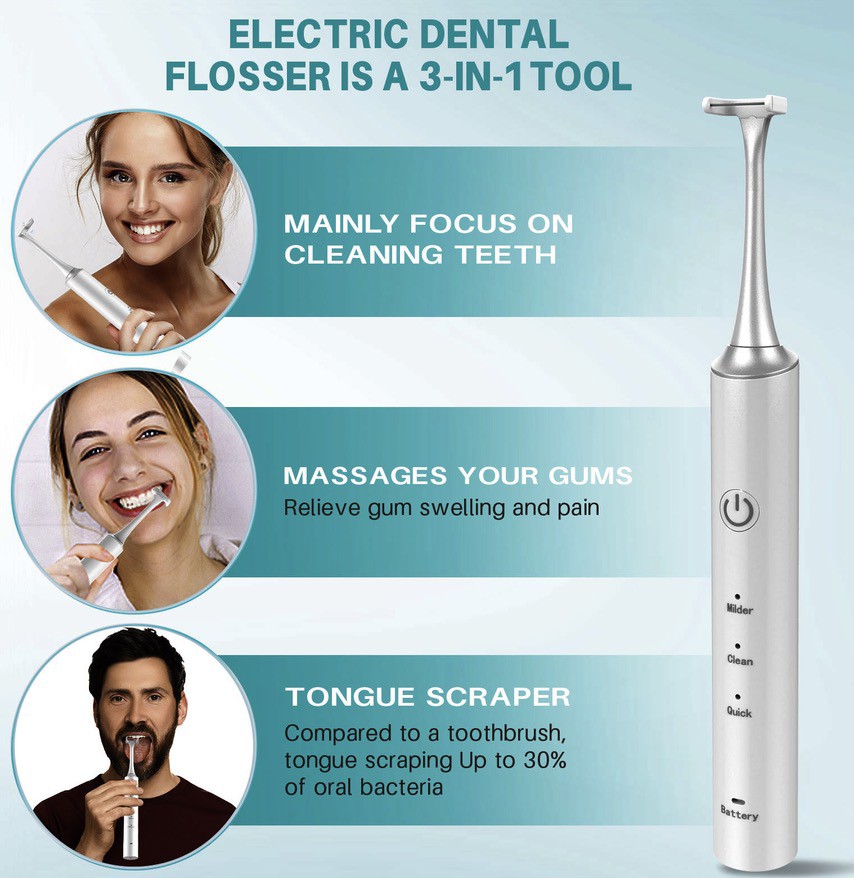
Why Fluoride-Free Cleaning Solutions Are Gaining Attention
Supporting Oral Hygiene Through Mechanical Cleaning
Good oral health depends on more than any single ingredient.
Daily habits such as brushing, flossing, rinsing, and regular dental visits remain essential for maintaining healthy teeth and gums.
Electric dental flossers support these habits by helping users clean areas that toothbrushes often miss.
Because they focus on physical plaque removal rather than chemical treatment, they have become increasingly attractive to consumers seeking fluoride-free oral care options.
Ideal for Modern Lifestyle Needs
Today's consumers want products that combine effectiveness, convenience, and simplicity.
Electric flossers address several common barriers to regular flossing:
- Easier to use than string floss
- Travel-friendly design
- Suitable for busy schedules
- Comfortable for many users
- Simple charging and maintenance
These benefits can encourage more consistent oral hygiene habits over time.
Choosing the Right Electric Dental Flosser
Look for Comfortable Vibration Technology
The best electric dental flossers provide effective cleaning while remaining gentle on sensitive gums.
Multiple intensity settings allow users to customize the experience according to their comfort level.
Consider Battery Life and Portability
Long battery life is particularly valuable for travelers and daily users.
Rechargeable models with USB charging offer additional convenience.
Evaluate Product Quality
When selecting an electric dental flosser, look for features such as:
- Durable construction
- Ergonomic design
- Replaceable floss heads
- Reliable battery performance
- Safety certifications
- Positive user reviews
Quality design can contribute to both user satisfaction and long-term value.
The Future of Oral Care Is Prevention-Focused
The FDA's recent action highlights a broader trend occurring throughout the oral care industry: increasing emphasis on prevention, evidence-based decision-making, and consumer education.
Families today have access to more oral health information than ever before. Rather than relying solely on traditional approaches, many are combining proven daily hygiene habits with innovative cleaning technologies.
Electric dental flossers represent one example of this evolution. By helping users clean between teeth more effectively and consistently, they support one of the most fundamental principles of oral care-removing plaque before it becomes a larger problem.
As research continues and oral health recommendations evolve, preventive tools that encourage healthy daily habits are likely to remain at the center of modern dental care strategies.

Conclusion
The FDA's action regarding certain unapproved ingestible fluoride products has encouraged many families to take a closer look at their oral care routines and product choices.
While fluoride discussions continue within the scientific and dental communities, one fact remains clear: effective plaque removal is essential for maintaining healthy teeth and gums.
Electric dental flossers offer a convenient, fluoride-free approach to interdental cleaning by helping users remove food particles and plaque from hard-to-reach areas. When combined with regular brushing, healthy dietary habits, and professional dental care, they can play an important role in a comprehensive oral hygiene routine.
As consumers increasingly prioritize preventive care and informed decision-making, innovative oral care technologies are helping shape the future of healthier smiles.
Frequently Asked Questions
1. What is the FDA's recent action regarding fluoride products?
The FDA announced enforcement actions targeting certain unapproved ingestible fluoride drug products marketed for children, particularly those intended for younger children and those not considered at high risk for tooth decay.
2. Is an electric dental flosser the same as a water flosser?
No. An electric dental flosser uses vibration-assisted flossing technology, while a water flosser uses a stream of pressurized water to clean between teeth.
3. Can an electric dental flosser replace brushing?
No. Electric flossers are designed to complement brushing by cleaning areas between teeth that toothbrushes may not effectively reach.
4. Are electric dental flossers suitable for daily use?
Yes. Most electric dental flossers are designed for everyday oral hygiene and can be incorporated into regular flossing routines.
5. Why are more consumers interested in fluoride-free oral care products?
Many consumers are exploring fluoride-free oral care options as part of broader efforts to simplify ingredients, focus on preventive hygiene habits, and make informed health decisions based on evolving research.
References
U.S. Food and Drug Administration (FDA). FDA Actions on Unapproved Ingestible Fluoride Drug Products.
American Dental Association (ADA). Oral Health Topics: Flossing and Interdental Cleaning.
National Institute of Dental and Craniofacial Research (NIDCR). Preventing Cavities and Gum Disease.
Mayo Clinic. Oral Health: A Window to Your Overall Health.
Cochrane Oral Health. Fluoride Interventions for Preventing Dental Caries.
Centers for Disease Control and Prevention (CDC). Oral Health Basics.
Harvard School of Dental Medicine. Daily Oral Hygiene Recommendations.
Cleveland Clinic. The Importance of Flossing for Oral Health.