






For brand owners and distributors entering the oral care market, the gap between a product concept and a certified, shelf-ready ultrasonic cleaner can feel enormous. Sourcing a manufacturer that handles not just production but deep ultrasonic cavitation cleaning technology, regulatory compliance, private-label design, and FBA-ready logistics - all under one roof - is the challenge that defines whether a brand launch succeeds or stalls. Gold Rose's ODM model was built specifically to close that gap, turning your blueprint into a verified batch without the typical delays, quality compromises, or minimum order barriers that plague sourcing from generic factories.
What Is Deep Ultrasonic Cavitation Cleaning - And Why It Matters for Dental Appliances
The Science Behind High-Frequency 45kHz Vibration
Ultrasonic cavitation cleaning operates on a precise physical principle. When a transducer vibrates at high-frequency 45kHz vibration - producing 45,000 pressure cycles per second - it propagates acoustic waves through water inside the tank. Those waves rapidly alternate between compression and rarefaction, generating millions of microscopic bubbles smaller than a human hair. The bubbles expand under negative pressure and then violently implode under positive pressure, releasing intense localised energy jets that blast contaminants - dental plaque, food residue, calculus, and bacterial biofilm - off the surface of any dental appliance in their path.
This cavitation effect is not superficial. The implosions occur at every exposed surface simultaneously, penetrating the micro-geometry of orthodontic hardware, the curved undercuts of aligner trays, and the porous interior of flexible retainers - locations that neither manual brushing nor soaking tablets can reliably reach. Research published in Applied Sonochemistry (Mason & Lorimer, 2002) confirms that acoustic cavitation achieves cleaning energy densities at the substrate surface that no mechanical or chemical method alone can replicate at comparable contact times.
Frequency selection determines the cleaning profile. At 42–45kHz, bubbles are sized to deliver thorough, uniform cleaning of delicate dental appliances without generating the surface abrasion associated with lower industrial frequencies. At 47–52kHz, bubble populations become denser and finer, maximising coverage across complex geometries such as Invisalign tray ridges and Hawley retainer wire joints. Gold Rosa's product lineup calibrates frequency to application - ensuring every ODM variant is engineered to specification rather than defaulting to a one-size-fits-all transducer.

360° All-Round Stain Removal - Reaching Where Brushes Cannot
The practical advantage of acoustic cavitation for dental appliances lies in its geometry-agnostic cleaning action. A conventional toothbrush, regardless of bristle configuration, cannot access the internal lingual surfaces of a full-arch retainer, the cemented bracket undercuts on a fixed appliance, or the clasp-to-tooth contact points on a removable partial denture. These blind zones are precisely where plaque accumulates fastest and bacteria colonise most aggressively.
Ultrasonic cavitation eliminates the concept of a blind zone. Because the implosion energy propagates through liquid rather than requiring physical contact, 360° all-round stain removal is not a marketing claim - it is a direct consequence of the acoustic field's omnidirectional nature. Every surface simultaneously exposed to the cleaning liquid receives equivalent cavitation exposure, regardless of orientation or geometric complexity. For brand partners building products for orthodontic and prosthetic care markets, this cleaning completeness is a clinically meaningful differentiator that supports premium retail positioning.
The Technology Stack Inside a Professional ODM Ultrasonic Cleaner
UV-C Sanitization - Beyond Cleaning to True Sterilization
Deep ultrasonic cavitation cleaning removes physical contaminants with high efficiency. UV-C sanitization function addresses the complementary threat: pathogens that survive as suspended organisms in the cleaning water or that recolonise appliance surfaces after mechanical debris removal.
Gold Rose integrates UV-C lamps operating at 260–280 nm - the wavelength band confirmed to disrupt bacterial DNA replication - into its ultrasonic dental cleaner units. A 2021 study published in PLOS ONE (Luo et al.) demonstrated greater than 99.9% reduction of common oral pathogens, including Streptococcus mutans and Candida albicans, within five minutes of 260–280 nm UV-C irradiation. By combining ultrasonic cavitation (which dislodges and suspends contaminants) with simultaneous UV-C exposure (which neutralises suspended organisms), Gold Rose's dual-mode units deliver a cleaning and sterilisation cycle in a single unattended operation.
For ODM partners, this dual-technology architecture is a product differentiation lever. UV-C sanitization function is now an expected feature in the premium dental care segment, and brands that launch without it face immediate feature-gap comparisons on retail platforms. Gold Rose can configure UV-C parameters - lamp count, wavelength selection, irradiation cycle timing - to your product specification during the ODM design phase.

Stainless Steel Inner Tank - Food-Grade SUS304 for Maximum Safety
The cleaning chamber is the component with the highest sustained chemical and mechanical stress in any ultrasonic cleaner. Lesser manufacturers use ABS plastic tanks that discolour, leach trace compounds into cleaning water, and degrade under repeated thermal cycling. Gold Rose specifies a stainless steel inner tank fabricated from SUS304 food-grade stainless steel across its ultrasonic dental cleaner range.
SUS304 combines corrosion resistance, thermal stability up to 870°C, and complete inertness to the acidic and enzymatic compounds present in dental cleaning tablets. It does not absorb odours, does not develop biofilm-friendly surface texture degradation, and can be sterilised without material compromise. For brand partners targeting the dental clinic and orthodontic practice market - where infection control standards are subject to regulatory scrutiny - a SUS304 tank is not a premium option but a compliance requirement. Gold Rose's ODM process accommodates tank geometry customisation (cylindrical or square footprint, 180 ml to 220 ml capacity) to match the appliance size profile your target market demands.
Compact Design Meets Powerful Performance
The portable dental pod cleaner segment is growing fastest among consumers who use orthodontic appliances and travel regularly - a demographic willing to pay a significant premium for a device that delivers clinical-grade performance in a carry-on-compatible form factor. Gold Rose's flagship US600 model demonstrates that compact travel-friendly design and high-specification performance are not competing priorities.
The US600 integrates a dual-core rechargeable battery supporting up to 10 full cleaning cycles per charge, a Type-C port compatible with standard mobile phone chargers, IPX6 waterproof construction, a magnetic-seal lid with built-in mirror, and a noise output of 35 dB - quieter than a library reading room. The overall footprint remains compact enough for a hotel bathroom counter or a carry-on toiletry bag. For ODM partners, this architecture is available for private-label customisation: colour, surface finish, LOGO engraving, and packaging design can all be specified to brand identity without altering the validated core specification.
Designed Gentle Enough for Daily Use - Even for Sensitive Appliances
Safe for Aligners, Retainers, and Dentures
A frequent concern among end users - and therefore among brand partners evaluating product liability exposure - is whether ultrasonic cavitation at dental appliance frequencies causes material degradation over repeated use cycles. At the frequencies Gold Rose employs (42–52kHz), the answer is clear: the cleaning action is gentle for aligners & dentures when used within the specified cycle parameters.
The US200, operating at 42kHz with 24W output, targets the mechanical cleaning of harder appliances - full dentures, metal retainer frameworks, and sports mouth guards - where stronger cavitation agitation accelerates deposit removal without risk to robust materials. The US600, at 47–52kHz, generates finer, more numerous bubbles with lower individual implosion energy, making it the appropriate specification for daily cleaning of thin thermoplastic aligner trays, Essix retainers, and flexible partial denture bases. Gold Rose's R&D team validates each product specification against material compatibility testing prior to mass production, providing ODM partners with documented evidence for retail compliance submissions.
One-Touch Timed Cleaning - Simplicity That Sells
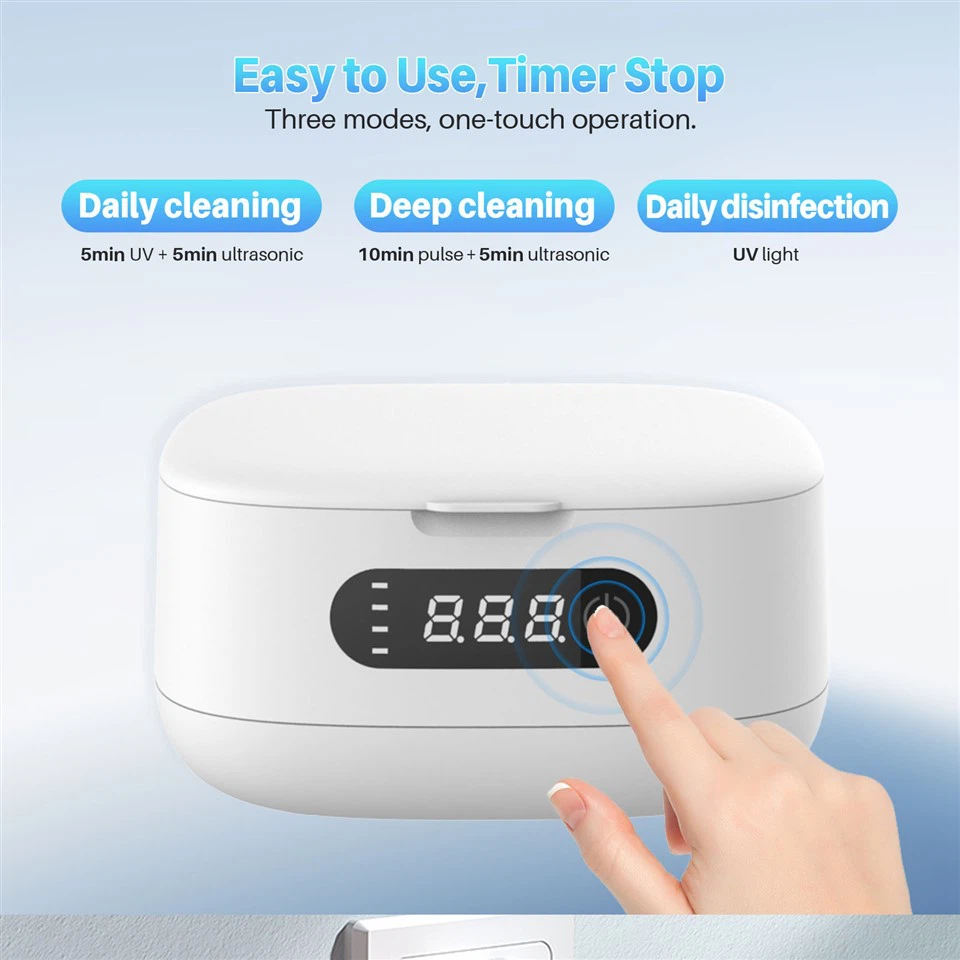
For consumer dental appliance cleaners, operational complexity is a conversion killer. End users who perceive a device as difficult to operate return it, leave negative reviews, or simply stop using it - outcomes that damage brand equity regardless of the underlying product quality. Gold Rose resolves this with one-touch timed cleaning: a single button cycles through cleaning modes and timer settings, with audible beep confirmation at each selection.
The US200 offers selectable 5-minute and 10-minute timer modes - calibrated to light daily soiling and heavier periodic cleaning respectively - and auto-powers off at cycle completion. The US600 adds a UV-only mode for appliances that require sterilisation without mechanical agitation. No app, no pairing process, no instruction manual required for daily operation. For brand partners, this operational simplicity translates directly into lower post-sales support burden and higher repeat-purchase rates - metrics that matter more than initial unit margin in the subscription-adjacent oral care category.
Gold Rose's ODM Process - From Your Blueprint to Batch Delivery
Step 1 - Requirement Consultation and Concept Design
The Gold Rose ODM engagement begins with structured requirement consultation. Brand partners submit their target market profile, desired price point, feature priority list, and any existing design references. Gold Rose's R&D team - comprising senior engineers with an average of over 15 years of industry experience, including alumni from TCL and leading sonic technology firms - translates those commercial inputs into an engineering specification.
Deliverables at this stage include a product concept document covering ultrasonic frequency selection, UV-C configuration, battery or corded power architecture, tank geometry, timer programming, noise target, and waterproof rating. Appearance design proposals are developed in parallel, with 3D renderings provided for brand partner review before any tooling investment is committed. This front-end alignment process prevents the costly late-stage revisions that characterise less disciplined ODM engagements.
Step 2 - Sample Prototyping and Performance Validation
Once the concept specification is approved, Gold Rose produces functional samples within 1 to 3 days for standard configurations, or 15 to 35 days for deep customisation projects involving new mould development. Samples are not aesthetic mockups - they are fully functional units produced on the same equipment and to the same component specifications as the eventual mass-production run.
Each prototype undergoes 32 technical validation tests covering ultrasonic frequency accuracy, UV-C irradiance measurement, IPX waterproof rating verification, cycle timer accuracy, motor noise output, drop resistance, and electrical safety compliance. Partners receive a full test report alongside the physical sample, enabling their own quality assurance teams to verify performance against the agreed specification before approving mass production. Sample fees are credited back in full upon placement of a formal production order.
Step 3 - Certified Mass Production and FBA-Ready Delivery
Approved specifications move to Gold Rose's self-owned manufacturing facility in Huizhou, Guangdong - a 3,000+ square metre plant equipped with automated assembly lines and high-precision injection moulding equipment. Monthly production capacity exceeds 15,000 units, scaling to an annual throughput of approximately 1.4 million units across all product categories.
Standard OEM production cycles run 15 to 25 working days from design lock. Deep ODM projects involving mould development require 30 to 45 working days. 100% outgoing quality inspection is conducted before shipment: every unit is tested for ultrasonic output, UV-C activation, timer function, waterproof integrity, and power system performance. All multi-use dental appliance cleaner products are manufactured to ISO 13485 Medical Device Quality Management System standards, with applicable units certified to FDA, CE, FCC, RoHS, BSCI, and SGS requirements. FBA-ready packaging - including colour box design, multilingual user manuals, compliance labelling, and FNSKU barcode placement - is completed in-house, eliminating the logistics complexity of third-party prep centres.

Why Global Brands Choose Gold Rose for Custom Ultrasonic Dental Cleaners
Gold Rose's position in the ODM ultrasonic dental cleaner market rests on a combination of technical depth and supply chain reliability that generic factories cannot replicate. The company holds 107 product technology R&D patents, covering transducer design, tank geometry optimisation, UV-C integration architecture, and portable power systems - a patent portfolio that simultaneously protects Gold Rose's innovation investment and provides ODM partners with proprietary differentiation rather than commodity replication.
Eight-plus years of focused ultrasonic technology development have produced a manufacturing knowledge base that spans frequency calibration, acoustic field modelling, and material compatibility - disciplines that take years to build and cannot be acquired by assembling off-the-shelf components. Certification coverage across FDA, CE, FCC, RoHS, BSCI, and SGS means that Gold Rose's production output is pre-qualified for the major retail and regulatory environments in North America, Europe, and Asia-Pacific, reducing the time and cost burden on brand partners entering new markets.
Flexible MOQ policies - standard orders from 3,000 to 5,000 units - lower the capital risk for emerging brands while Gold Rose's full marketing material support package (high-resolution product photography, 3D renderings, promotional video, and sales charts) accelerates the commercial launch timeline. Partners who are ready to discuss a custom ultrasonic dental cleaner specification can contact Gold Rose's ODM team directly for an exclusive price quote and tailored solution.
FAQs
Q1: How does deep ultrasonic cavitation cleaning work on dental appliances?
Ultrasonic cavitation cleaning works by driving a transducer at high frequency - typically 42 to 52kHz - to produce rapid pressure oscillations in water. These oscillations generate microscopic bubbles that implode violently on contact with the appliance surface, releasing focused energy jets that remove plaque, biofilm, food residue, and calculus from every exposed surface including areas inaccessible to manual brushing. Gold Rose's US600 operates at 47–52kHz, producing fine, dense bubble populations that deliver 360° all-round stain removal across complex dental appliance geometries in a single 5- or 10-minute cycle.
Q2: Is a 45kHz ultrasonic cleaner safe for invisible aligners and dentures?
Yes. At 45kHz and above, the cavitation bubbles produced are smaller and their individual implosion energy is lower than at industrial frequencies (20–28kHz). This means cleaning action is gentle for aligners & dentures, removing contamination effectively without generating the micro-abrasion that higher-power, lower-frequency industrial units can cause on thermoplastic aligner materials. Gold Rose's US200 and US600 models have been validated against material compatibility criteria for the common dental appliance polymers including PETG, polycarbonate, acrylic, and flexible nylon, confirming safe repeated daily use.
Q3: What is the difference between OEM and ODM for ultrasonic dental cleaners?
OEM (Original Equipment Manufacturer) engagement means the brand partner provides a complete product specification and Gold Rose manufactures to that exact blueprint - typically applied to LOGO, packaging, and colour customisation on an existing validated platform. ODM (Original Design Manufacturer) engagement means Gold Rose's R&D team develops the product concept, engineering specification, and design from scratch based on the brand partner's commercial and market requirements. Gold Rose supports both models, with ODM capability extending to frequency parameter tuning, UV-C configuration, battery architecture, tank geometry, and full industrial design.
Q4: What certifications should I require from a dental ultrasonic cleaner manufacturer?
At minimum, a dental ultrasonic cleaner manufacturer serving the consumer market should hold CE (EU market access), FCC (US electromagnetic compliance), and RoHS (hazardous substance restriction). For UV-C equipped units sold in the US market, FDA registration is strongly advisable. Gold Rose holds all of these certifications, plus BSCI (ethical manufacturing audit), SGS, and EPA compliance where applicable - providing brand partners with a certification package that covers the major retail compliance requirements across North American, European, and Asia-Pacific markets without supplementary third-party auditing.
Q5: What is the minimum order quantity for a custom ODM ultrasonic cleaner from Gold Rose?
Standard models start from 3,000 to 5,000 units. Deep ODM projects involving new mould development or significant specification customisation may require higher quantities, which Gold Rose's sales team will confirm based on the specific project scope. Gold Rose offers a flexible MOQ policy for initial partnership orders and provides complete private-label customisation - colour, LOGO, ultrasonic frequency tuning, UV-C configuration, packaging design, and FBA-ready fulfilment - within the standard MOQ framework.
References
1. GoldRosa.
OEM/ODM Services for Oral Care Products.
https://www.goldrosa.com/oem-odm
2. Luo, M. et al. (2021). "Ultraviolet-C irradiation for disinfection of oral pathogen biofilms."
PLOS ONE, 16(4), e0250066.
https://doi.org/10.1371/journal.pone.0250066
3. Mason, T.J. & Lorimer, J.P. (2002).
Applied Sonochemistry: The Uses of Power Ultrasound in Chemistry and Processing. Wiley-VCH. ISBN 978-3527303601.
4. American Dental Association. "Cleaning Your Removable Dental Appliance."
https://www.ada.org/resources/research/science-and-research-institute/oral-health-topics/dentures
5. ISO 13485:2016 -Medical Devices: Quality Management Systems.
https://www.iso.org/standard/59752.html