






It is 12:35 p.m. on a Tuesday. You are at your desk, and you have just finished a sandwich. You remove your clear aligners - the ones your orthodontist told you to wear 22 hours a day - rinse them under the office faucet, and slide them into the small plastic case that has lived in your pocket or bag since breakfast.
At 1:05 p.m., you walk into a meeting. The aligners sit in that case, warm, dark, and coated in a thin film of lunch residue and tap water. By the time the meeting ends, a microbial community has been quietly establishing itself on the plastic you are about to put back in your mouth.
This is the workday hygiene gap - and it is the reason the portable UV retainer sanitizer has become one of the fastest-growing accessories in orthodontic care. This article explains the science of pocket-sized UV-C disinfection, the engineering that makes a full germicidal cycle fit in your pocket, and why the workplace - not the bathroom counter - has become the real test of oral appliance hygiene.
Why Your Retainer Case Is the Dirtiest Object on Your Desk
The 8-Hour Incubation Window
Clear aligner therapy demands 20–22 hours of daily wear. That mandate creates an unavoidable reality: for the hours you are eating, meeting, or exercising, the appliance must live somewhere. For most people, that "somewhere" is a small plastic case in a pocket, bag, or desk drawer.
Consider the environment inside that case across a workday:
Moisture: A rinsed aligner is never truly dry, and the case seals that moisture in
Warmth: A pocket or bag near body temperature is ideal for bacterial metabolism
Nutrient load: Saliva proteins and food residue provide a ready food source
Darkness: The enclosed case blocks the UV light that would otherwise degrade microbes
Put those four conditions together and you have, functionally, an incubator. The microbiology is straightforward: given moisture, warmth, nutrients, and time, a bacterial population doubles roughly every 20–60 minutes. An eight-hour workday is enough time for a small contamination to become a mature biofilm.
What Is Actually Growing In There
The oral cavity hosts hundreds of microbial species, and appliances removed from the mouth carry a representative sample of them - including Streptococcus mutans, a primary driver of enamel demineralization, and Candida species, which thrive on moist plastic surfaces. Professional orthodontic guidance is unambiguous: appliances must be cleaned and disinfected daily, and they must be stored dry between uses.
A rinse under the tap removes visible debris. It does not disinfect. And a closed, damp case actively undermines the "store dry" rule the moment the lid clicks shut.
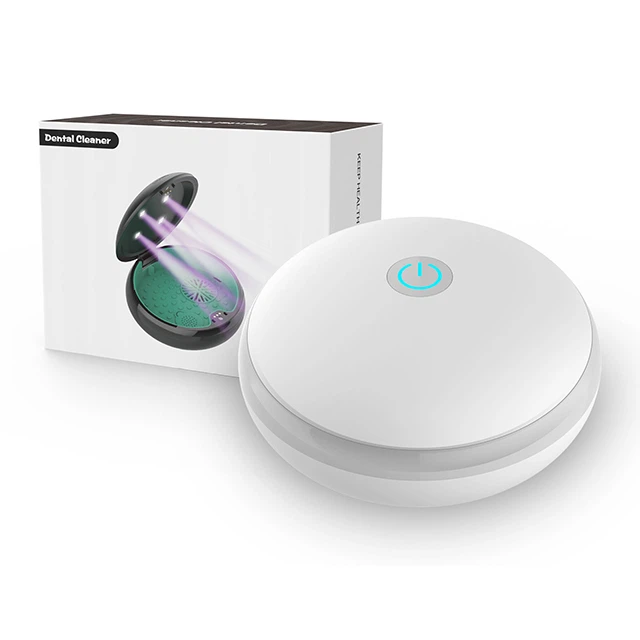
The Physics of Pocket-Sized UV-C
The Germicidal Band, Miniaturized
Ultraviolet light in the UV-C range (200–280 nm) is germicidal because its photons are absorbed by microbial DNA and RNA, with peak absorption around 260–280 nm. The absorbed energy fuses adjacent nucleotide bases into thymine dimers, distorting the genetic helix and halting replication. The microorganism cannot divide; it dies.
Critically, this mechanism is physical, not chemical:
No residue is left on the appliance
No taste or odor is imparted
No resistance develops - unlike antibiotics or chemical disinfectants, UV-C damage is universal and non-selective
Nothing needs to be rinsed off afterward
A 99.9% reduction claim - the industry standard - corresponds to a 3-log reduction: a 1,000-fold decrease in viable microorganisms. That is not marketing inflation; it is the same benchmark used in medical device and food-safety disinfection.
Why Smaller Can Mean Stronger
Here is the physics that makes pocket devices viable at all: irradiance follows the inverse square law. Double the distance from a light source and the intensity falls to one-quarter. A compact chamber means the UV-C source sits millimeters from the appliance surface - a geometric advantage a countertop unit cannot match.
A full-size sterilizer must illuminate a large chamber from a distance; a pocket case places its lamp close to the load and concentrates the dose. This is why a small device can complete a germicidal cycle in 3 minutes - not because it is weaker, but because its geometry is more efficient.
The Shadow Problem, Still Present
UV-C travels in straight lines, and a curved, grooved aligner still casts shadows in a miniature chamber. Legitimate pocket devices compensate in three ways:
Chamber geometry: surfaces and lamp positioning designed so the appliance is never far from a direct beam
Reflective interior materials: rays bounce off the chamber walls and scatter into under-curves
Cycle time engineered for coverage: the 3-minute cycle is calibrated to the chamber's actual optical environment, not to a generic assumption
The DC100's integrated design addresses all three - a deliberately shaped chamber, reflective internal surfaces, and a cycle duration validated against its optical geometry.
What "Pocketable" Demands From Engineering
Battery, Charging, and the Airline Rule
A device that lives in a pocket or handbag cannot be tethered to a wall outlet. The Gold Rose DC100 is built around a 500 mAh lithium battery - enough for dozens of sanitizing cycles per charge - recharged through a universal Type-C port from any USB source: laptop, power bank, car charger, or a standard 5V/1A adapter.
The travel math is worth stating explicitly. A 500 mAh cell at ~3.7 V stores roughly 1.85 watt-hours. International aviation rules permit lithium batteries up to 100 Wh in carry-on baggage - the DC100 is about 50 times below that ceiling. It is not merely carry-on compliant; it is trivially so. For a product marketed to travelers, that compliance is a feature, not an afterthought.
Safety Cannot Shrink
UV-C is hazardous to eyes and skin, which makes safety engineering the non-negotiable companion to miniaturization. A pocket device is carried into meetings, gyms, and airplanes - environments where a child, a colleague, or a customs agent might open it mid-cycle.
The DC100's design answers this with a sealed chamber and automated operation: the lamps are energized only during the active cycle with the lid closed. Gold Rose's wider UV case family extends the principle with magnetic-buckle interlocks that cut lamp power the instant the lid opens - the same fail-safe logic used in professional medical sterilizers, compressed into something that fits in a shirt pocket.
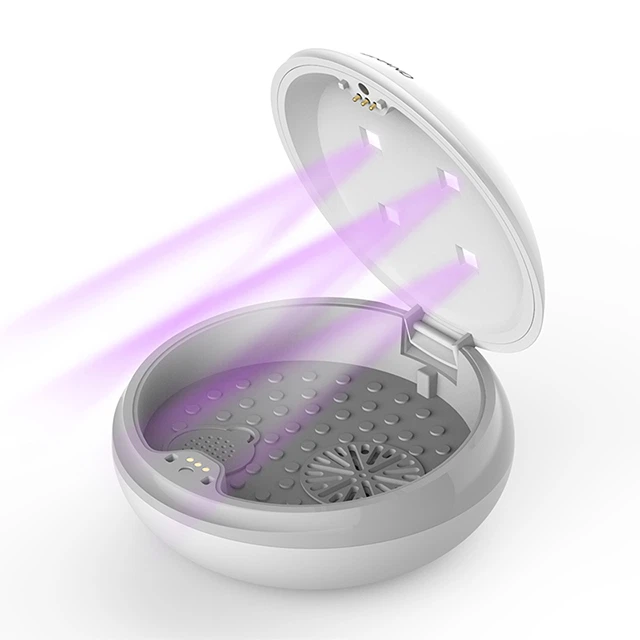
The DC100: A Full Sterilization Cycle in Your Pocket
The Spec Sheet
The Gold Rose DC100 portable UV sanitizing retainer case - also marketed as the UV Dental Pod Cleaner - is a pocket-sized case that doubles as a sanitizing chamber:
|
Feature |
Specification |
|
Cycle time |
3 minutes |
|
Efficacy |
Up to 99.9% (3-log) reduction of bacteria and germs |
|
Battery |
500 mAh lithium, dozens of cycles per charge |
|
Charging |
Type-C, from any 5V/1A USB source |
|
Interior |
Food-grade silicone liner, scratch-free and washable |
|
Ventilation |
Bottom vent holes disperse odor and moisture |
|
Build |
Splash-proof housing for humid environments |
|
Target appliances |
Aligners, retainers, night guards, mouth guards, dentures |
A Workday in Three Acts
The design intent becomes clear when you map it onto a typical day:
Morning: After breakfast, the aligners are rinsed and placed in the DC100. The 3-minute cycle runs while you make coffee. They emerge sterile, dry-ish, and ready to wear.
Lunchtime: The aligners are removed, rinsed, and dropped back into the case. The cycle runs during the meeting that follows - no faucet, no soaking tablet, no sink required.
Evening gym: The case rides in a gym bag, splash-proof against humid locker rooms, and delivers another cycle before you head home.
The product eliminates the two failure points of the traditional routine: the damp case (ventilated and UV-treated instead of sealed and stagnant) and the dependency on a sink, outlet, or countertop.
The Family Angle
The DC100 is one member of a coordinated UV line. For users who want a larger, mirror-reflective chamber with four lamps and a 90-second cycle, the DC300 portable UV sanitizer box covers the desk or bathroom-cabinet use case. The positioning is deliberate: DC300 for the counter, DC100 for the pocket. For distributors, this creates a natural cross-sell - the customer who buys one for the office is a candidate for the other at home.
The Workplace Showdown: Pocket UV vs. Ultrasonic vs. Tablets
How do the available methods compare specifically for the office environment?
|
Method |
Workplace Fit |
Time |
Power |
Key Limitations |
|
Pocket UV case (DC100) |
Excellent |
3 min, unsupervised |
Battery, no outlet needed |
Disinfects, does not remove plaque |
|
Countertop ultrasonic |
Poor |
3–10 min, supervised |
Outlet + water required |
Heavy, noisy, needs a sink and counter |
|
Cleaning tablets |
Marginal |
15+ min soak |
Water required |
Residue taste; single-use plastic waste; a 15-minute soak is impractical at a desk |
For the workplace, the pocket UV case wins on every dimension that matters: time, autonomy, portability, and discretion. It is the only option that runs start-to-finish without the user standing over it.

The B2B Opportunity: The Workplace Is an Untapped Shelf
Aligner Growth Plus Accessory Economics
The clear aligner market has been growing at double-digit rates for years, and every new aligner patient is a candidate for a hygiene accessory. But most orthodontic accessory shelves are built around the bathroom - ultrasonic cleaners, soaking solutions, and brushes. The workplace use case is underserved: a product explicitly designed for the person who wears aligners 22 hours a day and eats lunch at a desk.
For brands and distributors, the DC100's story is unusually easy to sell because it maps to a lived experience almost every aligner patient has had: the damp case, the rushed rinse, the faint smell by 4 p.m. The product does not need to invent a problem - it needs to name one the consumer already knows.
What Buyers Should Verify
When sourcing a pocket UV sanitizer, four checks separate a real device from a blue-glowing look-alike:
Wavelength: A legitimate device specifies UV-C operation in the 260–280 nm band. "UV light" without a wavelength is a red flag.
Quantified efficacy: Look for "99.9% (3-log)" claims supported by test documentation.
Safety interlock: Open-lid cutoff is a hard requirement, not a premium extra.
Compliance: FDA, CE, RoHS, and FCC documentation, backed by a factory operating under ISO 13485 quality management.
The DC100 ships with these credentials - a meaningful advantage for buyers entering North American or European markets, where UV device regulation is tightening.
Frequently Asked Questions (FAQ)
1. How long does one sterilization cycle take?
The DC100 completes a full germicidal cycle in 3 minutes - roughly the length of a short meeting. The chamber's compact geometry places the UV-C source close to the appliance, concentrating the dose so the cycle can be short without sacrificing efficacy.
2. Is UV-C safe for my aligners and retainer material?
Yes. UV-C damages microbial DNA but does not heat, warp, or chemically degrade the polyurethane, acrylic, or silicone used in dental appliances. This is a key advantage over boiling water (which warps soft polymers) and abrasive brushing (which scratches them).
3. Can I take it on a plane?
Yes. The 500 mAh battery stores roughly 1.85 watt-hours - far below the 100 Wh limit for lithium batteries in carry-on baggage. The Type-C port recharges from any standard USB source, so it tops up from a laptop or power bank anywhere.
4. Does the DC100 replace cleaning my retainer?
No - and this distinction matters. UV-C kills microorganisms on the surface but does not remove adhered plaque or debris. The correct routine is two-step: rinse or gently brush the appliance first to remove residue, then run a UV cycle to sterilize. The DC100 handles the second step anywhere, anytime.
5. What happens if someone opens the case mid-cycle?
The DC100's lamps are energized only during the active cycle with the lid closed, and Gold Rose's UV case family adds magnetic-buckle interlocks that cut power instantly when the lid opens. As with any UV-C device, deliberate exposure of eyes or skin to the lamp should always be avoided.
References
1. World Health Organization: "Guidelines on the Use of Ultraviolet Radiation for Disinfection in Health Care Settings," 2023.
2. Kowalski, W.:
Ultraviolet Germicidal Irradiation Handbook
- UVGI for Air and Surface Disinfection, Springer, 2022.
3. American Association of Orthodontists: "Retainer and Aligner Hygiene: Clinical Recommendations," 2025.
4. U.S. Food and Drug Administration: "Ultraviolet (UV) Radiation Products - Regulatory Framework for Consumer Disinfection Devices," 2024.
5. Gold Rose Product Documentation: "DC100 Portable UV Sanitizing Retainer Case - Technical Specification and Sterilization Verification," 2026.
Conclusion
The workday is where modern orthodontic hygiene breaks down - a damp case, a rushed rinse, and eight hours of quiet microbial growth. The pocket UV retainer sanitizer was engineered for exactly this moment: a 3-minute germicidal cycle, powered by a battery small enough to fly, safe enough to open in public, and effective enough to deliver a genuine 99.9% reduction.
The Gold Rose DC100 packages that engineering into something that fits in a pocket and disappears into a workday - and turns the lunchtime problem into a solved routine. For the consumer, it means never putting a bacterial community back in your mouth after a sandwich. For the B2B buyer, it means a product that sells itself to one of the largest and fastest-growing patient populations in dentistry.
The next time you finish lunch, you will know exactly where your aligners should be.
Interested in adding a pocket UV sanitizer to your oral care lineup? Explore Gold Rose's OEM/ODM capabilities at www.goldrosa.com or contact our team at seline@goldrosa.com.