






You finally found a routine that works. Retainers soak every morning, dentures are rinsed before bed, and your night guard gets a weekly deep clean. Then you press the power button on your ultrasonic cleaner, and the high-pitched buzz cuts through the room. In the bathroom, it is tolerable. In the bedroom, where you want to use it before sleeping or right after waking, it is a deal-breaker. You have probably seen the spec "≤45dB" or "ultra-quiet" on product pages - but what does that number actually mean, and is it quiet enough for a bedroom?
Why Traditional Ultrasonic Cleaners Buzz So Loudly
The noise problem is not a design oversight; it is the direct result of how ultrasonic cleaning works.
The Physics of Ultrasonic Noise - Where the Sound Comes From
Ultrasonic cleaners drive a piezoelectric transducer at frequencies between 40,000 and 53,000 Hz - far above human hearing. What you hear is not the ultrasonic wave itself but the side effects of its work. The dominant source is cavitation: microscopic bubbles form and violently collapse in the cleaning liquid, each collapse producing a tiny broadband "pop" that merges into a continuous hiss. A second contributor is mechanical resonance - the tank, lid, and base vibrate sympathetically with the transducer, turning the device into a small speaker. Cheaper units compound the problem with low-quality transducers, thin tank walls, and no vibration damping, so the noise radiates freely into the room.
Why Bedroom Use Demands a Different Standard
The bedroom is the worst possible acoustic environment for a noisy appliance. It is typically smaller, with hard surfaces like nightstands and mirrors that reflect rather than absorb sound. There is no running water or extractor fan to mask the noise, and the room is used exactly when quiet matters most - early morning and late evening. A cleaner that reads as "acceptable" in a kitchen can feel intrusive next to a bed, especially for light sleepers. Bedroom cleaning needs a fundamentally quieter class of device, not a slightly better model of the same design.
What ≤45dB Actually Means - A Decibel Primer
"Noise under 45 decibels" sounds technical, but the decibel scale is easy to understand once you know a few reference points - and even easier to appreciate when you realize how much difference a few numbers make.
The Decibel Scale in Everyday Terms
The decibel (dB) scale is logarithmic: every increase of 10 dB represents a tenfold rise in sound intensity and is perceived as roughly twice as loud. A whisper measures about 30 dB. A quiet library sits around 40 dB. Normal conversation runs 60 to 65 dB. Measured on the A-weighted scale (dBA), which mirrors human hearing sensitivity, a device rated at 45 dB sounds about as loud as the ambient hum of a quiet office - noticeable in silence, but easy to ignore in normal use. Many budget ultrasonic cleaners emit 55 to 65 dB, landing in conversational-range noise that will definitely be heard across a bedroom.
How Ultrasonic Cleaner Noise Is Measured
Manufacturers usually measure sound pressure at a fixed distance - commonly one meter - from the device in a quiet room during steady-state operation. This is why the spec-sheet number can feel lower than what you experience at close range: your ear is often less than a meter away, and a hard-walled bedroom adds reflections the measurement environment removes. Treat the rated figure as a reliable ranking of relative quietness between models, while expecting real-world levels to run several decibels higher. That margin is exactly why choosing a cleaner rated at 35 dB rather than 45 dB matters - the extra 10 dB of headroom keeps actual operation comfortably below the "conversation" threshold even in a reflective room.
The Noise Problem in Real Life
A decibel number is abstract until you map it onto real moments when a cleaner actually runs. Daily scenarios show why the noise rating is the single most important spec for bedroom users.
Nighttime Cleaning and Sleep Disruption
The most common bedroom routine is cleaning a night guard, retainer, or aligner right before bed - and the World Health Organization recommends that continuous background noise during sleep stay below 30 dB for undisturbed rest. A traditional cleaner buzzing at 55 to 60 dB sits far above that threshold and produces the kind of high-frequency whine the brain treats as alerting rather than background. Research on noise and sleep architecture shows that even sub-awakening acoustic events fragment deep sleep and reduce its restorative quality. For couples, the disruption doubles: the person not using the cleaner is disturbed by noise they derive no benefit from.
Small Spaces Amplify the Problem
Bedrooms, compact apartments, and home offices are acoustically unforgiving. Hard floors, bedside tables, and uncovered walls reflect sound waves, and a small room means the device sits close to your ears. The same cleaner that hums unobtrusively in a tiled bathroom can dominate a small bedroom. Vibration is a second amplifier - transmitting vibration to a nightstand turns the furniture into a resonator, making the noise seem louder than the decibel rating suggests. Silicone feet, a soft base mat, and internal vibration damping all reduce this transmitted energy, which is why premium quiet models pay attention to more than just the transducer.

What to Look for in a Quiet Ultrasonic Cleaner
Not every "ultra-quiet" claim survives contact with a real bedroom. Concrete criteria separate genuinely quiet devices from marketing noise.
Rated Noise Under 45 dB - Ideally 35 dB
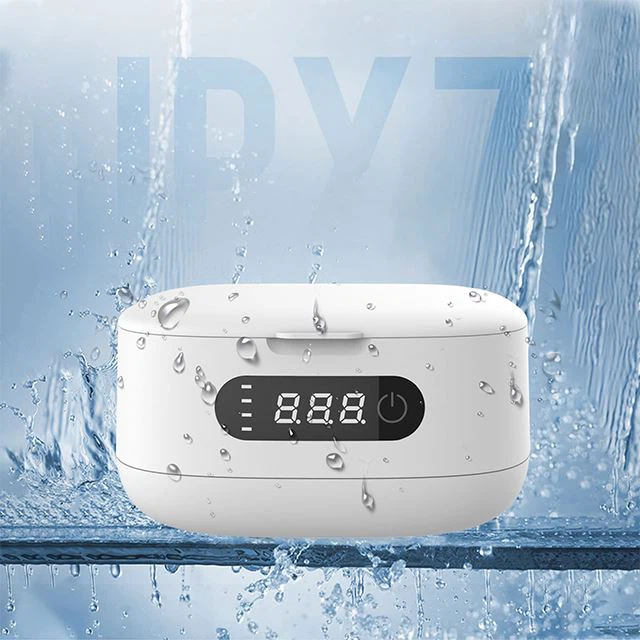
The headline number should be your first filter. Anything rated at or below 45 dB will be acceptable in a bathroom and usable in a bedroom; a 35 dB rating puts operation at whisper-to-library level, leaving comfortable headroom above the sleep-relevant threshold even after real-world reflections are added. The GoldRosa US600 rechargeable ultrasonic cleaner, for example, is rated at 35 dB - quiet enough that most users describe it as a soft hum rather than a buzz, which is the difference between a device you use nightly and one you keep in a drawer.
Design Details That Actually Reduce Noise
Quiet operation is engineered, not claimed. Look for three things. First, transducer and driver quality: a sweep frequency (such as 47–52 kHz) that shifts slightly during operation reduces the mechanical resonance that causes fixed-pitch whining. Second, structural damping: a double-layer tank, weighted base, or sound-isolating mounts prevent the casing from acting as a speaker. Third, sealed operation: a magnetic lid that fits snugly contains the hiss of cavitation. The US600 combines a double-layer structure with a magnetic lid and premium driver design, addressing all three noise sources.
Battery Power and the Quiet-Compliance Link
There is a less obvious connection between power source and noise: battery-powered cleaners are overwhelmingly designed around quiet, portable home use, whereas corded units with strong pumps and transformers are built for throughput in clinics and workshops. A rechargeable cleaner with a dual-core battery and Type-C charging - like the US600, which delivers up to ten cleaning cycles per charge - signals a device engineered for bedroom contexts. Cordless operation also eliminates transformer hum and gives placement freedom, so the cleaner can live wherever it disturbs the least.
How to Use a Quiet Ultrasonic Cleaner in Your Bedroom Routine
Even a genuinely quiet cleaner performs best when you set it up deliberately. A few placement and timing choices close the gap between spec-sheet numbers and lived-in silence.
Placement and Timing Tips
Set the cleaner on a soft surface - a folded towel or silicone mat - to absorb vibration before it reaches furniture. Position it at least one meter from the bed, ideally behind a nightstand facing away from your pillow. Run long cycles during the day when ambient noise masks the faint hum, and reserve short 3-to-5-minute cycles for the bedtime routine. A visible timer and digital display - the US600 includes an LED readout - lets you start a cycle and know exactly when it will finish.
Making Quiet Cleaning a Lasting Habit
The real benefit of a 35 dB cleaner is behavioral. When a device is unobtrusive, the five-minute nightly clean of your retainer or night guard stops feeling like a chore and becomes a default part of the routine - and consistent cleaning extends the life of oral appliances. Choose a model with a smart Hall sensor that automatically cuts the UVC sterilizer when the lid opens, so it is safe on the nightstand even with family around. Between the whisper-quiet operation, the safety features, and USB-C charging that works with the charger next to your bed, a quiet ultrasonic cleaner becomes the easiest step of your evening.

FAQs
Q: How loud is a typical ultrasonic cleaner?
A: Most budget ultrasonic cleaners operate at 55 to 65 dB - comparable to normal conversation - because of cavitation noise and tank resonance. Quiet-rated models drop to 45 dB or below, and premium units like the GoldRosa US600 run at just 35 dB.
Q: Is 45 dB quiet enough for bedroom use?
A: Yes, 45 dB is roughly library-quiet and usable in a bedroom, though real-world reflections add a few decibels. A 35 dB rating, like the GoldRosa US600, provides more comfortable headroom and is nearly inaudible from a meter away.
Q: Why is my ultrasonic cleaner so loud?
A: The sound comes from cavitation bubbles collapsing in the liquid plus mechanical resonance in the tank and casing. Cheap transducers, thin tank walls, and the absence of vibration damping all make the noise worse.
Q: What does dB mean on an ultrasonic cleaner spec?
A: It is the A-weighted sound pressure level, usually measured at roughly one meter. Because the scale is logarithmic, every 10 dB increase sounds about twice as loud - 55 dB is not slightly louder than 45 dB; it is twice as loud.
Q: Can I use an ultrasonic cleaner on my nightstand?
A: Yes, if it is quiet and safety-equipped. Place it on a soft mat at least a meter from your head, and choose a model with a Hall sensor that switches off the UV light when the lid opens, like the GoldRosa US600.
References
1. GoldRosa US600 Rechargeable Ultrasonic Cleaner - [https://www.goldrosa.com/ultrasonic-dental-cleaner/rechargeable-ultrasonic-cleaner.html](https://www.goldrosa.com/ultrasonic-dental-cleaner/rechargeable-ultrasonic-cleaner.html)
2. GoldRosa Ultrasonic Dental Cleaner Product Line - [https://www.goldrosa.com/ultrasonic-dental-cleaner/](https://www.goldrosa.com/ultrasonic-dental-cleaner/)
3. GoldRosa Best Ultrasonic Dental Cleaner (US500) - [https://www.goldrosa.com/ultrasonic-dental-cleaner/best-ultrasonic-dental-cleaner.html](https://www.goldrosa.com/ultrasonic-dental-cleaner/best-ultrasonic-dental-cleaner.html)
4. GoldRosa Official Website - [https://www.goldrosa.com/](https://www.goldrosa.com/)
5. World Health Organization. "Environmental Noise Guidelines for the European Region" (2018) - [https://www.who.int/europe/publications/i/item/9789289053563](https://www.who.int/europe/publications/i/item/9789289053563)
6. Basner, M., et al. (2014). "Auditory and non-auditory effects of noise on health." *The Lancet*, 383(9925), 1325-1332.