


In preventative oral healthcare, interdental plaque and food debris removal represents the single most critical defense against gingivitis, periodontitis, and interproximal carious lesions.
While powered interdental cleaning appliances-encompassing hydrodynamic water flossers and high-frequency sonic vibrating flossers-dramatically reduce user effort compared to manual string, their clinical efficacy remains strictly dependent upon operator technique.
A substantial percentage of end-users experience suboptimal plaque debridement, painful gum lacerations, or excessive fluid splattering simply because they fail to grip and orient the appliance correctly.
For commercial oral care brands, dental clinic procurement directors, pharmacy retail buyers, and private-label distributors, analyzing the best way to hold an electric tooth flosser is essential for optimizing clinical outcomes, elevating consumer satisfaction, and drafting authoritative user onboarding manuals.
From an ergonomic and clinical biomechanics perspective, the optimal technique is not a tight fist grip, but a relaxed modified pen grasp (or balanced palmar power grip for heavier cordless irrigators), angling the operational tip at precisely 90 degrees to the long axis of the tooth while maintaining a forward-leaning posture over the sink basin.
Mastering this angular orientation ensures that hydrodynamic kinetic energy or sonic micro-vibrations flush the interdental embrasure space without damaging the vascular junctional epithelium.
This comprehensive technical guide evaluates the biomechanical principles of holding electric flossers, outlines structured clinical operating steps, reviews verified manufacturing hardware, and establishes institutional procurement audit standards.
Biomechanical Principles: Grip Dynamics, Vector Alignment, and Soft-Tissue Safety
Properly holding an electric tooth flosser requires understanding the physical forces exerted within the oral cavity:
1. The Modified Pen Grasp vs. Balanced Palmar Power Grip
The choice of grip depends directly on appliance architecture and mass distribution:
The Modified Pen Grasp for Sonic Flossers: Lightweight sonic vibrating flossers (under 100 grams) should be held using a modified pen grasp, resting the cylindrical handle between the thumb, index finger, and middle finger. This three-point contact tripod provides precise tactile sensitivity, allowing micro-adjustments around lingual margins and posterior third molars without finger strain.
The Balanced Palmar Power Grip for Water Flossers: Heavier cordless hydrodynamic flossers containing fluid reservoirs (weighing 250 to 450 grams when filled) require a relaxed palmar power grip. The fingers wrap securely around the textured handle while the thumb rests naturally on the multi-mode power switch, utilizing the larger muscle groups of the wrist and forearm to guide the nozzle smoothly along the dental arch.
2. The 90-Degree Vector Rule at the Gingival Margin
Orienting the operational tip relative to tooth anatomy dictates clinical safety and debridement depth:
Perpendicular 90-Degree Trajectory: The nozzle or vibrating tip must maintain a 90-degree angle relative to the long axis of the tooth at the gingival margin. Directing hydrodynamic fluid or sonic oscillations perpendicularly into the interdental embrasure flushes out trapped food debris and unattached subgingival plaque efficiently.
Risks of Acute Subgingival Angulation: Angling the tip acutely downward into the gingival sulcus can force pathogenic bacteria deeper into periodontal pockets, stripping delicate epithelial attachments and causing localized inflammation, tissue trauma, and immediate bleeding.
3. Anatomical Guidance Trajectory (M & W Arch Mapping)
Navigating the human dentition requires a disciplined anatomical route:
Continuous Gingival Tracing: The user should trace an inverted "M" contour across the maxillary upper arch (following the rise and fall of the interdental papillae) and a "W" contour across the mandibular lower arch.
Lingual and Interproximal Pauses: Rather than sweeping continuously across enamel faces, the operator must pause the tip for two to three seconds at each interdental contact, ensuring complete hydrodynamic flushing of both facial (outer) and lingual (inner) surfaces.
Step-by-Step Clinical Protocol: Standard Operating Procedure for Powered Flossing
To maximize interproximal plaque clearance while preventing fluid mess and tissue irritation, dental professionals recommend a standardized, nine-step operational workflow:
Step 1: Ergonomic Posture and Environmental Preparation
Stand comfortably in front of a well-illuminated bathroom vanity mirror.
Lean forward slightly over the sink basin from the hips, maintaining a head tilt of approximately 45 degrees.
This forward posture ensures that expelled fluids and dislodged food debris drain naturally into the sink bowl rather than running down the user's forearm or splattering onto clothing.
Step 2: Reservoir Filling with Isothermal Fluid
Fill the water reservoir with lukewarm water (approximately 35°C to 40°C).
Cold tap water triggers dentin hypersensitivity in patients with exposed cervical margins or periodontal recession, inducing involuntary flinching and erratic hand movements.
A small capful of antimicrobial or alcohol-free mouthwash may be introduced for enhanced breath freshening.
Step 3: Nozzle Selection and Engagement
Select the specialized nozzle tailored to clinical needs-such as a standard jet tip for general hygiene, an orthodontic tip for braces, or a soft periodontal pocket tip.
Insert the tip firmly into the handle manifold until a distinct mechanical click confirms full lock engagement.
Step 4: Ergonomic Hand Placement
Grasp the handle using a relaxed modified pen grasp for slim sonic models or a full-palm grip for reservoir-equipped cordless units.
Ensure the index finger can easily touch the 360-degree nozzle rotation wheel while the thumb rests over the power and mode toggle switches.
Step 5: Pre-Activation Intraoral Placement
Place the tip inside the mouth and position it between the posterior second molars before pressing the power button.
Close the lips partially around the nozzle shaft to form a splash barrier, allowing fluid to flow freely from the mouth into the sink basin.
Activating the flosser outside the oral cavity results in uncontrollable water spraying across bathroom mirrors.
Step 6: Low-Pressure Onboarding and Activation
Activate the unit on its lowest pressure setting (Soft or Gentle mode, typically 30 to 45 PSI).
Allow the oral tissues to adapt to the pulsating sensation before gradually escalating to standard or deep-cleaning pressures (70 to 110 PSI).
Step 7: Systematic Posterior-to-Anterior Progression
Begin at the distal surface of the rearmost molar and advance methodically toward the central incisors.
Pause for two to three seconds at each interproximal embrasure, directing the stream along the gingival margin before transitioning to the adjacent interdental space.
Step 8: Complete Lingual and Palatal Coverage
Once the facial surfaces of both arches are completed, pivot the wrist or rotate the 360-degree nozzle wheel to address the lingual (tongue-side) and palatal (roof-side) surfaces.
Placental plaque accumulation along lingual margins is a primary source of subgingival calculus and halitosis.
Step 9: Post-Use Fluid Purge and Sanitary Storage
Power off the device before removing the tip from the oral cavity.
Empty any residual fluid from the reservoir, activate the motor for two seconds out of water to purge the internal pump manifold, detach the nozzle, and store the unit upright on its wireless charging base in a ventilated environment.
Hardware Architecture Benchmark: Verified Ergonomic Electric Flosser Platforms
Institutional buyers, retail pharmacy chains, and oral care private-label brands must benchmark prospective OEM manufacturing partners against verified ergonomic specifications:
The Gold Rose Professional Electric Flosser represents an engineering benchmark in ergonomic power handling and multi-functional oral hygiene.
Featuring an advanced 3-in-1 oral care architecture, the device couples high-frequency sonic micro-vibrations with a 30-degree mechanical oscillating sweep that guides specialized dual-line dental filament deep between tight contacts and posterior molars without manual finger strain.
Constructed with a non-slip silicone contoured grip measuring 238 by 31.5 mm, the lightweight handle eliminates hand fatigue during extended operation, supported by four customizable cleaning modes (Gentle, Moderate, DeepClean, and Massage) to protect sensitive gingival tissue.
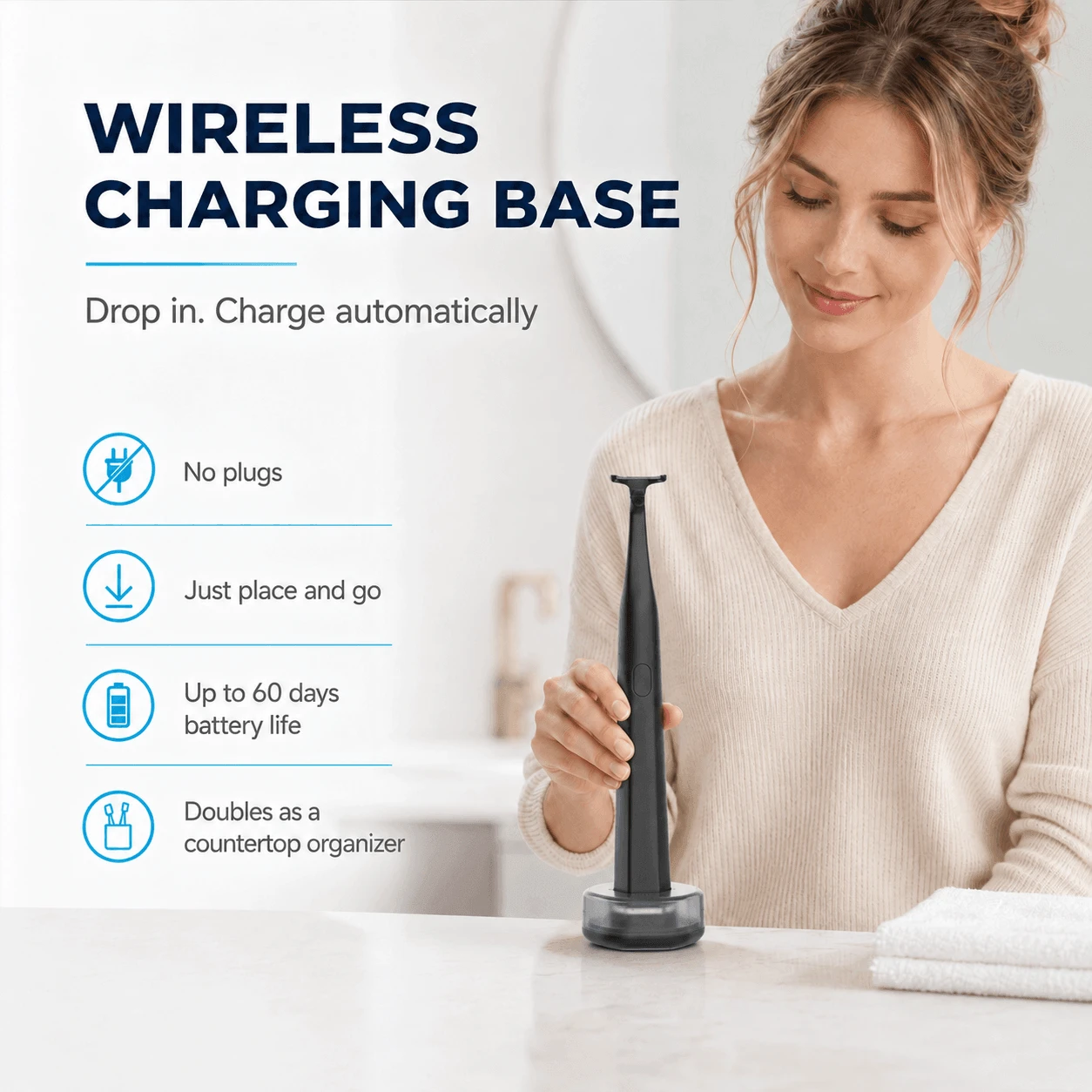
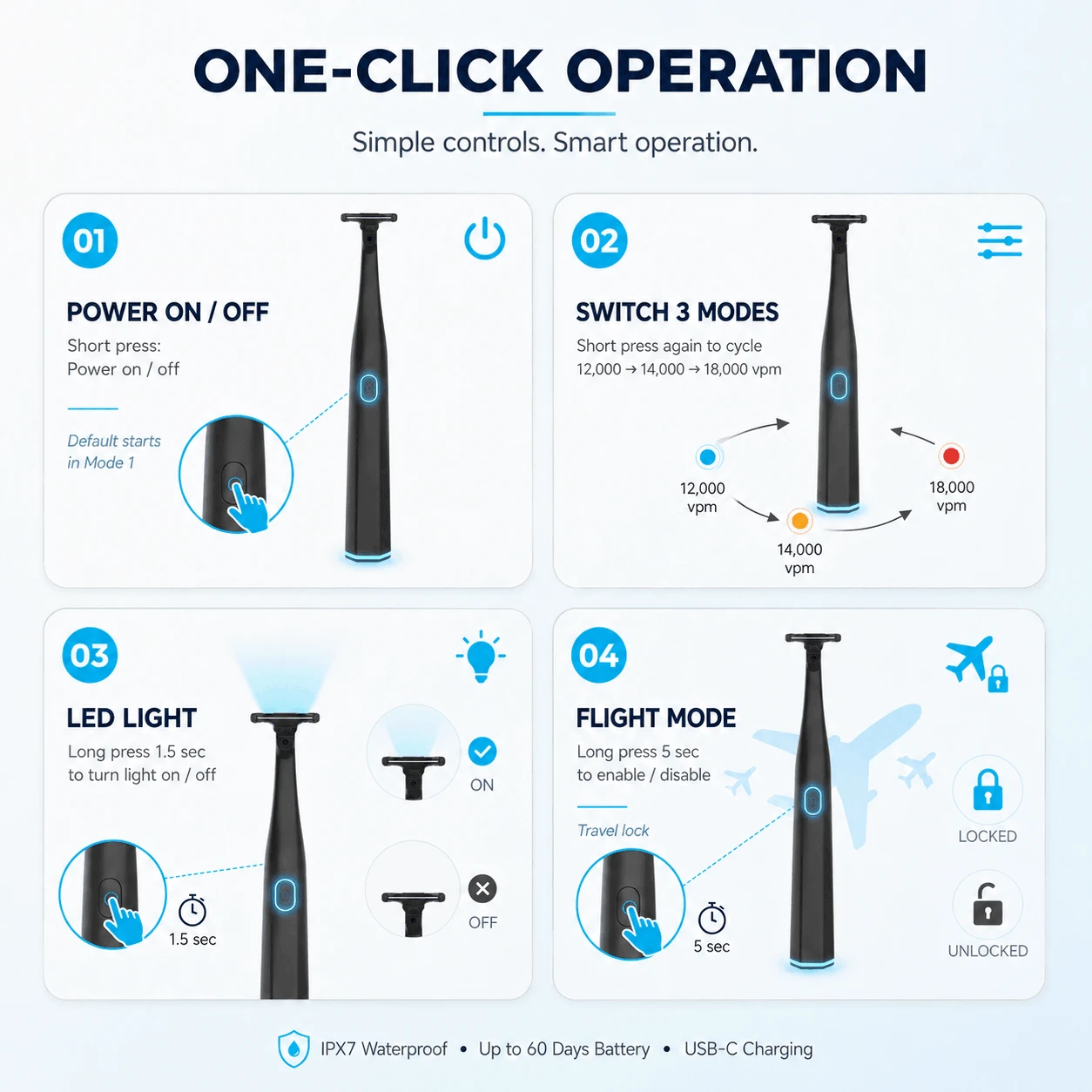
Engineered with full IPX7 waterproof sealing, a contact-free wireless induction charging base, an internal 800 mAh high-retention lithium cell providing up to 60 days of continuous operation per charge, and a bundled starter kit of 50 replaceable floss heads with an integrated tongue scraper, this platform operates under ISO 13485:2016 and FDA medical device establishment registrations with private-label OEM runs starting at 1,000 units.
The Gold Rose Sonic Dental Cleaner integrates 30,000 vibrations per minute with a 30-degree oscillating motion that dislodges up to 99.9% of interdental food debris and dental plaque.
B2B Procurement Specifications: Quality Auditing for Ergonomic Handling and Safety
When selecting an OEM/ODM manufacturing partner for commercial electric flosser product lines, procurement officers must mandate rigorous validation testing across four core technical pillars:
1. Anthropometric Handle Ergonomics and Surface Texturing
Ensure the physical device conforms to human hand biomechanics:
Non-Slip Thermoplastic Overmolding: Mandate liquid silicone rubber (LSR) or textured thermoplastic elastomer (TPE) overmolds along key gripping zones to maintain tactile grip security even when the handle is covered with water or foaming dentifrice.
Center-of-Gravity Optimization: Ensure the internal component layout places the battery cell and drive motor in the lower half of the chassis, preventing top-heavy torque that induces wrist strain during prolonged use.
2. 360-Degree Nozzle Articulation and Tactile Detents
Verify mechanical adjustability for anterior and posterior access:
Rotational Smoothness: Require the nozzle manifold to incorporate smooth 360-degree indexing with distinct mechanical detents, enabling users to re-orient the fluid jet using a single finger without altering their primary hand grasp.
Push-Button Ejection Safety: Ensure nozzle release mechanisms require a dedicated push-button latch, preventing accidental tip detachment under high hydraulic back-pressure.
3. Vibration Damping, Ingress Sealing, and Charging Safety
Verify user comfort and bathroom moisture resistance:
Acoustic and Mechanical Decibel Caps: Mandate internal silicone dampeners that cap acoustic noise below 55 dB while isolating vibration within the working tip, preventing sensory numbness in the user's palm.
IEC 60529 IPX7 Waterproofing: Require certified test reports demonstrating that the complete handle assembly withstands complete underwater immersion to a depth of one meter for thirty minutes without moisture penetration.
Wireless Inductive Charging: Prioritize contact-free inductive docks over mechanical USB sockets to eliminate exposed electrical contacts that corrode in humid bathroom environments.
4. International Regulatory Compliance and Factory QMS Accreditations
Maintain complete regulatory compliance across all target distribution territories:
Medical Device QMS Certification: Verify that manufacturing facilities operate under certified ISO 13485:2016 and ISO 9001 quality management systems, ensuring strict incoming component inspection and automated surface-mount assembly.
Global Electrical Clearances: Confirm valid compliance certificates for CE (LVD 2014/35/EU and EMC 2014/30/EU), FCC Part 15 Subpart B, and RoHS 2011/65/EU.
Frequently Asked Questions
Q1: What is the single most common mistake users make when holding an electric flosser?
The most common mistake is holding the device upright and activating it before placing the nozzle inside the mouth, which results in water spraying across the bathroom rather than leaning forward over the sink with lips slightly parted.
Q2: Why should the flosser tip be held at a 90-degree angle to the tooth surface?
Maintaining a perpendicular 90-degree angle ensures that the hydrodynamic water jet or sonic micro-vibrations flush directly through the interdental embrasure without forcefully driving bacteria downward into the delicate gingival attachment.
Q3: Can an electric tooth flosser be used safely in the shower?
Yes; high-quality electric flossers engineered with certified IEC 60529 IPX7 waterproofing can be used safely in the shower, which completely eliminates sink-side water splattering concerns.
Q4: How does holding a sonic vibrating flosser differ from holding a water flosser?
Sonic vibrating flossers are lightweight and held using a light modified pen grasp for tactile control around tight contacts, whereas water flossers are heavier due to their water reservoir and require a balanced palmar power grip.
Q5: What private-label OEM/ODM services does Gold Rose provide for ergonomic electric flossers?
Huizhou Gold Rose Technology Co., Ltd. provides comprehensive OEM/ODM manufacturing, including custom ergonomic handle tooling, anti-slip silicone texturing, custom mode programming, private logo silk-screening, and complete global regulatory dossiers (ISO 13485, CE, FCC, RoHS) directly through goldrosa.com.
References
American Dental Association. (2023). The Importance of Interdental Cleaning: Clinical Guidance and Patient Techniques. ADA Council on Scientific Affairs, Chicago, IL.
Journal of Clinical Dentistry. (2022). The Efficacy of Powered and Hydrodynamic Flossers in Plaque Removal and Gingival Health Maintenance. Clin Dent Res Bull, 33(2), 88–95.
International Organization for Standardization. (2016). ISO 13485:2016 Medical Devices - Quality Management Systems - Requirements for Regulatory Purposes. ISO Standards Catalogue, Geneva, Switzerland.
International Electrotechnical Commission. (2013). IEC 60529: Degrees of Protection Provided by Enclosures (IP Code). IEC Standards Catalogue, Geneva, Switzerland.
International Electrotechnical Commission. (2017). IEC 62133-2: Secondary Cells and Batteries Containing Alkaline or Other Non-Acid Electrolytes for Portable Sealed Secondary Cells. IEC Standards Catalogue, Geneva, Switzerland.
Gold Rose. Professional Electric Flosser: Ergonomic 3-in-1 Sonic Oral Care System with 30° Oscillation. https://www.goldrosa.com/electric-tooth-flosser/professional-electric-flosser.html
Gold Rose. Sonic Dental Cleaner: 30,000 VPM High-Frequency Interdental System with Wireless Induction Base. https://www.goldrosa.com/electric-tooth-flosser/sonic-dental-cleaner.html
Gold Rose. Electric Flosser for Sensitive Gum: Ultra-Lightweight 30,000 VPM Interdental Cleaning System. https://www.goldrosa.com/electric-tooth-flosser/electric-flosser-for-sensitive-gum.html
Gold Rose. Electric Toothbrush with Flosser: Multi-Functional Sonic Dental Hygiene System with IPX7 Waterproofing. https://www.goldrosa.com/electric-tooth-flosser/electric-toothbrush-with-floss.html
Gold Rose. B2B Turnkey OEM/ODM Medical Device Engineering and Global Export Services. https://www.goldrosa.com/oem-odm