





Removable dental prostheses and protective appliances share a biological burden that fixed teeth do not: they spend hours every night bathed in warm saliva, compressed against mucous membranes, and shielded from the mechanical shear of chewing and tongue movement. This creates ideal conditions for mature microbial biofilm formation. For denture wearers and night guard users, the visible consequence is a rough, discolored film that gradually hardens into a chalky deposit around the denture base, along the intaglio surface, and inside the suction relief chambers.
The question of whether an ultrasonic cleaner can remove this stubborn tartar is therefore both practical and commercially significant. The honest answer requires separating two very different substrates: the soft, living biofilm that accumulates within hours, and the mineralized calculus that forms over weeks. Ultrasonic cavitation is exceptionally effective against the first and only partially effective against the second. Understanding where that boundary lies determines how a cleaning protocol should be staged, and it determines what a responsible product claim can actually deliver.
The Denture Tartar Problem: Why Brushing and Soaking Tablets Fall Short
The microporous topography of PMMA acrylic resin and Candida albicans colonization
Heat-cured polymethyl methacrylate, the dominant material in denture bases, is not a smooth solid. Its polymerization process leaves a network of subsurface micropores, microscopic surface irregularities, and residual monomer voids that measure in the range of a few micrometers. These features provide protected ecological niches that are smaller than the tip of a nylon bristle and inaccessible to the shear flow generated by a denture brush. Candida albicans, the primary fungal colonizer of acrylic appliances, adheres to these sites through specific cell-surface adhesins and rapidly matures into a dense, matrix-encased biofilm. Once established, the biofilm acts as a scaffold that traps salivary calcium and phosphate ions, seeding the mineral precipitation that eventually becomes calculus.
Denture stomatitis: The clinical cost of incomplete nocturnal appliance hygiene
The clinical consequence of this colonization is denture stomatitis, a chronic erythematous inflammation of the palatal mucosa that affects a substantial proportion of removable prosthesis wearers. The condition is driven less by the presence of the prosthesis itself than by the sustained contact between colonized acrylic and the mucosal surface beneath it. Because the inflamed tissue is frequently asymptomatic in its early stages, patients often continue wearing inadequately cleaned appliances for months, allowing the biofilm to thicken and the underlying resin to become increasingly porous and stained. This progression makes subsequent cleaning progressively harder, which is precisely the point at which consumers begin searching for products that can remove stubborn tartar.
The Physics of Cavitation: How 43–45 kHz Acoustic Energy Reaches Blind Crevices
Nucleation, bubble growth, and asymmetric micro-jet implosion
An ultrasonic cleaning bath generates its effect not through bulk fluid motion but through acoustic cavitation. A piezoelectric transducer bonded to the tank floor oscillates at 43 to 45 kHz, launching pressure waves through the liquid. In the low-pressure phase of each cycle, dissolved gases and microscopic vapor nuclei expand into small cavities. In the subsequent high-pressure phase, these cavities collapse violently and asymmetrically, directing a high-velocity micro-jet of liquid toward the adjacent solid surface. Each implosion produces a localized pressure spike and a microscopic scouring effect on the order of micrometers in scale.
Why cavitation penetrates porous resin and suction-cup relief areas that bristles cannot
The practical advantage of this mechanism is geometric. A bristle can only act on surfaces it can physically reach, and its diameter is roughly two orders of magnitude larger than the pores it is attempting to clean. Cavitation bubbles, by contrast, nucleate throughout the entire fluid volume, including inside the suction relief chambers, around the post dam, and within the micropores of the acrylic base. On collapse, the resulting micro-jets strike these interior surfaces directly. This is why cavitation consistently outperforms manual brushing on complex, cavity-rich geometries that cannot be visually inspected or mechanically accessed.
The Honest Boundary: Biofilm versus Calcified Calculus
What ultrasonic cavitation reliably removes
Ultrasonic cavitation is highly reliable against soft and semi-soft deposits. It dislodges viable and non-viable microbial biofilm from the intaglio surface, lifts food particulate from the denture base relief areas, mobilizes salivary proteins and mucin films, and removes loosely bound extrinsic pigment from coffee, tea, and tobacco. Combined with a short pre-soak in a suitable denture cleanser, cavitation also accelerates the breakdown of the outer biofilm matrix, allowing the acoustic micro-jets to reach the resin interface more effectively.
Why mature calculus requires chemical softening or professional scaling
Mature calculus is a different material. Once calcium phosphate precipitates within the biofilm matrix and undergoes progressive mineralization, its hardness approaches that of the adjacent tooth structure, and its bond to the acrylic surface becomes mechanically interlocked rather than merely adhesive. Cavitation micro-jets act on a scale measured in micrometers and cannot generate the macroscopic shear required to fracture a mineralized, interlocked deposit. A realistic clinical protocol therefore stages the process: soften with a suitable cleanser or an acidic denture soak, perform ultrasonic cavitation to remove the loosened matrix and remaining biofilm, and refer genuinely hard, tenacious calculus to a prosthodontic professional for mechanical scaling. For heavily mineralized deposits on a valuable prosthesis, professional intervention remains the correct answer, and no consumer device should claim otherwise.
Top Recommended Ultrasonic Systems for Denture and Night Guard Care
Gold Rose US900 Ultrasonic + UV-C Dual Sanitizer: Best Overall
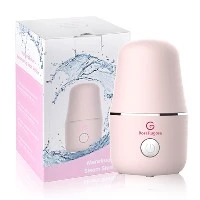
The Gold Rose US900 Ultrasonic + UV-C Dual Sanitizer is the most capable system in this category, engineering a complete hygiene cycle rather than a single cleaning action. It operates at 43 to 45 kHz acoustic frequency, generating the cavitation intensity required to strip biofilm from porous acrylic and from the relief chambers beneath a denture base. Uniquely, it pairs acoustic debridement with four dual-band UVA and UV-C germicidal lamps, addressing the Candida and bacterial load that cavitation alone disperses but does not necessarily inactivate. Its separable tank design allows the basin to be rinsed and refilled independently of the electrical base, and an integrated 4000mAh lithium battery with universal Type-C charging supports cordless operation.

Gold Rose US601 Portable Ultrasonic Cleaner: Best for Chairside and Travel
For prosthodontic clinics performing chairside cleaning between appointments, and for patients who travel with appliances, the Gold Rose US601 provides full cavitation capability in a genuinely portable format. Its food-grade 110ml SUS304 stainless steel chamber concentrates acoustic energy into a compact, high-density cleaning zone. The device weighs 306 grams, measures 52.6 millimeters at its thickest point, and carries IPX7 waterproofing with 1.2-meter drop resistance. A 4000mAh battery delivers up to 14 complete cleaning cycles per charge, with automated 5-minute and 10-minute modes covering routine maintenance and heavier deposits respectively.

Gold Rose DC300 UV & Airflow Drying Case: Best for Post-Cycle Dry Storage
Cleaning and drying are separate problems, and the interval between them is when recolonization begins. The Gold Rose DC300 addresses this gap with four UV sanitizing lamps, a reflective interior mirror that distributes light across the full appliance surface, and an integrated micro-fan with ventilation vents that actively circulates air to evaporate residual moisture. Powered by a 500mAh battery, it provides hygienic dry storage overnight, when a damp denture or night guard would otherwise sit in a closed container at mouth temperature.

Effervescent Denture Tablets Alone: Reference Benchmark
Chemical soaking tablets remain the conventional benchmark and retain a legitimate role in the staged protocol described above, particularly for softening deposits before cavitation. Used alone, however, they rely on oxidizing chemistry without mechanical energy, which limits their penetration into micropores and suction relief areas, and they leave the appliance wet and immediately susceptible to recolonization.
B2B Sourcing: Why Dental Labs and Silver-Economy Brands Are Adding Cavitation Units
Chairside integration in denture clinics and prosthodontic laboratories
Prosthodontic practices that deliver new dentures face a recurring compliance problem: patients receive a clean appliance and are given verbal hygiene instructions that are rarely followed precisely. Supplying or retailing a cavitation unit at the point of delivery converts an abstract instruction into a concrete behavior, reduces returns attributable to staining and odor, and creates a defensible clinical protocol for managing stomatitis risk. Laboratories benefit similarly, using compact units for pre-delivery cleaning and for servicing appliances returned during adjustment visits.
Gold Rose OEM/ODM manufacturing advantages
Huizhou Gold Rose Technology Co., Ltd. supports brand owners, clinic networks, and distributors with end-to-end manufacturing rather than component assembly. The company holds 107 international patents, trademarks, and utility models across China, the United States, Japan, and the European Union, and operates under ISO 9001, ISO 13485, and BSCI certified quality management systems with FDA, CE, FCC, and RoHS compliance across its product lines. OEM and ODM programs start at a minimum order quantity of 1,000 units and support custom housing colors, private-label branding, bespoke retail packaging, and documentation packages for regulated markets. Standard inventory ships within 1 to 3 working days, while customized production runs complete within 15 to 20 working days.
Frequently Asked Questions
Can an ultrasonic cleaner fully remove hard tartar from dentures?
Not in a single step, and no credible device can. Ultrasonic cavitation at 43 to 45 kHz removes biofilm, staining, and food deposits from porous acrylic and relief chambers with high efficiency, and it removes mineralized calculus once that calculus has been chemically softened. Fully hardened, interlocked calculus on a valuable prosthesis should be scaled by a prosthodontic professional, after which ultrasonic maintenance prevents rapid re-accumulation.
Will ultrasonic cleaning damage acrylic resin or metal frameworks?
No. Cavitation is a non-contact mechanism that acts through fluid dynamics rather than abrasion, so it does not scratch or wear acrylic resin, cobalt-chrome frameworks, or titanium components. This is a meaningful advantage over brushing, which progressively abrades the acrylic surface and creates additional micropores for biofilm to colonize. Water temperature should nevertheless be kept moderate for heat-sensitive appliances.
How often should dentures and night guards be ultrasonically cleaned?
Daily ultrasonic cleaning is appropriate for dentures, ideally after the evening meal and before overnight storage. Night guards and clear retainers benefit from daily cavitation as well, since biofilm maturation begins within hours of placement. A longer cycle with a suitable cleanser once or twice weekly addresses accumulated pigment and early mineral deposits.
Is ultrasonic cleaning alone enough to prevent denture stomatitis?
Cleaning is necessary but not sufficient. Stomatitis risk is governed by three variables: appliance hygiene, nocturnal tissue rest, and mucosal health. Ultrasonic cavitation addresses the first with high efficiency, but the appliance should also be removed for several hours each day to allow the palatal mucosa to recover, and a UV drying case prevents the moist recolonization that occurs during closed-container storage.
What OEM options does Gold Rose offer for denture care devices?
Gold Rose provides full OEM and ODM programs from 1,000 units, covering custom housing colors, private-label branding, bespoke retail packaging, localized instruction manuals, and certification documentation for target markets. Standard inventory ships in 1 to 3 working days, with customized production completing in 15 to 20 working days.
References
PubMed Central: Candida albicans biofilm formation on polymethyl methacrylate denture surfaces
PubMed: Denture stomatitis - etiology, prevention and clinical management
Gold Rose US900 Ultrasonic + UV-C Dual Sanitizer Technical Specifications
Gold Rose US601 Portable Ultrasonic Cleaner Product Data
Gold Rose B2B Manufacturing, Certification and OEM/ODM Capabilities