



Many people assume that a clear Invisalign retainer is clean as long as it still looks transparent. That assumption can be misleading. Saliva proteins, food residue, plaque, and odor-causing microorganisms can accumulate on a retainer even when the surface appears clear. The better question is not simply whether a retainer looks clean, but whether it is being cleaned often enough for the way it is worn.
The practical answer is more nuanced than "sanitize it once a week." A retainer needs basic care whenever it is removed, regular cleaning during daily use, and periodic deep cleaning according to the wearer's routine, the appliance material, and the instructions provided by an orthodontic professional. For brands developing oral-care products, this distinction between daily cleaning and scheduled sanitizing is also an important opportunity to create clearer, more trustworthy consumer guidance.

Why Invisalign Retainers Need More Than a Quick Rinse
Clear does not mean clean
A retainer may remain visually clear while a thin film develops across its surface. This film can include saliva residue, plaque, and particles from food or drinks. Because the layer is often difficult to see, users may underestimate how much cleaning is required. A quick rinse can remove some fresh debris, but it does not necessarily remove the film that forms after repeated wear.
This is why cleaning instructions should focus on routine rather than appearance. A retainer that looks acceptable can still develop an unpleasant taste or odor if it is repeatedly stored while damp and uncleaned. Regular maintenance also helps users identify changes such as cloudiness, staining, cracks, or deformation before the appliance becomes uncomfortable to wear.
The closed, moist environment encourages buildup
When a retainer is worn over the teeth, it creates a warm and moist environment. If the teeth have not been cleaned before insertion, residue can become trapped between the appliance and the tooth surface. When the retainer is removed and placed directly into a case, moisture may remain on both the appliance and the case.
This does not mean that every retainer requires an aggressive treatment every day. It means that consistent, gentle cleaning is more useful than occasional intensive cleaning. The right routine should remove residue without exposing the appliance to excessive heat, abrasive products, or unapproved chemicals.

How Often Should You Sanitize Your Invisalign Retainer?
Rinse after every removal
After removing an Invisalign tray or retainer, rinse it with cool or lukewarm water. This simple step helps prevent fresh saliva and food residue from drying onto the surface. Hot water should be avoided unless the appliance manufacturer specifically permits it, because heat may affect the shape of some clear orthodontic appliances.
Rinsing is a first step, not a complete cleaning method. It is most useful when performed promptly, before residue has time to harden or form a sticky film.
Clean daily when the appliance is worn daily
A retainer used every day should normally be cleaned every day. The exact method should follow the appliance manufacturer's instructions and the user's orthodontic advice. Many users choose a soft cleaning method that does not scratch the plastic, while others use an approved cleaning solution or appliance-cleaning device.
Ordinary toothpaste is not automatically suitable for clear retainers. Some toothpaste formulas contain abrasive ingredients that may create fine scratches. These scratches can make the surface look cloudy and may provide more places for residue to collect. The safest approach is to use a cleaning method specifically intended for retainers or aligners.
Schedule a deeper clean once or more each week
For many wearers, a deeper cleaning session once a week is a practical baseline. The American Association of Orthodontists describes using a retainer cleaning tablet or solution once per week for 5 to 10 minutes as one option. Some orthodontic practices recommend a more frequent schedule, especially when a retainer is worn for long periods, develops odor, or accumulates visible residue.
The important point is that "weekly" is a starting reference, not a universal rule. A person who wears an appliance overnight may need a different routine from someone wearing an aligner throughout the day. Users should also follow the specific instructions supplied by their orthodontist and the appliance manufacturer.
Cleaning and Sanitizing Are Not the Same Thing
Cleaning removes physical residue
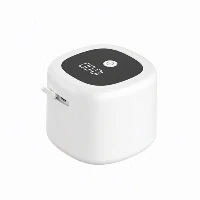
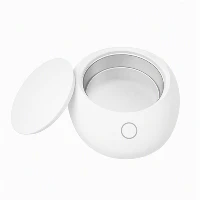
Cleaning is the physical removal of plaque, protein film, and food particles. This step matters because microorganisms can remain protected beneath organic residue. A device such as the GoldRosa US600 is designed to support this process with 47–52 kHz ultrasonic micro-bubble technology. According to the GoldRosa product page, the US600 is intended for retainers and aligners and is described as helping remove plaque and residue from their surfaces.
Ultrasonic cleaner is especially useful for areas that are difficult to reach by hand, such as edges, grooves, and small contours. The device page also lists ultrasonic and pulsed ultrasonic functions for personal-care items, while recommending that users select the appropriate mode for the item being cleaned.
Sanitizing is an additional hygiene step
Sanitizing refers to reducing microorganisms on an exposed surface. UV-C light can be used as an auxiliary hygiene treatment, but it does not replace physical cleaning. UV light works best when it can reach the surface directly. If a retainer is covered by a layer of plaque or residue, that material can limit the effectiveness of the light.
For this reason, a sensible routine treats sanitizing as a complement to cleaning rather than a substitute for it. Consumers should avoid claims that promise absolute sterilization in every situation. Results depend on the device design, exposure time, surface coverage, appliance condition, and correct operation.

How an Ultrasonic and UV Cleaner Fits Into a Retainer Routine
Use ultrasonic cleaning for hard-to-reach surfaces
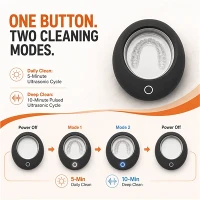
An ultrasonic cleaner can support the physical-cleaning stage by using micro-bubbles to loosen residue from areas that are difficult to brush gently. GoldRosa's US600 is listed for retainers, aligners, dentures, and other personal-care products. Its product page also identifies a combined ultrasonic and UVC mode, a pulsed ultrasonic and UVC mode, and a UVC-only mode.
Users should still check whether their specific appliance is compatible with ultrasonic cleaning. A device should not be used as a reason to ignore an orthodontist's instructions.
Add UV assistance after the retainer is physically clean
Once visible residue has been removed, a UV cycle can serve as an additional hygiene step. The GoldRosa DC200, for example, is a compact UV disinfection box designed for oral-care products such as retainers, dentures, and mouthguards. Its product page lists four UV-C lamps in the 260–280 nm range and a timed disinfection cycle.
The DC100 is not a replacement for ultrasonic cleaning because it does not provide the same physical cleaning action. It is better positioned as a compact UV-focused option for users who want a portable sanitizing step after cleaning.
GoldRosa US600: A Practical Solution for Retainer Care
Best overall: GoldRosa US600 ultrasonic cleaner
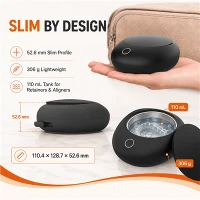
For brands and distributors seeking a multi-function retainer-care product, the GoldRosa US600 combines cleaning and hygiene-support features in one rechargeable unit. The verified product information lists 47–52 kHz ultrasonic micro-bubble technology, Type-C charging, up to 10 uses per charge, an operating noise level of about 35 dB, IPX6 waterproofing, and a food-grade 304 stainless-steel structure.
The product also includes a Hall sensor that automatically switches off the UVC light when the lid is opened. This is a useful safety-oriented feature for a household appliance that combines water-based cleaning with UV light. For B2B buyers, GoldRosa lists OEM/ODM support, including logo, appearance, color, color-box, and specification customization. The product page lists a minimum order quantity of 1,000 units.
Common Retainer-Care Mistakes to Avoid
A retainer should not be cleaned with boiling water, abrasive toothpaste, or a chemical solution that has not been approved for the appliance material. Users should also avoid assuming that a UV-only cycle can remove plaque, or that a longer cycle is automatically safer or more effective. If the appliance has a persistent odor, visible damage, cracks, or a change in fit, it should be inspected by an orthodontic professional rather than repeatedly treated at home.
The most reliable routine is simple: rinse after removal, clean regularly, schedule deeper cleaning at an appropriate interval, and follow the instructions for the specific retainer.

FAQs
How often should I sanitize my Invisalign retainer?
Rinse it after every removal and clean it daily when it is worn daily. A deeper cleaning session once a week is a practical reference for many users, but the correct schedule depends on wear time, residue, odor, material, and professional advice.
Can I use an ultrasonic cleaner for Invisalign retainers?
You may use an ultrasonic cleaner only when the device and the appliance instructions indicate compatibility. GoldRosa lists the US600 for retainers and aligners. Users should still follow their orthodontist's recommendations.
Is UV-C safe for clear retainers?
Safety depends on the device, exposure time, material compatibility, and correct use. Do not extend cycles without guidance. Check the appliance instructions and consult an orthodontic professional when uncertain.
Does sanitizing replace rinsing or cleaning?
No. Rinsing and ultrasonic or manual cleaning address physical residue. UV-C is an additional hygiene-support step and does not remove plaque by itself.
Can I use the GoldRosa US600 every day?
The US600 is designed for recurring personal-care cleaning, but users should select the appropriate mode and follow the appliance manufacturer's instructions. "More cleaning" is not always better if the material is not compatible with the method.
References
American Association of Orthodontists: How to Clean Your Retainer
Invisalign Official Cleaning Crystals
GoldRosa US600 Rechargeable Ultrasonic Cleaner
GoldRosa DC100 UV Disinfection Box